Psychological features of resilience formation in volunteers
ABSTRACT
Barinov S. A. Psychological features of resilience formation in volunteers. — Qualifying scientific work as a manuscript.
Dissertation submitted for the degree of Doctor of Philosophy in the field of knowledge 05 — Social and Behavioural Sciences, speciality 053 — Psychology. — G. S. Kostiuk Institute of Psychology, NAES of Ukraine, Kyiv, 2026.
The dissertation provides a theoretical foundation and an experimental study of the problem of resilience formation in volunteers. The work is an independent, integrated and complete piece of research presenting the theoretical and practical aspects of the psychological factors and conditions for forming volunteers' resilience. The scientific novelty and theoretical significance consist in the following:
For the first time:
- a conceptual model of the phased formation of volunteers' resilience at the personal, motivational, regulatory and behavioural levels has been developed;
- the leading role of seeking-social-support coping among the psychological predictors of volunteers' resilience has been demonstrated;
Clarified:
- the age and gender specificity of resilience in volunteers;
- the linear dependence of personal resilience on the length of volunteer tenure;
- the positive effect of personal maturity, emotional stability, existentiality and existential motivation on the resilience of volunteers;
Further developed:
- the means of psychological support of volunteer activity through the design and implementation of a resilience-formation programme;
- the means of psycho-diagnostics of the agent of activity through the construction of a valid and reliable methodology for the volunteer's altruistic orientation;
- the conception of resilience as a resource for coping with the negative effects of professional activity, on the example of volunteering.
The work delivers new, scientifically substantiated theoretical and practical results that make a substantive contribution to the development of national psychology.
The dissertation is devoted to the theoretical justification and experimental investigation of the principal directions of work with volunteers aimed at raising their level of resilience.
The practical significance of the work lies in the empirical identification of the factors and predictors of volunteers' resilience, which were incorporated into the formation programme designed and implemented in this study. An author's methodology for diagnosing a volunteer's altruistic orientation has been created, with its validity and reliability demonstrated.
Chapter 1. On the basis of a theoretical analysis of the state of the field, it was established that volunteering is a multi-level process of interaction between personal and social factors that simultaneously shapes the volunteer's self-development, the formation of prosocial identity and the collective resilience of the community. Volunteer activity performs both an adaptive and a regulatory function, reducing the sense of helplessness, supporting the integration of traumatic experience, and shaping moral values, social maturity, empathy and responsibility, but it can also be accompanied by emotional exhaustion, secondary traumatisation and occupational burnout — which makes the development of psychological resources of resilience indispensable for volunteers. In the context of forming the volunteer's capacity to withstand stress, particular significance attaches to the phenomenon of resilience as a dynamic mechanism for maintaining adaptive functioning under stressful conditions. Resilience is shaped by the interplay of individual, social and contextual factors and can be developed through psychological preparation, self-regulation training and social support. Under conditions of war, volunteer activity demands a high level of resilience as a baseline resource for coping with stress, preserving mental health and ensuring the effectiveness of help.
Chapter 2 conducts a comparative analysis of resilience by gender, age and length of activity, showing that volunteers with the longest experience have the highest resilience indicators and significantly outperform less experienced volunteers. Female volunteers score lower than male volunteers on most resilience indicators. A non-linear age specificity of volunteers' resilience was identified: in middle adulthood, resilience is higher than in early or late adulthood, although long volunteer tenure at a young age has a positive effect on resilience — particularly on the orientation to challenges and goal achievement in men and on constructive coping in women.
The psychological correlates of volunteers' resilience were established empirically. Orientation to challenges and goal achievement correlates positively with the overall index of personal maturity, particularly with life philosophy. Self-control and the ability to overcome difficulties correlate positively with the responsibility component of personal maturity. Self-determination and meaningfulness of life correlate positively with all indicators of personal maturity — especially life philosophy, depth of experience and autonomy — and with existential self-transcendence.
Stress resistance has a strong relationship with the self-acceptance component of personal maturity and with existential freedom. Constructive coping shows positive links with the synergy component of personal maturity. Social connectedness is strongly tied to the tolerance and contact components of personal maturity and to the fundamental existential motivation of relatedness, time and closeness. Optimal regulation correlates positively with self-acceptance, existential self-transcendence and responsibility, and with the fundamental existential motivation of support, security and space.
Openness to life experience correlates with the creativity component of personal maturity, with existential freedom and responsibility, and with the fundamental existential motivation of interested attention, fair attitude and value-determination. All resilience indicators correlate positively with all fundamental existential motivations, existentiality, altruistic orientation, emotional stability, and with seeking-social-support and planful problem-solving coping — and negatively with state and trait anxiety.
A number of psychological factors of volunteers' resilience were empirically identified. Critically low personal maturity, low existentiality and fundamental existential motivation, low emotional stability and high anxiety are factors of reduced resilience in volunteers. The typological analysis of coping behaviour yielded four profiles — "Dominance of avoidance coping", "Dominance of confrontational coping", "Distancing of responsibility for problem-solving", and "Dominance of constructive coping" — the first two of which are inferior in resilience to the last two.
The positive role of volunteer tenure in the formation of resilience was established empirically. Novice volunteers — characterised by critically low personal maturity, low levels of existentiality, existential motivation and altruistic orientation, as well as high neuroticism and anxiety — show the lowest indicators of self-control, optimal regulation and the ability to overcome difficulties, of self-determination and meaningfulness of life, and of general resilience. Volunteers who began their helping activity during the war — and especially long before its outbreak — and who have high personal maturity, altruistic orientation, existentiality and existential motivation, high emotional stability and low or moderate anxiety, show the highest resilience indicators.
Regression analysis identified the strongest predictors of resilience in volunteers: high levels of seeking-social-support coping, planful problem-solving, self-acceptance and creativity, combined with low neuroticism. Self-transcendence and the existential motivation of relatedness, time and closeness positively define most parameters of volunteers' resilience.
Chapter 3 presents the conceptual model and the structural-content characteristics of the psychological programme for forming volunteers' resilience, taking into account the phased formative impact at the personal, motivational, regulatory and behavioural levels. The modular structure of the programme was delivered in a group format using psychoeducational, reflective and practice-oriented methods; the programme aimed not only at developing isolated psychological skills or resources but at building internal coherence, autonomous motivation, emotional stability and a mature altruistic orientation of volunteer activity. Implementation of the programme produced a significant rise in resilience indicators among participants in the experimental group, while no significant changes were observed in the control group.
- The present study does not exhaust all aspects of the problem of volunteers' resilience; prospective directions for further enquiry include — at the theoretical level — the investigation, alongside the specifics of resilience, of other psychological resources and competencies of volunteers in different sectors and fields of activity; and — at the practical level — the development of psychological methods and technologies for forming volunteers' resilience under conditions of war and the post-war reconstruction of Ukraine.
Keywords: volunteering, resilience, coping strategies, personal maturity, altruistic orientation, existentiality, fundamental existential motivations, neuroticism, anxiety, resources, volunteers, psychological support programme.
LIST OF PUBLICATIONS ON THE DISSERTATION TOPIC
Articles in scientific specialist journals approved by the Ministry of Education and Science of Ukraine:
- Giacomuzzi S., Kocharian O. S., Barinova N. V., Barinov S. A. Experiencing and Coping with Trauma in Warfare and Military Conflicts. // Psychological Counselling and Psychotherapy. 2021. Issue 16. P. 12–29.
- Kocharian O., Barinova N., Giacomuzzi S., Barinov S. The Technique of Metaphor: Psychotherapeutic Casuistry. // Psychological Counselling and Psychotherapy. 2022. Issue 17. P. 6–11.
- Antonovych M., Aralova O., Barinov S. Features of Psychological Stability (Resilience) of Female Volunteers at the Call-Centre of the Territorial Defence Forces of the Armed Forces of Ukraine and the National Information Bureau. // Psychological Counselling and Psychotherapy. 2022. Issue 18. P. 6–14.
- Kharchenko A., Barinov S. The Technique of Schematic Visualisation of the Emotional Sphere in Group Work with Clients of Low Reflectivity. // Psychological Counselling and Psychotherapy. 2023. Issue 19. P. 33–37.
- Fedoseev V., Kharchenko A., Lisena A., Liseny Ye., Kabarhina V., Barinov S. Psychological Features of the Emotional Sphere of Internally Displaced Persons of the First and Second Waves. // Psychological Counselling and Psychotherapy. 2024. Issue 21. P. 35–45.
- Kocharian O., Barinova N., Barinov S. Growth Points of Client-Centred Psychotherapy. Psychological Counselling and Psychotherapy. 2024. Issue 22. P. 15–21.
- Kharchenko A., Fedoseev V., Lisena A., Liseny Ye., Barinov S. Thematic Trends in Client Requests during Martial Law and the Specifics of CBT Work with Them. Psychological Counselling and Psychotherapy. 2025. Issue 23. P. 13–17.
- Barinov S., Shandruk S. Psychodiagnosis of Altruistic Orientation of a Volunteer. Bulletin of H. S. Skovoroda Kharkiv National Pedagogical University. Psychology. 2025. Issue 73. P. 465–474. doi: 10.34142/23129387.2025.73.30.
- Barinov S. Resilience as a Resource for Overcoming the Negative Impacts of Volunteering. Psychological Counselling and Psychotherapy. 2025. Issue 24. P. 59–66.
Publications in conference proceedings of national and international scientific conferences:
- Barinov S. A., Barladin V. M., Ostapchuk N. B. Personal Resilience under Conditions of Crisis Social Challenges. // Proceedings "Mental Health in Times of Challenge: Personality and Environment". Nauka. Psykholohiia. Vinnytsia, 2025. P. 40–44.
- Barinov S. The Structural-Content Model of Volunteers' Resilience under Conditions of Prolonged Stress. // Proceedings of the International Scientific Conference "Science, Technology, and Society under Global Uncertainty", International Humanitarian Research Centre, Birmingham, Germany, 5 February 2026. Research Europe, 2026.
- Barinov S. Psychological Determinants of the Formation of Volunteers' Resilience. // Science and Information Technologies in the Modern World: Collection of Scientific Papers with Proceedings of the 5th International Scientific and Practical Conference. International Scientific Unity. 11–13 February 2026. Athens, Greece. P. 400–403.
Publications additionally reflecting the scientific results of the dissertation:
Medical Psychology. Edited by Academician S. D. Maksymenko. Volume 1. — Kyiv: "Liudmyla" Publishing, 2023. — 512 p. (Authors' collective: Kocharian O. S. together with Barinova N. V. and Barinov S. A. — subsection 2.1.7.) ISBN 978-617-555-097.
INTRODUCTION
Relevance of the study. In times of danger and catastrophe, the volunteer movement becomes substantially more active. Over the past two years, the attention of researchers abroad has been drawn to various aspects of volunteer activity during the COVID-19 pandemic; in Ukrainian scholarship, in addition, attention has been paid to the events of 2013–2022 (the Revolution of Dignity, the Anti-Terrorist Operation and the Joint Forces Operation). The full-scale invasion of Ukraine by the Russian Federation gave a powerful impetus to the further development of the volunteer movement, which determines the social significance of the present study. It is precisely now, during martial law, that resilience acquires new meaning and urgency, because it is resilience that keeps society from being paralysed and helps it "hold the line". A substantial theoretical legacy exists, contributed by scholars from around the world who have studied this phenomenon from a variety of angles; yet the resilience of volunteers as a specific population has received almost no attention from the scientific community. Meanwhile, it must be recognised that under wartime conditions volunteers are a vivid example of psychologically resilient people who actively respond to today's challenges and — despite fear and inner turmoil — find the strength to act.
Connection of the work with scientific programmes, plans and themes. The dissertation research was carried out within the planned scientific work of the P. R. Chamata Laboratory of Personality Psychology on the theme "Psychological technologies for promoting positive mental health of personality" (2022–2024; state registration No. 0122U000305).
The topic of the dissertation was approved by the Academic Council of the G. S. Kostiuk Institute of Psychology, NAES of Ukraine (Minutes No. 7 of 24 May 2023) and endorsed by the Interdepartmental Council for the Coordination of Research in Pedagogical and Psychological Sciences in Ukraine (Minutes No. 2 of 22 June 2023).
Object of the study — the resilience of volunteers as a psychological phenomenon that is formed and manifested in the course of volunteer activity.
Subject of the study — the psychological factors, structure and conditions of resilience formation in volunteers in the course of volunteer activity.
Aim — to provide a theoretical justification and an empirical investigation of the psychological factors and conditions of resilience formation in volunteers, and to develop and experimentally test the effectiveness of a psychological programme for forming resilience under conditions of volunteer activity.
Tasks:
- To carry out a theoretical analysis of resilience as a resource for coping with the negative effects of volunteer involvement.
- To examine the level of resilience in volunteers as a function of gender, age and length of activity.
- To identify the psychological correlates of resilience in volunteers.
- To determine the psychological factors of resilience in volunteers.
- To investigate the role of volunteer tenure in the formation of personal resilience.
- To identify the psychological predictors of volunteers' resilience.
- To identify the conditions for forming volunteers' resilience within the framework of a psychological-support programme.
Methodological and theoretical foundations of the study comprise: studies of resilience (A. Bolshakova, E. Hrishyn, D. Dubinin, H. Lazos, L. Karamushka, O. Kokun, Z. Kireeva, M. Mushkevych, K. Odnostalko, L. Serdiuk, O. Chykhantsova), of volunteer activity (T. Bazyl, V. Zlyvkov, O. Kokun, O. Krutsiuk, S. Lukomska, T. Liakh, V. Peretiatko, N. Pidbutska, D. Sai, L. Serdiuk, I. Chaika, H. Yurchynska, and others); conceptions of resilience formation within the humanistic (A. Maslow, G. Allport, C. Rogers), existential (M. Boss, A. Längle, I. Yalom), cognitive-behavioural (A. Beck, A. Ellis), coping-oriented (S. Folkman, R. Lazarus), resource-based (S. Hobfoll) and systems (N. Bashavets, O. Kustovska, Yu. Shabanova) approaches; the conceptions of self-determination (E. Deci, R. Ryan) and of altruistic orientation of the person (D. Batson, G. Allport, E. Fromm).
Research methods. To achieve the aim and address the tasks of the dissertation, a complex of complementary general-scientific research methods was used, the choice of which was driven by the substance of the problem under study, namely: theoretical — analysis, classification, systematisation and generalisation of the scientific literature; empirical — testing; methods of data processing and interpretation — quantitative and qualitative analysis (descriptive statistics; comparison of sample means by Student's t-test; correlation and regression analysis).
The empirical study employed the following psycho-diagnostic instruments: 1) E. Hrishyn's resilience-diagnostic method in adapted form; 2) the short Resilience Scale (CD-RISC-10) by Campbell-Sills & Stein in the adaptation by Z. O. Kireeva, O. S. Odnostalko and B. V. Biron; 3) the author's methodology for the volunteer's altruistic orientation; 4) the Existence Scale (Existenzskala) by A. Längle and K. Orgler in the adaptation by S. V. Kryvtsova; 5) A. Längle's Test of Existential Fulfilment (existential motivations) in the adaptation by V. B. Shumsky, O. M. Ukolova, Ye. M. Osin and Ya. D. Lupandina; 6) O. S. Shtepa's Personal Maturity Inventory; 7) Eysenck's EPI (the emotional stability–instability scale); 8) the State and Trait Anxiety scale by C. D. Spielberger in Yu. L. Khanin's adaptation; 9) Lazarus & Folkman's Ways of Coping Questionnaire in the adaptation of the team led by L. I. Wasserman.
Mathematical-statistical methods: descriptive statistics, correlation analysis, the non-parametric Kruskal-Wallis H and Mann-Whitney U tests, analysis of variance, factor analysis, regression analysis, cluster analysis.
Experimental base of the study. The research was carried out in 2022–2025. The empirical study involved 127 individuals (49 women and 78 men), aged 18–60, with varying lengths of volunteer activity — "novices" (under 1 year) — 44 individuals; "experienced" (under 4 years), who began their activity at the start of the full-scale invasion — 55 individuals; "veterans", who began their activity over 4 years ago, before the full-scale invasion, and continue helping to this day — 28 individuals. The implementation and effectiveness testing of the comprehensive resilience-formation programme involved 43 individuals.
The reliability and validity of the results are ensured by qualitative theoretical analysis, a sound methodological basis, the soundness of the initial theoretical positions, the correspondence of the psycho-diagnostic toolkit to the problem, aim, object, subject and tasks of the study, the combination of quantitative and qualitative methods of data analysis, and the substantive analysis of factors and dependencies on a representative sample.
Statistical processing of the empirical data and graphical visualisation of the results were performed using Statistica 6.0.
Scientific novelty and theoretical significance consist in the following:
For the first time:
- a conceptual model of the phased formation of volunteers' resilience at the personal, motivational, regulatory and behavioural levels has been developed;
- the leading role of seeking-social-support coping among the psychological predictors of volunteers' resilience has been demonstrated;
Clarified:
- the age and gender specificity of resilience in volunteers;
- the linear dependence of personal resilience on the length of volunteer tenure;
- the positive effect of personal maturity, emotional stability, existentiality and existential motivation on the resilience of volunteers;
Further developed:
- the means of psychological support of volunteer activity through the design and implementation of a resilience-formation programme;
- the means of psycho-diagnostics of the agent of activity through the construction of a valid and reliable methodology for the volunteer's altruistic orientation;
- the conception of resilience as a resource for coping with the negative effects of professional activity, on the example of volunteering.
Theoretical significance: within this work, resilience is conceptualised as a process, a result, a volitional psychic state, a personality trait and a competence that lead to successful adaptation to difficult or testing life experience, as well as to psychological and spiritual growth after trauma and adverse life situations — and to the capacity to find meaning in them. Resilience was shown to be a resource of psychological well-being and of the volunteer's effectiveness in activity. A conceptual model of the formation of volunteers' resilience was developed.
Practical significance of the work lies in the empirical determination of the factors and predictors of volunteers' resilience, which were incorporated into the resilience-formation programme that was designed and implemented. An author's methodology for diagnosing the volunteer's altruistic orientation has been created, with its validity and reliability demonstrated.
Approbation and implementation of the results. The main provisions and results of the study were reported at the International Conference "Client-Centred and Experiential Psychotherapy Today: Theory and Practice" (16–17 May 2025, Warsaw, Poland); at the XVII International Scientific-Practical Conference "Psychological Foundations of Health, Education, Science and Self-Actualisation of the Personality: A Client-Centred Approach" (26–29 March 2025, Lutsk); and at the International Scientific-Practical Conference "Psychological Foundations of Health, Education, Science and Self-Actualisation of the Personality" (Lesya Ukrainka Volyn National University, Lutsk, 22–29 March 2024).
Publications. The results of the dissertation research have been fully published in 11 scientific works, including: 10 articles in scientific specialist journals approved by the Ministry of Education and Science of Ukraine and included in international scientometric databases; 1 publication of an educational-methodological character.
The candidate's personal contribution. The dissertation was completed by the candidate independently. All formulated provisions and conclusions are grounded in the author's own research. Nine articles were published in co-authorship; the candidate's contribution in each: 25% in the article "Experiencing and Coping with Trauma in Warfare and Military Conflicts" — theoretical analysis of the problem of coping strategies under wartime conditions; 25% in "The Technique of Metaphor: Psychotherapeutic Casuistry" — implementation of the metaphor technique and analysis of its effectiveness on a volunteer sample; 50% in "Features of Psychological Stability (Resilience) of Female Volunteers at the Call-Centre of the Territorial Defence Forces of the Armed Forces of Ukraine and the National Information Bureau" — administration and analysis of the resilience diagnostics of female call-centre volunteers; 50% in "The Technique of Schematic Visualisation of the Emotional Sphere in Group Work with Clients of Low Reflectivity" — implementation of the technique and analysis of its effectiveness on a volunteer sample; 15% in "Psychological Features of the Emotional Sphere of Internally Displaced Persons of the First and Second Waves" — analysis of the empirical results; 30% in "Growth Points of Client-Centred Psychotherapy" — methodological analysis of the possibilities of applying the client-centred approach in psychological assistance to those affected by war; 25% in "Thematic Trends in Client Requests during Martial Law and the Specifics of CBT Work with Them" — methodological analysis of the possibilities of applying the cognitive-behavioural approach in psychological assistance to those affected by war; 75% in "Psychodiagnosis of Altruistic Orientation of a Volunteer" — development of the questionnaire and its testing on a volunteer sample.
Ideas and developments belonging to the co-authors of the listed publications were not used in the dissertation.
Structure and length of the dissertation. The dissertation consists of an introduction, three chapters, conclusions, a list of references and appendices. The list of references contains 182 entries, of which 81 are in foreign languages. The work contains 36 tables on 31 pages and 83 figures on 47 pages. The main content of the dissertation is presented on 193 pages; the total length of the work is 271 pages.
Chapter 1. Theoretical and methodological foundations for the study of the psychological features of resilience formation in volunteers
1.1. Psychological analysis of volunteering as a form of social activity
A psychological analysis of volunteering involves examining this phenomenon as a specific form of social activity that integrates altruistic, moral and ethical, communicative, and self-realising motives of the personality. In situations of social crisis, particularly in conditions of war, volunteer activity becomes one of the leading mechanisms for maintaining social cohesion, mutual support, and the restoration of basic feelings of safety and trust.
In Western psychology, the phenomenon of volunteering in complex social and crisis situations has been studied for several decades. Its investigation rests upon theoretical approaches to altruism and prosocial behaviour, which constitute the methodological basis for understanding the psychological nature of volunteer activity. It is precisely these conceptions that make it possible to explain the inner motives of helping others, the mechanisms of empathic engagement, and the role of moral and value orientations and emotional processes in the decision to participate in socially significant activity.
One influential theoretical model explaining the psychological mechanisms of such helping activity is the conception developed by J. Piliavin and H. Charng. The researchers systematised empirical and theoretical studies of the phenomenon of helping others and developed a coherent socio-psychological model of altruism as a stable disposition of the personality, which may evolve from a situational, emotionally conditioned act into a stable personality characteristic integrated into the structure of the moral self.
Within this model, altruism is regarded not as an exceptional or heroic act but as a regular form of social behaviour that maintains social bonds, reduces tension in the community, and develops the moral culture of society. According to the authors, helping motives may combine both emotional components (empathic compassion) and cognitive-evaluative components (awareness of the social significance of the action, responsibility, reciprocity) [177].
In light of the findings of J. Piliavin and H. Charng, it may be asserted that their conception provides methodological prerequisites for analysing the phenomenon of volunteering as an organised form of altruistic behaviour. In contemporary social conditions, volunteer activity may be regarded as a manifestation of an integrated altruistic attitude, in which helping others becomes not a situational reaction but a consciously chosen life position.
An important step in the development of ideas about the psychological foundations of altruistic behaviour was the empathy–altruism theory developed by D. Batson, who in a series of experimental studies consistently demonstrated that the principal determinant of helping behaviour is empathic compassion — the ability of the personality to identify emotionally with someone who is experiencing hardship or suffering [122]. The foundation of his approach is the assumption of the existence of egoistic motivation, directed at reducing one's own emotional discomfort, and altruistic motivation, oriented directly towards alleviating the suffering of another person.
It is precisely the second, empathy-driven motivation that, according to the results of numerous experiments, determines the depth and stability of helping behaviour, functioning as a mechanism that unites the emotional, cognitive, and moral components of personality regulation and creates the psychological basis for altruistic actions [124].
Although D. Batson did not study volunteering directly, his conception is of substantial methodological significance for contemporary psychological research on volunteer activity, since it explains why people are prepared to help others in situations of social danger even in the absence of external reward. From the standpoint of this theory, volunteer activity may be regarded as a socially organised form of the manifestation of empathy-driven altruism, in which internal compassion and a sense of moral duty acquire stable behavioural forms.
This makes it possible to understand the psychological mechanisms of long-term participation in volunteering, particularly in conditions of crises and wartime, when empathic motivation becomes the principal factor sustaining activity, stability, and moral self-reinforcement.
In contemporary psychological theories of prosocial behaviour, a key place is assigned to empathy as a mechanism that mediates the emergence of helping motives, yet is not reduced to an immediate emotional reaction. In this context, the conception of N. Eisenberg emphasises the multi-component character of empathy, which encompasses affective response, cognitive evaluation of the situation, moral judgement, and the capacity for self-regulation of emotional reactions.
Of fundamental importance is the differentiation between empathic compassion, which fosters altruistic behaviour, and personal distress, which, on the contrary, may block the readiness to help [143]. Thus, empathy functions as a necessary but insufficient condition for prosocial activity, since its transformation into action requires regulatory and moral mechanisms.
P. Slovic proposed another perspective on the analysis of altruism, related to the phenomenon of the emotional perception of the suffering of others. In his studies he identified the phenomenon of psychic numbing — the reduction of emotional reactivity in response to mass human suffering. In contrast with singular cases, in which empathy is readily activated, the scale of a tragedy diminishes the sense of personal responsibility. This finding is significant for understanding the specificity of volunteer behaviour in the context of social crises and humanitarian catastrophes: it underscores the necessity of cognitive awareness of moral duty as a factor that overcomes the limits of emotional exhaustion and indifference [184].
Overcoming the limits of purely emotional regulation in prosocial behaviour is associated with motivational mechanisms that endow helping with personal and meaningful significance. In this context, the functional approach to altruism developed by M. Snyder and his colleagues regards helping others as a multi-motivated process in which moral-value and personal-utilitarian aims are combined. Prosocial activity may perform the functions of self-realisation, social integration, support of self-esteem, and the formation of positive identity [186].
It is precisely this approach that has created the conceptual basis for contemporary models of volunteering, in which helping others is conceptualised as a stable form of personal and social self-realisation [138; 187].
In general, the work of N. Eisenberg, P. Slovic, and M. Snyder demonstrates a gradual transition from emotional-motivational explanations of altruism to a socio-psychological understanding of prosocial behaviour as a form of personal self-realisation, which allows altruistic motives to be integrated into the structure of a mature, socially responsible personality. Summarising the approaches indicated, it may be stated that prosocial and volunteer behaviour is formed at the intersection of empathic sensitivity, cognitive evaluation of the situation, moral responsibility, and motivational-semantic factors.
Such a multilevel structure creates the psychological prerequisites not only for engagement in helping but also for sustaining the stability of volunteer activity under conditions of prolonged stress, which directly links this problematic to the phenomenon of resilience. Such an interpretation creates a direct bridge to the psychological analysis of volunteering as a particular form of prosocial activity that unfolds in complex social and crisis circumstances.
Thus, in contemporary socio-psychological models, volunteering is regarded not as a one-off act of helping but as a prolonged process of personal engagement, within which stable motivational, value, and regulatory mechanisms are progressively formed. This processual perspective is of fundamental importance for the analysis of volunteer resilience, since it makes it possible to trace how participation in volunteer activity is transformed from a reaction to external demand into an internally integrated resource for coping with stress.
In this context, the processual model of volunteering developed by A. Omoto and M. Snyder is illustrative; it describes volunteering as a dynamic, multistage process — from the initiation of participation to its long-term maintenance and possible termination [175]. Importantly, the authors of the model underline the role of the socio-organisational context in sustaining volunteer activity. Support from the organisation, effective communication, opportunities for learning, self-development, and symbolic recognition of the volunteer's contribution serve as external conditions that mediate the formation of stable coping strategies and prevent emotional exhaustion [175].
Thus, resilience in volunteer activity emerges not only as an individual trait but also as the outcome of the interaction of the personality with a supportive social environment.
An analytical complement to the processual model is provided by the functional approach to volunteering proposed by M. Snyder, E. G. Clary, and their colleagues, in which volunteer activity is regarded as a conscious, multi-component activity that performs various psychological functions. The identification of value-based, knowledge-based, social, career, protective, and ego-enhancing motivations makes it possible to explain how volunteering satisfies key psychological needs of the personality and contributes to maintaining inner balance under conditions of stress [138].
The practical significance of the functional approach is confirmed by the creation of the psychodiagnostic instrument, the Volunteer Functions Inventory, which is widely used to study the motivational profiles of volunteers. Overall, the models of M. Snyder and his colleagues make it possible to regard volunteering as a psychologically significant resource for coping with stress that fosters the formation of resilience through the integration of motivational, semantic, and socio-regulatory mechanisms.
The further development of the functional approach to volunteering has demonstrated that, even where pronounced motivational functions are present, the stability of volunteer participation cannot be explained solely by the internal factors of the personality. In this context, empirical studies conducted by A. Stukas, M. Snyder, and E. G. Clary showed that the effectiveness and duration of volunteer activity depend substantially on the extent to which the social and organisational environment supports and confirms the leading motives of the volunteer [188; 189].
In particular, it has been established that social support, symbolic recognition of the volunteer's contribution, and a clear organisational structure act as critically important factors for sustaining engagement and satisfaction with the activity. When institutional conditions create opportunities for the realisation of the value-based, social, or personal functions of volunteering, the probability of long-term participation increases and the risk of emotional exhaustion is reduced. At the same time, the authors emphasise that excessive external control or so-called "mandatory volunteering" (in particular, within formalised educational programmes) may have the opposite effect, reducing autonomous motivation and accelerating the decline of prosocial activity [188; 189].
From the standpoint of resilience research, this proposition is of fundamental importance, since it points to the necessity of aligning the inner resources of the personality with a supportive social context.
An expansion of the analysis of the social conditions of volunteering is presented in the socio-psychological theory of volunteer participation developed by M. Musick and J. Wilson. Within this approach, volunteering is regarded as the result of the interaction of three forms of capital — social, cultural, and human — which determine not only the possibility of engagement in helping activity but also the character and duration of participation in it [172]. Such a perspective makes it possible to go beyond the purely psychological analysis of motivation and to regard volunteering as a socially embedded process.
The researchers pay particular attention to the function of volunteering as a mechanism of social integration. Volunteer activity contributes to strengthening social cohesion, the development of trust among members of the community, and the formation of collective responsibility for the common good. At the same time, it is emphasised that access to volunteer activity is uneven and depends on socio-economic conditions, cultural context, and the level of institutional support [172]. This underscores that the resilience of volunteers is formed not only as an individual psychological characteristic but also as the result of inclusion in social structures capable of providing support in crisis and traumatic events.
Thus, studies developing the functional approach of M. Snyder, as well as the social-capital analysis of volunteering, allow volunteer activity to be regarded as a multilevel resource of adaptation. It simultaneously contributes to the personal resilience of volunteers and acts as a factor in enhancing the stability and adaptive potential of society as a whole.
The generalisation of motivational and socio-contextual approaches to volunteering brings to the fore the necessity of an integrative analysis that combines the individual resources of the personality, the social conditions for their realisation, and the semantic mechanisms for sustaining prosocial activity. It is precisely such a holistic perspective that is offered by the integrative conception of prosocial behaviour.
In this context, the integrative conception of prosocial behaviour proposed by L. Penner allows volunteering to be regarded not as a situational reaction to an external demand but as a long-term process linked to the formation of a stable prosocial identity of the personality [176]. Such an approach is methodologically significant for the analysis of volunteer resilience, since it focuses attention on the internal mechanisms of sustaining activity under conditions of prolonged stress load.
According to the conception, volunteer behaviour is formed as a result of the interaction of three key levels of determination: individual-personal, social-contextual, and value-motivational. At the individual level, the leading role is played by personal dispositions, particularly empathy, moral responsibility, altruistic convictions, and the propensity for compassion. These characteristics create the psychological prerequisites for engagement in helping activity but do not, in themselves, guarantee its stability. For this reason, L. Penner's conception devotes special attention to social influences and the cognitive interpretation of one's own activity as socially significant [176].
At the meso level, decisive importance is acquired by the inclusion of the personality in social networks and communities in which volunteer activity is supported, approved, and normatively reinforced. The macro level, in turn, is associated with cultural and social norms that determine the symbolic value of volunteering, its social prestige, and its moral legitimation [176]. Together, these levels form a multidimensional context within which volunteer activity acquires a stable and internally motivated character.
The central element of the conception is the notion of volunteer identity, which is regarded as the pivotal psychological factor of the stability and duration of volunteer participation [176].
From the standpoint of resilience research, these propositions are of fundamental importance, since they explain why volunteer activity is often sustained even in situations of prolonged social crises and after the acute phase of danger has ended. The integration of volunteering into personal identity creates an internal resource of psychological stability that contributes to sustaining motivation, the meaning of the activity, and the subjective sense of control under conditions of uncertainty and emotional load.
Regarding volunteering as a stable form of civic participation, integrated into the system of the personality's identity, simultaneously requires the clarification of its psychological specificity under emergency and crisis conditions. While in the general context prosocial activity is sustained by semantic and value-based regulation, under conditions of high risk, uncertainty, and mass suffering, questions of psychological preparedness, endurance, and the preservation of the volunteer's internal resources come to the fore.
This aspect of volunteer activity is precisely the one disclosed in the conceptual model proposed by C. McLennan and S. Birch, which was developed on the basis of studies of volunteers engaged in mitigating the consequences of natural disasters, accidents, and social crises [168].
Within this approach, volunteering in crisis conditions is regarded as a particular type of activity that requires not only empathy and moral motivation but also a high level of self-regulation, psychological endurance, and readiness to act in situations of uncertainty and threat. The authors emphasise that prolonged assistance to victims is accompanied by an increased risk of emotional exhaustion, secondary traumatisation, and cognitive overload, which substantially raises the demands placed on the volunteer's internal resources. In this context, the effectiveness of volunteer activity is directly connected with the development of resilience, stress tolerance, self-efficacy, and the capacity for coordinated collective interaction [168].
Within the proposed model, the researchers identified three key blocks of factors of psychological preparedness:
– individual-psychological resources — stress resistance, flexibility of thinking, internal locus of control, moral motivation;
– social resources — team cohesion, mutual support, trust among members of the volunteer group;
– organisational-contextual conditions — effective leadership, clear distribution of roles, adequate preparation, and supervision [168].
Within the proposed model of psychological preparedness for crisis volunteering, the researchers distinguish three interrelated groups of factors. The first group encompasses individual-psychological resources, in particular stress resistance, flexibility of thinking, an internal locus of control, and moral motivation. The second group is represented by social resources — team cohesion, mutual support, and trust among members of the volunteer group. The third group consists of organisational-contextual conditions, among which effective leadership, clear distribution of roles, appropriate preparation, and professional supervision are of particular significance [149].
The heuristic value of this model lies in the fact that it makes it possible to regard psychological preparedness for volunteering in crisis conditions as an integral formation that combines personal, social, and organisational resources. The combination of the factors indicated determines not only the effectiveness of assistance to victims but also the degree of preservation of the volunteer's mental health under conditions of prolonged extreme load [149]. In the context of the present dissertation, this proposition is methodologically significant, since it directly links psychological preparedness for crisis volunteering with the processes of the formation and maintenance of resilience.
The analysis of models of psychological preparedness for volunteering in crisis conditions leads logically to the question of the further adaptation of the personality in situations of mass traumatic events and the role of volunteer activity in the processes of individual and collective recovery. In this context, particular significance is acquired by the studies of George Bonanno, devoted to the dynamics of psychological adaptation after societal traumas, in particular the events of 11 September 2001 in the USA, when volunteer activity assumed a mass character [126; 127].
Within the conception of dynamic adaptation to traumatic events, volunteering is regarded not only as a form of social assistance to victims but as a psychologically significant mechanism of self-regulation and recovery for the volunteers themselves. According to Bonanno, participation in joint activity in providing assistance contributes to the restoration of the subjective sense of control over the situation, the reduction of feelings of helplessness, and the formation of a collective meaning in overcoming the traumatic experience. In this sense, volunteer activity acts as a behavioural form of the constructive processing of trauma, which makes it possible to integrate emotionally complex experience into a broader meaningful context of life functioning.
The empirical data presented in the works of J. Bonanno indicate that individuals engaged in volunteer assistance after mass tragedies generally demonstrate a higher level of emotional stability and a lower probability of developing post-traumatic stress symptoms [126; 127]. This is explained by the mobilisation of both individual and social resources — empathy, the capacity for compassion, trust in others, and the sense of belonging and mutual support. Thus, volunteering activates the very psychological mechanisms that, in contemporary studies, are regarded as basic components of resilience.
Thus, in J. Bonanno's approach, volunteer activity appears as a multidimensional mechanism of collective and personal recovery after crisis and traumatic events. It simultaneously performs the social function of supporting victims and an internal regulatory function for the volunteers themselves, contributing to the restoration of psychological balance, the meaning-making of experienced events, and the preservation of adaptive potential. Such a perspective makes it possible to regard volunteering not only as outwardly directed helping activity but as a resourceful form of adaptation and meaning-making, which is of key importance for the formation and maintenance of resilience under conditions of societal trauma.
Regarding volunteer activity as a resource of psychological recovery after mass traumatic events brings to the fore the question of the conditions under which participation in volunteering becomes possible, stable, and psychologically safe for the personality. In this context, it is important to analyse not only internal motivational factors but also individual resources, life circumstances, and meaning orientations that determine readiness for helping activity under crisis conditions.
Thus, in the works of H. Bailey and L. Kaplan, the key factors influencing the decision to participate in volunteer activity during crises have been systematised. These include the level of personal preparation, the presence of previous experience, the state of physical and mental health, language competence, situational awareness, the availability of resources, and the subjectively assessed level of danger of the location [120]. From the standpoint of resilience research, these factors may be regarded as prerequisites for the preservation of adaptive potential that prevent overload and reduce the risk of maladaptive consequences of volunteer participation.
Another important dimension of volunteer activity is connected with its role across the personality's life course. In the works of N. Morrow-Howell, J. Hinterlong, P. Rozario, and F. Tang, volunteering is substantiated as an important factor in active ageing that contributes to the preservation of emotional health, social engagement, and vital energy in later life.
The authors show that in old age, volunteer activity performs a number of psychologically significant functions: a meaning-making function — through the sense of being needed, moral duty, and the value of one's own life experience; a socio-regulatory function — through the maintenance and expansion of social ties; and an emotional-compensatory function — through the preservation of a positive emotional background and the reduction of feelings of loneliness and isolation [171]. Together, these functions form an important resource of resilience that sustains the psychological stability of the personality at the later stages of ontogenesis.
The further development of the semantic approach to volunteering is presented in the studies of C. Rehberg, who regards volunteer activity as a form of global civic participation and moral responsibility in conditions of humanitarian crises. The author shows that the motivation of contemporary volunteering has a complex, multidimensional structure that combines humanistic values, the striving for self-knowledge, social identification, and cultural experience.
C. Rehberg devotes particular attention to the semantic regulation of volunteer behaviour, emphasising that participation in humanitarian programmes is often conditioned not by external compulsion but by an inner aspiration to authenticity and the search for personal meaning under conditions of global crises and social inequality [178].
The distinctive feature of C. Rehberg's approach is that volunteering is interpreted as a personally meaningful choice that combines moral maturity, value identity, and the striving for self-realisation. In the context of the present dissertation, this makes it possible to regard the semantic regulation of volunteer activity as one of the key psychological mechanisms of resilience, which ensures the stability of volunteer activity even under conditions of prolonged crises and high emotional load.
Thus, the analysis of Western studies demonstrates that volunteering appears as a multidimensional psychological activity that combines motivational and value-based mechanisms, the dynamics of personal engagement, and the influence of the socio-organisational context, while simultaneously performing the functions of individual and collective recovery. In Ukrainian psychology, the phenomenon of volunteering has become the subject of systematic scholarly analysis comparatively recently, which is conditioned by both historical and social factors of the development of civil society.
The first Ukrainian studies focused primarily on volunteering by young people and future specialists in the helping professions, as well as on sports volunteering (in particular, in the context of the preparation and hosting of the Euro 2012 championship). In these works, volunteer activity was interpreted primarily as a form of civic activity, social communication, professional formation, and the development of youth leadership, while the psychological mechanisms of stability and long-term engagement remained outside the focus of analysis.
In this context, the studies of O. Bida, A. Chychuk, and O. Syroyezhko are illustrative; in them volunteering is regarded as a socially useful activity and an effective means of socialisation of the personality, primarily of student youth. The authors systematise the criteria of volunteer activity (voluntariness, non-remuneration, social usefulness, personal initiative) and analyse its role in the formation of civic position, spiritual and moral potential, and social activity [10]. At the same time, in their approach, volunteering appears rather as a normatively desirable form of social behaviour than as a psychologically demanding activity that requires special adaptive resources.
Close to this in logic is the work of T. Kabysh-Rybalka, devoted to the analysis of the personal qualities of sports volunteers. The author identifies emotional equilibrium, control of affects, openness to new experience, team interaction, and high self-organisation as key factors of effective volunteer activity [34]. Although these characteristics are indirectly connected with psychological stability, they are regarded primarily in a functional rather than a resource-adaptive dimension.
A more in-depth psychological analysis of volunteering is presented in the dissertation study of O. Krutsiuk, in which volunteer activity is interpreted as a form of self-realisation of the personality and the satisfaction of needs for social interaction, recognition, and belonging to a common goal. The author argues that engagement in the volunteer movement is conditioned by a combination of value-moral motives (altruism, empathy, social responsibility) and personal characteristics such as benevolence, extraversion, emotional stability, and reflexivity [51]. At the same time, the questions of the preservation of psychological balance and the overcoming of exhaustion under conditions of prolonged volunteer activity remain insufficiently disclosed.
The motivational dimension of volunteering is thoroughly presented in the works of T. Liakh, who regards volunteer activity as the result of a combination of individual and social motives. The author systematises groups of motivating factors — from basic safety needs to value-humanistic orientations towards self-realisation and altruism [59]. Such a classification broadens the understanding of the motivational structure of volunteering but does not fully explain the mechanisms of its psychological stability under crisis conditions.
The value-oriented perspective on the development of the volunteer movement is presented in the study of V. Pohribna, who distinguishes types of volunteers ("mental", "situational", and "pseudo-volunteers") and emphasises that it is precisely "mental" volunteers who ensure the value-based stability of volunteering [81]. This approach is important for understanding the internal factors of long-term engagement, but it does not disclose the psychological mechanisms of overcoming emotional load and stress.
Within the semantic analysis of volunteering is the work of V. Podshyvalkina and O. Tereshchenko, in which the types of self-determination of volunteers are distinguished: volunteering as a way of overcoming uncertainty, as the meaning of life, and as a form of social engagement [82]. These results lead directly to the understanding of volunteering as a meaning-making resource but leave open the question of its role in preserving psychological stability under conditions of prolonged crises.
In contemporary Ukrainian studies of volunteering, particular significance is acquired by the analysis of altruistic attitudes as an internal motivational and value-based resource of prosocial activity. In the works of L. Serdiuk, it is substantiated that altruism has a disinterested basis and is grounded in the internal motivation to act in the interests of another without expectation of reward [98]. In the context of the military aggression in Ukraine, altruistic orientation is defined as a psychological resource for the preservation of identity and the inner integrity of the personality, which supports faith in the future and the consolidation of society [98].
In this dimension, volunteering emerges as a form of the realisation of altruistic orientation, in which helping others is not only socially necessary but also internally meaningfully grounded activity.
In subsequent works, altruistic orientation is regarded as a factor of psychological well-being of the personality, that is, not only as a moral value but also as an ego-protective resource that sustains inner equilibrium under conditions of prolonged uncertainty [94].
In the context of volunteering, these propositions are of fundamental importance. Altruistic attitudes may act both as a powerful motivational driver of engagement in helping activity and as a risk factor in the case of their excessive, uncritically integrated form, accompanied by self-sacrifice and the disregard of one's own resources. Thus, in the structure of volunteer activity, altruistic orientation emerges as a two-dimensional phenomenon: on the one hand, as the basis of social solidarity and the inner meaningfulness of helping; on the other, as a psychological factor that requires balance between "giving" and "preserving oneself".
A generalising approach is presented in the work of M. Ruban, who, comparing global and Ukrainian experience, defines volunteering as a voluntary, unpaid, socially useful activity based on moral motivation and humanistic values [88]. At the same time, the emphasis on the normative and value-based aspect of volunteering is once again not accompanied by an analysis of its psychological "cost" for the personality.
The development of Ukrainian studies of volunteering is also associated with the analysis of its value-moral and personal-developmental potential, primarily in the context of the professional preparation of future specialists in the helping professions. In these works, volunteer activity is regarded as an environment for the formation of humanistic orientations, social responsibility, and moral maturity of the personality, which creates a basis for her social and professional formation.
In particular, in the works of D. Sai, it is substantiated that engagement in volunteer activity contributes to the interiorisation of humanistic values, the development of empathy, responsibility, benevolence, tolerance, and readiness to help others. The author distinguishes the structural components of the moral values of future social workers-volunteers — cognitive, emotional-value, and behavioural [90; 91; 92]. At the same time, the proposed structure is oriented primarily towards the normative-moral dimension of volunteering and does not take into account the dynamics of the psychological stability of the personality under conditions of prolonged emotional load.
A similar axiological approach is also traceable in the study of T. Tkachuk, in which volunteering is regarded as an important educational and worldview-shaping resource in the system of the professional training of future educators. The author argues that volunteer activity contributes to the formation of humanistic values, empathy, tolerance, and social responsibility, acting as a factor of moral maturity and self-realisation of student youth [102]. At the same time, the psychological mechanisms of preserving inner balance and overcoming stress impacts in the course of such activity remain outside the scope of analysis.
A more structured approach to the study of readiness for volunteer activity is presented in the dissertation study of K. Chervonenko, in which volunteering is interpreted as a professionally and personally significant component of the activity of the social worker. The author defines the structure of readiness for the organisation of volunteer activity, which includes motivational-value, cognitive, activity-based, and reflective components [108]. Despite the comprehensiveness of this model, it focuses primarily on the pedagogical-organisational aspect of the preparation of specialists and does not disclose the specifics of psychological endurance and resilience in volunteer activity as such.
In a broader socio-philosophical dimension, volunteering is analysed in the work of I. Chaika, where it is regarded as a disinterested, unpaid activity directed at the development of the public good and the increase of human capital. The author emphasises that volunteer activity creates conditions for self-realisation, self-expression, and the spiritual development of the personality [107]. However, in this approach too, volunteering emerges rather as a socially desirable phenomenon than as an activity with potential psychological risks.
Separate attention to the psychological effects of volunteer activity is paid by K. Piontkovska, who regards volunteering as a form of emotionally supportive and partly therapeutic practice. It is noted that volunteer activity contributes to the preservation of emotional balance, the harmonisation of interpersonal relationships, and the prevention of stress states [84]. At the same time, these propositions are predominantly descriptive and are not accompanied by an analysis of the internal mechanisms of psychological stability.
Closest to the problematic of resilience are the results of the study by H. Yurchynska and O. Krutsiuk, in which the interrelationship between hardiness as an integral personal characteristic and the motivational structure of volunteer activity is analysed [34]. However, hardiness is regarded in this work as a background factor, without the unfolding of its structural components and without an analysis of the process of its formation under conditions of prolonged volunteer activity.
With the onset of military hostilities in Ukraine, volunteering has acquired a qualitatively new content, becoming one of the key forms of social solidarity, civic responsibility, and the psychological stability of society. Under conditions of full-scale war, volunteer activity has extended beyond humanitarian assistance, encompassing psychological, medical, and informational support and the coordination of the evacuation and rehabilitation of victims. This has led to the formation of a separate field of research — the psychology of volunteering in crisis and wartime conditions — within which motivational factors, emotional resources, the risks of exhaustion, and the mechanisms of volunteer resilience are analysed.
In this context, in Ukrainian studies, volunteering is regarded not only as a form of assistance but as a systemic socio-psychological phenomenon that performs a number of critically important functions. Thus, in the works of I. Boiko, volunteer activity in the wartime period is analysed through the prism of its functional load — from material-technical provision and medical assistance to psychological rehabilitation and information support.
The author substantiates the role of volunteers as a communicative link between the army, state institutions, and civil society, distinguishing the supportive, morale-mobilising, and communicative functions of volunteering [11]. Such a position underscores the macro-social significance of volunteer activity but leaves open the question of its psychological "cost" for the volunteers themselves.
An attempt at a structural analysis of psychological preparedness for volunteering in crisis conditions has been undertaken in the study of T. Bazyl, in which a model is proposed that combines psychological resources (motivational-value, emotional-volitional, psychological capital, soft skills) and the socio-professional characteristics of volunteers. The identification of such qualities as empathy, stress resistance, flexibility, tolerance of uncertainty, and the capacity for autonomous decision-making brings this approach directly closer to the problematic of resilience [3]. At the same time, the model focuses primarily on readiness for engagement rather than on the dynamics of psychological stability in the process of prolonged activity.
An important supplement to the predominantly positive interpretation of volunteering is provided by the study of O. Avramchuk, in which volunteer activity is regarded as a possible mechanism of the rationalisation of emotional tension. The author shows that focusing on helping others may perform the function of emotional avoidance, reducing the subjective feeling of anxiety and helplessness, but at the same time increasing the risk of secondary traumatisation and exhaustion in the absence of adequate self-regulation [1]. This proposition is of fundamental importance for understanding the ambivalent role of volunteering in the formation of psychological stability.
The analysis of the role of volunteers in providing the moral and psychological state of military servicemen is presented in the works of M. Holyk, in which the informational-propagandistic, psychological, military-social, and cultural-educational directions of volunteer activity are identified. Special attention is paid to the phenomenon of volunteer psychologists who provide psychoemotional support and rehabilitation of military personnel, in particular on the basis of the experience of the Anti-Terrorist Operation (ATO) [21]. However, within this approach, the question of the psychological resilience of the volunteers themselves remains secondary.
The stress-inducing character of volunteer activity in conditions of armed conflict is thoroughly delineated in the works of S. Hlaholych, where volunteering is defined as an extreme activity that combines a high level of moral motivation with the constant influence of psychotraumatic factors — danger, contact with human suffering, physical exhaustion, and emotional overstrain [20]. Such an approach directly brings to the fore the necessity of analysing the psychological resources of endurance and self-regulation of volunteers.
At the individual-personal level, the studies of O. Krutsiuk demonstrate that volunteers differ from persons not engaged in volunteer activity by a higher level of self-control, emotional stability, and interpersonal orientation, while non-volunteers are more characterised by impulsivity and emotional instability [50]. These data indicate the presence of a specific personal profile of the volunteer; however, they do not allow conclusions to be drawn regarding the mechanisms of sustaining this stability under conditions of chronic stress.
The socio-philosophical dimension of wartime volunteering is presented in the works of A. Lenov, who regards it as a form of hybrid civic activity that combines altruistic and instrumental motives, as well as the interaction of state, corporate, and civic initiatives [57]. A complement to this is the study of A. Lovochkin, in which volunteering is analysed as a resource for the restoration of social interest, activity, and life perspective of internally displaced persons [58]. Both approaches emphasise the socio-adaptive potential of volunteer activity but do not disclose its inner psychological structure.
The theoretical analysis conducted of contemporary foreign and Ukrainian studies of volunteering demonstrates that volunteer activity is a complex, multidimensional psychological phenomenon that cannot be reduced either to a situational act of helping or to exclusively morally conditioned behaviour. In scholarly approaches, volunteering is regarded as a dynamic process that unfolds in the interaction of individual motivations, value-semantic orientations, personal resources, and the socio-organisational context, and which simultaneously performs social, regulatory, and recovery functions.
On the basis of the survey conducted within the framework of the present dissertation, volunteering is proposed to be understood as a conscious, voluntary, unpaid form of socially significant activity directed at helping others and society, which is realised under conditions of heightened emotional and moral engagement and which simultaneously functions as a psychological process within which the mobilisation, regulation, and recovery of personal resources occur. In this understanding, volunteering emerges not only as a form of civic activity but as a particular space of psychological adaptation, self-determination, and the formation of resilience.
Foreign conceptions focus on the processuality of volunteer participation, the multi-motivated character of helping behaviour, the role of identity, semantic regulation, and social support in ensuring its stability, as well as on the connection of volunteering with adaptation to stress and traumatic events. Ukrainian studies, in turn, focus primarily on the axiological, motivational, and socialisation aspects of volunteer activity and, under conditions of war, on its socio-mobilising, supportive, and stress-inducing role.
At the same time, the analysis of scholarly sources allows it to be stated that the study of the psychological stability of volunteers is fragmentary and that there is an absence of integrated models that would combine the motivational, emotional-regulatory, semantic, and behavioural mechanisms of their prolonged activity under conditions of heightened load, which necessitates further theoretical-empirical research on the resilience of volunteers as a key resource of their long-term and effective activity in wartime.
1.2. Psychological effects and consequences of engagement in volunteer activity
In conditions of large-scale crisis situations, volunteer activity acquires the significance not only of a social movement but also the status of an important psychological phenomenon that directly influences the state, motivation, and personal dynamics of its participants.
In this context, particular significance is acquired by the analysis of scholarly studies devoted to investigating the psychological consequences of engagement in volunteer activity, which make it possible to trace both its resource and its potentially risky influence on the personality.
In Western psychology, volunteering under conditions of crises and disasters has been studied for several decades, which has made it possible to accumulate substantial empirical material on its psychological consequences. Thus, in the study by H. Bailey and L. Kaplan it has been shown that participation in volunteer missions associated with an elevated level of danger is accompanied by substantial risks for mental health. The authors emphasise that the absence of proper preparation, a clear organisational structure, and a system of support substantially raises the probability of the development of post-traumatic symptoms, emotional exhaustion, and maladjustment after the completion of the mission [120].
Thus, volunteer activity under crisis conditions emerges not as an automatic source of psychological well-being but as a potentially vulnerable type of activity.
This thesis is confirmed by the results of empirical studies by H. Barnett and K. Wahl, who investigated the relationship between resilience, compassion fatigue, professional burnout, and compassion satisfaction among volunteers and crisis-response specialists. The data obtained demonstrated a high prevalence of compassion fatigue and burnout against the background of a relatively low level of resilience, which, in the opinion of the authors, creates the preconditions for depressive manifestations and a reduction in the effectiveness of assistance [135]. At the same time, resilience is regarded as the central psychological mechanism that ensures the capacity for recovery, adaptation, and the preservation of functional activity under conditions of chronic emotional load [134].
Within the conception of dynamic adaptation, J. Bonanno emphasises that volunteer activity may perform both a restorative and a traumatising function. In the absence of adequate mechanisms of self-regulation and social support, prolonged emotional engagement in helping others may lead to secondary traumatisation, even where high motivation and humanistic values are present [126; 127]. This proposition focuses attention on the necessity of distinguishing the mere fact of participation in volunteering from the psychological conditions under which such participation becomes adaptive.
At the same time, a number of studies demonstrate the significant positive potential of volunteer activity for psychological well-being. S. Brown and R. Brown substantiate that helping behaviour correlates with better indicators of somatic and mental health, lower levels of depressive symptomatology, and greater life expectancy. The authors regard meaningful engagement — the correspondence of volunteer activity with personal values and inner convictions — as the key condition of the positive effect, which secures the effect of self-transcendence and the expansion of the boundaries of the self [129; 131]. At the same time, excessive self-sacrifice, orientation towards external approval, or the loss of the sense of control may nullify these positive effects and contribute to emotional exhaustion [112].
A significant role in the formation of the psychological consequences of volunteer activity is played by the organisational context. In the studies of H. Dekel, M. Geldenhuys, and J. Harris, it has been shown that perceived organisational support is one of the key factors in preserving psychological resources and preventing burnout. Even where motivation and altruistic intentions are high, the absence of support from the organisation may lead to a reduction in satisfaction with the activity and in psychological well-being [141].
A similar ambivalence of the influence of volunteering under crisis conditions is emphasised by C. McLennan and S. Birch, who regard it simultaneously as an opportunity for personal growth and as a factor in the risk of emotional exhaustion [168]. Thus, the psychological consequences of volunteer activity are determined not by its intensity as such but by the relation between the demands of the activity and the available psychological resources.
Studies of volunteering in later life (N. Morrow-Howell, J. Hinterlong, P. Rozario, F. Tang) demonstrate that, under conditions of adequate load, volunteer activity contributes to an increase in positive affect, life satisfaction, cognitive activity, and the sense of one's own competence, performing the function of a psychological buffer against depression and loneliness. At the same time, the authors emphasise that overload or the absence of a subjectively significant result of helping may have the opposite effect [171].
Analogous regularities have been identified also in studies of volunteering during the COVID-19 pandemic, where it has been shown that motivation to help, given sufficient resources and support, contributes to the reduction of burnout and the growth of psychological capital, whereas an imbalance between high expectations and limited resources increases the risk of emotional exhaustion [160].
Summarising the results of the studies by M. Jongenelis and co-authors, it may be asserted that the psychologically favourable consequences of volunteering depend on the awareness of the social significance of the cause, the meaningfulness of the tasks performed, and the absence of chronic overload. Where these conditions are violated, volunteer activity ceases to perform a resource function and may intensify stress and frustration [152].
Further empirical studies elaborate on the psychological mechanisms through which volunteer activity may acquire both a resource-bearing and a destructive character. In particular, in the works of M. McDonald, S. Mex, and S. Lancaster, it has been shown that volunteers belong to a group at heightened risk of emotional exhaustion and professional burnout; however, a reliable protective factor in this process is self-compassion. A high level of self-compassion reduces the intensity of distress, post-traumatic symptoms, and secondary traumatisation, while simultaneously contributing to the growth of life satisfaction and resilience.
Thus, the capacity for a benevolent and accepting attitude towards one's own limitations is regarded as an internal regulator of the psychological stability of the volunteer [167].
An important source of psychological tension is also role conflict. The studies by M. Magrone, F. Montani, S. Emily, A. B. Bakker, and V. Sommovigo show that the combination of volunteer activity with family and domestic obligations may foster the formation of cynicism as a specific form of burnout, which in its turn increases the intention to leave the volunteer organisation. At the same time, the feeling of support, recognition, and fair treatment from the organisation substantially mitigates this negative effect, performing the function of an external protective resource [162]. This underscores the role of the organisational environment as an important moderator of the psychological consequences of volunteer activity.
Large-scale review studies of the mental health of humanitarian volunteers conducted by S. M. Nasrullah, T. Refat, and M. E. Gustavsson demonstrate that this group is systematically situated in a zone of heightened risk for the development of post-traumatic stress disorder, depression, anxiety, and professional burnout. The authors link the particular vulnerability of volunteers to their lower level of preparation and more limited resources in comparison with professional rescuers, which reduces their possibilities for psychological recovery under conditions of chronic exposure to traumatic events [173].
At the same time, studies of the influence of volunteering on general well-being, presented in the works of B. Nichol, R. Wilson, and others, confirm its substantial positive potential. Among the most stable effects are the improvement of physical functioning, the reduction of depressive and anxious symptomatology, the expansion of social ties, and the growth of the sense of belonging. However, the authors emphasise that under conditions of high emotional load, the absence of support, or the disruption of the balance between the demands of the activity and the available resources, these positive effects may be nullified, transforming into a risk factor for mental health [174].
A similar regularity is also traceable in the studies of R. Sneed and S. Cohen, who showed that intensive volunteering in old age is associated with better indicators of physical and psychological health, in particular with a reduction in blood pressure and an increase in life activity. At the same time, excessively demanding or emotionally exhausting volunteer activity in the absence of support may lead to overload and the formation of pathological reactions [185]. This demonstrates that, even where age-related or life resources are present, volunteering requires the regulation of its intensity.
The classic socio-psychological studies of P. Thoits and L. Hewitt confirm that systematic participation in volunteer activity is positively correlated with life satisfaction, self-esteem, social integration, and the sense of the meaning of life. These effects are mediated by the expansion of social contacts, the development of prosocial identity, and the growth of the sense of one's own significance. At the same time, the authors caution that excessive engagement or the dominance of a sense of duty in the absence of inner motivation may lead to emotional exhaustion and a reduction in subjective well-being [192].
A separate field of research is focused on the balance between empathic engagement and self-care. It has been shown that satisfaction with volunteer activity is associated with opportunities for learning, self-development, and social interaction, whereas compassion fatigue arises as a result of the suppression of one's own feelings, difficulties of emotional distancing, and over-saturation by the suffering of others. Excessive empathic engagement without skills of self-regulation increases the risk of depressive symptoms and the loss of motivation, whereas the preservation of balance between concern for others and for oneself sustains the resilience of volunteers [136].
A significant external factor of the psychological well-being of volunteers is the quality of management. The studies of H. Cho, Z. Wong, and W. Chiu showed that effective management — a flexible schedule, opportunities for learning, social interaction, a system of recognition — increases satisfaction with the activity, reduces the level of stress, and strengthens the sense of belonging. Conversely, ineffective management contributes to emotional exhaustion and a reduction in the motivation for further participation [137].
Finally, the study of C. Yang demonstrates another important aspect of volunteer activity — its function of self-help. In crisis situations, volunteering may act as a means of restoring subjective control, transforming anxiety, helplessness, and grief into constructive action. Such "self-help through helping others" secures a high level of motivation, self-organisation, and readiness for prolonged engagement even in the absence of external leadership [197].
In summary, the results of Western empirical studies have served as the basis for the development of protocols of psychological support of humanitarian missions and of programmes for the development of resilience in volunteer communities, aimed at reducing the risks of burnout, secondary traumatisation, and at preserving psychological stability under conditions of prolonged crises [150; 151; 195; 198].
In Ukrainian scholarship, the problem of the psychological consequences of volunteer activity is also attracting growing attention, primarily in the context of its positive influence on personal development and the social formation of volunteers. Most domestic studies focus on the analysis of volunteering as a resource for the formation of humanistic values, social activity, civic responsibility, and professional orientation, primarily among student youth.
In particular, in the study by Z. Bondarenko, volunteering is substantiated as an important factor in the development of social activity, spirituality, empathy, the culture of behaviour, and responsibility. The author shows that participation in volunteer initiatives contributes to the formation of humanistic values, positive thinking, the capacity for interaction, self-education, and self-actualisation [12]. In this approach, volunteering emerges as a favourable environment for personal growth; however, the psychological risks and tensions associated with intensive helping activity remain outside the focus of analysis.
A similar emphasis on the socio-developmental potential of volunteering is traceable in the works of S. Demyda and M. Nosok, who regard the volunteer movement as a driving force of the social activity of young people, contributing to the formation of civic position, leadership qualities, and social responsibility [26]. Volunteering is interpreted in these works predominantly as a positive social phenomenon, without consideration of the inner psychological mechanisms of overcoming stress and emotional load.
In the article by V. Podshyvalkina and O. Tereshchenko, volunteer activity is conceptualised as a space for the realisation of the processes of the self-determination of the personality, directed at the achievement of autonomy, self-realisation, and the meaning of life [82]. Such an approach is methodologically significant, since it introduces the semantic dimension of volunteering, yet focuses primarily on its motivational aspects, without analysing the manner in which these processes are sustained under conditions of prolonged emotional exhaustion.
D. Sai, in his works, substantiates volunteer activity as a factor in the formation of the moral values, professionally significant qualities, and humanistic orientation of the personality [90; 91; 92]. Volunteering is regarded as an environment for the interiorisation of ethical norms and the development of prosocial behaviour, which is important for the professional formation of future specialists in the helping professions. At the same time, the question of the psychological stability of volunteers in complex conditions of activity does not receive an independent theoretical treatment.
Similar in content are the results presented in the study of O. Shumakova, in which volunteering is defined as an important factor in the socialisation of student youth, the formation of value orientations, and professional readiness for socio-pedagogical activity. The author emphasises the educative and professionally orienting potential of volunteer activity, leaving its possible psychoemotional costs outside the scope of analysis [116].
Analogous conclusions are also traceable in the works of other Ukrainian researchers, who emphasise the humanistic, educative, and psychoemotionally supportive role of volunteering, regarding it as a factor of moral improvement, the development of empathy, and the social activity of the personality, which contributes to the formation of prosocial attitudes, empathy, altruism, and a sense of social responsibility [16; 17; 22; 23; 25; 28; 33; 47; 49; 63; 66; 72; 83; 85; 86; 87; 93; 103; 114; 118].
Alongside the numerous empirical confirmations of the positive influence of volunteering on personal development and psychological well-being, contemporary Ukrainian studies increasingly emphasise the risks of psychological maladjustment that arise under conditions of prolonged, intensive, and emotionally loaded engagement in helping activity. This aspect acquires particular relevance in conditions of the prolonged crisis situation characteristic of contemporary Ukrainian society, when volunteering ceases to be an episodic activity and acquires a chronic character.
In this context, in the studies of O. Avramchuk, a complex of psychological risks inherent in volunteer activity under conditions of war has been documented: an elevated level of stress and anxiety, emotional exhaustion, social deprivation, disturbances of concentration, motivation, and vital energy, as well as phenomena of secondary traumatisation. The author emphasises that a characteristic feature of volunteer behaviour becomes the systematic neglect of one's own needs for rest, closeness, and recovery, which disrupts the balance between activity and self-preservation and increases the vulnerability of the psyche [1].
Similar conclusions are presented in the works of I. Boiko, in which volunteer activity in the zone of combat operations is described as such that is accompanied by a high level of psychoemotional tension, the risk of the development of post-traumatic stress disorders, emotional burnout, and disturbances of sleep. Constant contact with death, losses, and human suffering forms conditions for secondary traumatisation even in the absence of direct participation in combat operations [11].
The analysis of the international context of volunteer activity, presented in the works of E. Balashov, makes it possible to conclude that the combination of elevated emotional load, intercultural adaptation, and high social activity creates additional risks of psychological exhaustion and requires targeted psycho-prophylactic support of the participants of volunteer programmes [4].
Empirical data obtained by S. Hlaholych indicate that, among volunteers engaged in providing for military personnel in the ATO zone, a significant proportion display signs of psychological and psychosomatic maladjustment. The most prevalent symptoms are emotional disturbances, sleep disorders, somato-vegetative manifestations, chronic fatigue, and a reduction in motivation, which points to the exhaustion of the adaptive resources of the personality [18; 19; 20].
At the level of communities, volunteer activity may also act as a source of emotional exhaustion, as noted by L. Holovko and T. Holovko, who emphasise that the absence of clear boundaries between helping others and one's own life creates the conditions for gradual exhaustion and the loss of psychological balance [22].
A separate group of risks consists of moral-ethical conflicts. In the works of L. Zasiekina and A. Martyniuk, moral distress is regarded as a specific form of psychological suffering associated with the inability to act in accordance with one's own ethical convictions. It has been empirically demonstrated that moral distress, in combination with prolonged traumatic stress and high emotional expressiveness, forms a predictive model of compassion fatigue, which is accompanied by irritability, apathy, insomnia, somato-vegetative disturbances, and a reduction in the quality of functioning [31]. The loss of personal resources in this process is directly connected with the reduction of resilience and the risk of professional burnout and moral injury.
Similar mechanisms of exhaustion are described in the studies of O. Zazymko, devoted to volunteers in the medical sphere. The author shows that prolonged helping under conditions of war leads to a reduction in life competence, the disturbance of the sense of safety, and a deficit of social support. Unrealised basic needs for rest, communication, and creative self-expression substantially increase the probability of the development of stress disorders and burnout [30].
The clinical-psychopathological dimension of the problem is disclosed in the works of K. Zelenska, in which it is shown that prolonged volunteer activity in combat conditions may lead to the formation of post-stress disorders with the dominance of intrusive memories, anxious dreams, emotional detachment, anhedonia, panic attacks, and somatised reactions [32].
Psychological risks are also conditioned by motivational ambivalence and the systemic limitations of volunteer activity. V. Zlyvkov and S. Lukomska note that the gap between initial altruistic intentions and the realities of bureaucratised or politicised systems of assistance contributes to disillusionment, emotional burnout, and a reduction in the activity of volunteers [33].
In the same context, M. Kyrylenko draws attention to the latent deformations of volunteer motivation — the "rescuer complex", the propensity for self-sacrifice, the overestimation of one's own significance, and the fanaticisation of activity. Such deformations increase the risk of emotional exhaustion, somatic disorders, depressive states, and the loss of the capacity for authentic compassion [40].
Professional burnout as a consequence of prolonged emotional overstrain is described in detail in the works of O. Keryk, who emphasises its connection with secondary traumatisation, the reduction of empathy, disturbances of sleep, somato-vegetative symptoms, and the loss of professional effectiveness [39].
A comprehensive psychophysiological analysis of volunteer activity under conditions of war is presented in the studies of O. Kokun, I. Vizniuk, and M. Paikush, in which asthenic, anxious-phobic, hysteriform, and depressive syndromes are distinguished as typical reactions to prolonged stress and continuous exposure to traumatic events [45].
At the individual-psychological level, O. Krutsiuk shows that excessive emotional engagement without formed mechanisms of self-regulation may lead to exhaustion, anxiety, insomnia, psychosomatic manifestations, and a temporary loss of motivation for volunteer activity [51].
The further development of Ukrainian studies has made it possible to move from general descriptions of the risks of volunteer activity to a systematic clinical-psychological analysis of its consequences, primarily in the context of armed conflict. Among the first such works were the studies of M. Markova and S. Hlaholych, in which a high level of depressive response among volunteers working in combat conditions has been empirically documented. The close interconnection identified between maladjustment, emotional burnout, and depressive manifestations makes it possible to regard prolonged volunteer activity in the conflict zone as a psychologically risk-inducing environment, which requires special resources for sustaining psychological balance [62].
The clinical dimension of the problem is complemented in the works of B. Lazorenko, in which the mental consequences of volunteer activity — from post-traumatic stress symptoms to emotional exhaustion and the disturbance of adaptability — are described in detail. The author links these manifestations with deep empathic engagement and a propensity for self-sacrifice, which, in the absence of skills of self-regulation, is transformed into a factor of psychological vulnerability [53]. Analogous conclusions are presented in the studies of V. Pavlieiev, who argues that excessive psychoemotional load in wartime substantially increases the risks of anxious, depressive, and somatic disorders in volunteers [75].
At the same time, Ukrainian authors document the heterogeneity of the psychological consequences of volunteer activity, which depends on the context, motivation, and level of personal resources. Thus, in the works of V. Peretyatko, the volunteer movement is regarded as a socio-pedagogical and moral phenomenon capable of fostering the formation of a stable system of values, the harmonisation of the inner world, and the development of altruism, social responsibility, and patriotism [76; 77].
Overall, this approach emphasises the resource potential of volunteering, yet does not contradict the data on its possible psychoemotional "cost". In particular, V. Pyzhuk draws attention to the fact that work with vulnerable groups of the population is accompanied by elevated emotional tension and requires special psychological preparation [78]. In turn, V. Pohribna notes that the militarisation of volunteering and its functioning under conditions of constant threat reinforces the risks of moral overload and secondary traumatisation [80].
A comprehensive view of the psychological state of volunteers is presented in the study by O. Savychenko, A. Lushchyk, S. Melnychenko, and Y. Shunevych, in which the coexistence of both a relatively high level of mental well-being, associated with the experience of the social significance of the activity, and pronounced depressive, anxious, and asthenic symptoms is demonstrated. The authors regard the mental health of volunteers as a dynamic balance between stress, burnout, and post-traumatic growth, emphasising the role of emotional regulation, coping strategies, and the semantic interpretation of the experience of helping [89].
The problem of burnout as a systemic phenomenon is analysed in detail in the works of D. Tkachenko, in which it has been established that a significant proportion of volunteers are situated in a zone of high risk of physical, emotional, and motivational exhaustion. Among the most severe consequences of this state are somatic disorders, emotional indifference, cynicism, and maladaptive forms of behaviour [101]. A complement to this is the conception of "inmutations" proposed by O. Kholod, which describes the negative transformations of the motivational-value sphere of the volunteer — the loss of meaning, frustration, and the gap between altruistic intentions and the real results of helping [106].
Socio-legal factors of tension are disclosed in the works of I. Chaika, who shows that legal and social uncertainty in the wartime period intensifies psychological tension and stress in volunteers [107]. In the same vein, H. Yurchynska and O. Krutsiuk emphasise the necessity of psychological preparedness for load as a precondition of the preservation of effectiveness and mental balance in volunteer activity [118].
A significant number of other studies also directly or indirectly indicate that the high level of responsibility and engagement of volunteers in helping others may potentially lead to a reduction in motivation, the loss of satisfaction, a decrease in engagement, overload, compassion fatigue, indifference, and emotional exhaustion [9; 15; 21; 26; 27; 28; 49; 60; 61; 74; 79; 81; 91; 116], and that volunteer activity requires a substantial level of psychological stability, endurance, self-regulation, and resilience [14; 34; 38; 48; 64; 65; 67; 68; 91; 134; 197].
Thus, the results of the analysis demonstrate that volunteer activity in a prolonged crisis situation combines both substantial potential for personal growth, the formation of moral values, and social activity, and significant psychological risks associated with emotional exhaustion, compassion fatigue, secondary traumatisation, and professional burnout.
1.3. Resilience as a resource for coping with the negative effects of engagement in volunteer activity
As was noted in the previous subsection, volunteer activity under prolonged crisis conditions acts simultaneously as a powerful factor of personal development, moral formation, and social cohesion, while at the same time being capable of being accompanied by significant negative consequences, such as emotional exhaustion, secondary traumatisation, compassion fatigue, and manifestations of professional burnout. The balance between these poles is determined to a considerable extent by the level of internal resources, the presence of social support, and the capacity for self-regulation.
For this reason, the further analysis is appropriately directed at disclosing the role of resilience as the key psychological mechanism that secures the stability and adaptation of the personality under conditions of volunteer activity.
One of the first theoretical conceptions of resilience was the developmental model of E. Werner and R. Smith, created on the basis of a longitudinal study of children from disadvantaged families. The researchers defined resilience as a dynamic process of positive adaptation arising in spite of serious life difficulties or risk factors. In their view, the key content of resilience is not so much the absence of negative consequences of stress as the capacity of the personality to sustain psychosocial functioning, to cope effectively with difficulties, and to restore inner equilibrium after the influence of traumatic events.
Within this model, resilience is regarded as an integrative property formed in the interaction of three systems of factors:
– individual (cognitive competence, self-efficacy, autonomy, achievement motivation, positive self-esteem);
– family (stability of emotional bonds, support of significant adults, positive identification);
– socio-contextual (supportive relationships with peers, inclusion in socially significant activity, participation in the community) [194].
Thus, resilience as understood by E. Werner and R. Smith is not an innate trait but the result of a multilevel interaction of the personality with the environment, which secures the capacity to overcome difficulties and even to undergo personal growth following them [194]. In the context of volunteer activity, this model makes it possible to understand that support from the community, the presence of stable interpersonal bonds, and the development of internal resources are key conditions for the formation of resilience, which helps volunteers to maintain emotional balance and effectiveness in prolonged crisis circumstances.
A significant contribution to the development of the contemporary understanding of the phenomenon of resilience was made by S. Luthar, D. Cicchetti, and B. Becker, who regarded it as a dynamic process of successful adaptation in the context of significant threats to the development or functioning of the personality. In contrast with the earlier approaches, which placed the emphasis on the individual traits of resilient persons, the authors emphasised the contextual and interactive nature of resilience, stressing that it is not a stable characteristic but is formed in the process of the interaction of the individual with the environment and changes depending on the situation [161].
The scholars identified key criteria by which the manifestation of resilience may be identified: the presence of a significant risk or stress impact potentially capable of leading to maladjustment; a positive outcome of adaptation — successful functioning, the preservation of mental health, or the achievement of development, in spite of the difficulties present [161].
According to this approach, resilience is not a universal but a situationally specific property, which may manifest itself in certain domains (for example, the social or emotional) while remaining vulnerable in others. The authors emphasise the need to take into account a multilevel system of influences — from personal resources (self-esteem, self-efficacy, optimism) to supportive social ties, an environment of safety, and positive models of behaviour [161].
In this context, resilience is interpreted as a process of mutual regulation between risk and protection, in which protective factors (social support, emotional competence, constructive coping strategies) modify the impact of stress factors, reducing the probability of the development of negative consequences [161].
Thus, the conception of S. Luthar, D. Cicchetti, and B. Becker places the emphasis on the plasticity and dynamics of resilience, which opens up broad opportunities for psychological intervention and the development of this resource [161]. In the context of volunteer activity, this model underscores the importance of forming multilevel support — both individual (emotional regulation, semantic orientation) and social (team interaction, organisational support) — which allows volunteers to maintain stability and effectiveness in situations of chronic stress.
An important contribution to the development of the theoretical foundations of the understanding of resilience was made by A. Masten, who formulated the conception of "ordinary magic". In her works, the researcher defines resilience as a normal rather than an exceptional process, grounded in the ordinary adaptive systems of human development. In her view, the capacity to overcome difficulties and to sustain functioning under stress is not the result of rare talents or heroic exertions but is a manifestation of the natural mechanisms of self-regulation, social interaction, and learning [165].
A. Masten's model is based on an ecological approach, according to which resilience is developed through the interaction of individual, family, and social systems. As the principal adaptive systems sustaining stability, she identifies: cognitive-emotional competence (the capacity for the regulation of emotions, planning, and problem-solving); safe and supportive relationships (with parents, mentors, the community); a sense of the meaning and value of one's own life; and a positive social environment that fosters activity, cooperation, and learning [165].
The researcher emphasises that the destruction or exhaustion of these systems (for instance, through war, the loss of social support, or instability) leads to a reduction in resilience, whereas their restoration or reinforcement leads to the growth of psychological stability. She also emphasises that resilience may develop throughout the life course, since adaptive systems have the property of restoring themselves even after serious upheavals [165].
Thus, A. Masten's conception emphasises that the source of human stability lies in everyday resources — relationships, support, competence, and meaning. In the context of volunteer activity, this idea is especially relevant: it is precisely the ordinary but stable adaptive mechanisms — mutual help, the cohesion of the community, and the awareness of the value of one's own actions — that create the basis for the resilience of volunteers in prolonged crisis circumstances.
An influential theoretical approach to the understanding of resilience was proposed by K. Reivich and A. Shatte, who regard it as a set of skills and cognitive-behavioural strategies that enable a person to overcome difficulties effectively, to adapt to changes, and to maintain emotional balance. In contrast with approaches that interpret resilience predominantly as a personal trait or process, the authors emphasise its educational and trainable character, stressing that stability can be developed through purposeful work with thinking, emotions, and behaviour [179].
According to the conception of K. Reivich and A. Shatte, resilience is based on the following key components: self-awareness — the capacity to recognise one's own emotional reactions and automatic thoughts; self-control — the ability to manage impulsive reactions and to regulate one's emotional state; optimism — the propensity to interpret difficulties as temporary and surmountable; mental flexibility — the ability to see alternative explanations of events and to find constructive solutions; empathy — the capacity to understand the emotional states of others and to sustain mutual understanding; achievement — orientation towards a goal and the capacity to restore motivation after failures [179].
The authors hold that the development of these skills forms the capacity for the positive reformulation of experience, that is, the reinterpretation of stressful events in a constructive manner, which contributes to an increase in adaptability and prevents distress.
Thus, the conception of K. Reivich and A. Shatte delineates resilience as the result of the development of cognitive-emotional skills that secure inner flexibility and stress resistance [179]. In the context of volunteer activity, this model has particular applied significance, since it allows resilience to be regarded not only as a natural property but as a complex of skills that can be purposefully formed, securing the psychological stability of volunteers under the influence of prolonged stress factors.
One of the most influential conceptions of military resilience is the model proposed by P. Bartone, R. Ursano, and K. Wright, developed on the basis of studies of the reactions of American military servicemen to combat stress, conditions of isolation, losses, and moral dilemmas. In this model, resilience is regarded as a complex of cognitive, affective, and behavioural characteristics that enable the preservation of adaptive functioning during extreme stress, including combat situations, the loss of control, prolonged uncertainty, and moral tension [121]. Its key propositions are as follows:
– resilience is adaptation to combat stress without disorganisation of the personal, moral, or professional sphere — the model assumes that resilient military personnel are capable of maintaining emotional control, the logic of action, the effectiveness of communication, and operational efficiency even under conditions of threats to life or moral dilemmas;
– resilience is regarded as a combination of three components: individual characteristics (emotional stability, cognitive flexibility, self-efficacy); social support (relationships with the commander, trust in the collective, cohesion); and contextual factors (organisational structure, clarity of goals, correspondence of tasks with capabilities);
– the preservation of psychological functioning is based on the subjective perception of the situation — that is, not the objective threat but the interpretation of the event as controllable/uncontrollable influences resilience [121].
In the context of volunteer activity, the conception of P. Bartone and others has direct practical significance: it explains why volunteers with a high level of engagement, a sense of control, and a readiness to accept challenges cope better with prolonged load, display fewer symptoms of burnout, and maintain stability in complex socio-traumatic conditions.
A significant contribution to the study of the phenomenon of resilience, in particular in the context of volunteer and rescue activity, was made by G. Bonanno. In his studies [126; 127], he proposed a model of dynamic resilience that describes individual differences in responses to stressful and traumatic events, in particular among persons providing help to others in crisis circumstances.
In contrast with the traditional approaches, which regarded the consequences of trauma predominantly through the prism of pathology or post-traumatic disorders, G. Bonanno showed that the majority of people are capable of maintaining emotional stability and effective functioning even after severe upheavals. He distinguished several types of adaptation trajectories: resilient, recovery, chronic-depressive, and delayed [126; 127]. This typology makes it possible to understand why some volunteers remain psychologically stable while others display signs of emotional exhaustion or secondary traumatisation.
A key proposition of G. Bonanno's model is also the idea that resilience is not a fixed trait but a process that rests upon the combination of individual resources (flexibility of thinking, positive emotional regulation, meaning-making) and social factors (support from the surrounding environment, trust, inclusion in the community) [126; 127]. In his empirical studies after the terrorist attacks of 11 September 2001, he showed that volunteers and rescuers who demonstrated the capacity for the cognitive reappraisal of traumatic events and maintained emotional contact with the social environment had manifestations of post-traumatic stress significantly less frequently [126; 127].
The application of this model to the analysis of volunteer activity makes it possible to explain why participation in helping others may simultaneously act as a risk factor and as a resource of development. Resilient volunteers are capable of transforming stress experience into a source of self-development, the enhancement of self-efficacy, and the strengthening of moral identity. Thus, G. Bonanno's conception focuses attention on the adaptive potential of the person, capable not only of withstanding the pressure of extreme conditions but also of preserving inner equilibrium while fulfilling a socially significant mission.
In the context of volunteer activity, G. Bonanno's conception is of particular significance, since it emphasises the role of emotional flexibility and adaptive regulation as the key mechanisms of stability. It makes it possible to explain why some volunteers, in spite of constant exposure to traumatic events, maintain productivity, the capacity for compassion, and inner equilibrium: their resilience manifests itself in the variability of coping strategies and effective recovery after emotional overloads.
A significant contribution to the understanding of the nature and mechanisms of resilience was made by K. Connor and J. Davidson, who developed a clinical-psychological model of resilience and created one of the best-known instruments for its measurement — the Connor–Davidson Resilience Scale (CD-RISC). According to K. Connor and J. Davidson, resilience is defined as the capacity to adapt successfully to stress, trauma, or significant life changes and is grounded in a system of interconnected resources — cognitive, emotional, behavioural, and social [139]. The researchers distinguished several key components of this phenomenon:
– personal competence and persistence, which reflect confidence in one's own powers and orientation towards achievement;
– trust in one's intuition and tolerance of negative influence, which reduce vulnerability to stress;
– positive acceptance of change and security in relationships, which secure social support;
– control, which presupposes an active attitude towards difficulties and the sense of influence over events;
– spirituality, which helps to find meaning in trials and sustains inner equilibrium [139].
The model of K. Connor and J. Davidson emphasises that resilience is not a static trait but a dynamic construct, which may change under the influence of therapy, learning, or life experience. In particular, the authors indicate that its development is possible through the formation of cognitive flexibility, optimism, self-efficacy, and the capacity for meaning-making.
In the context of volunteer activity, this conception provides a practical understanding that psychological resources can support the person under conditions of prolonged stress, and that a high level of competence, the positive reappraisal of events, the acceptance of change, and the presence of social support act as the factors that reduce the risk of emotional exhaustion and contribute to the long-term effectiveness of volunteers.
One of the most influential contemporary conceptions in the field of resilience is the model of post-traumatic growth developed by R. Tedeschi and L. Calhoun. According to this model, post-traumatic growth is the positive psychological change that occurs as a result of struggling with serious life challenges [190; 191]. The researchers distinguished five principal domains of this growth:
– an increased appreciation of life — the re-evaluation of life priorities, the strengthening of gratitude for the everyday;
– the improvement of interpersonal relationships — the growth of empathy, compassion, and the capacity to support others;
– an increase in personal strength — the awareness of one's own resilience and inner resources;
– the opening of new possibilities — the appearance of new goals, motivations, and meanings;
– spiritual development — a deeper awareness of existential questions, faith, or the philosophical acceptance of life [190; 191].
R. Tedeschi and L. Calhoun emphasised that post-traumatic growth is not an automatic consequence of suffering — it arises only on condition of an active cognitive interpretation of experience, reflection, and the search for new meanings. At the same time, resilience acts as the foundation that enables a person not only to withstand the influence of trauma but also to transform it into a source of development [190; 191].
In the context of volunteer activity, the approach of R. Tedeschi and L. Calhoun is of particular significance, since volunteers, who often encounter human suffering, may experience both distress and profound personal growth. Post-traumatic growth in this case manifests itself in the formation of mature empathy, the reinterpretation of life values, the growth of moral consciousness and inner strength, which increases their capacity to act effectively even in the most difficult conditions.
F. Friborg and colleagues developed a multi-component model of resilience, in which this phenomenon is regarded as an integrated system of psychological and social factors that secure for the person the capacity to maintain adaptation and well-being under conditions of stress [146]. Resilience in this model consists of six principal components:
– perception of self — confidence in one's own powers, positive self-esteem, self-efficacy;
– planning of the future — the presence of goals, life perspectives, and motivation;
– social competence — communicative skills, flexibility in interaction, and the capacity to receive support;
– family cohesion — support, trust, and emotional stability within the family;
– social resources — external help, the sense of belonging to a community, and the support of friends and colleagues;
– structured style — organisation, responsibility, and discipline in actions [146].
The researchers emphasise that these factors not only reduce vulnerability to stress but also form an active adaptive position, in which the personality not merely overcomes difficulties but uses them as a condition of development. The model is also one of the few that emphasises the significance of social integration as an obligatory condition of resilience: stability is regarded not as an individual achievement but as the result of interaction in the system "personality – family – society" [146].
In the context of volunteer activity, the model of F. Friborg and colleagues is particularly relevant, since volunteering, by its very nature, presupposes active social interaction, support, a common goal, and the awareness of the significance of one's role. A high level of social and family resources, the presence of goals and meaning, and the capacity for communication and self-regulation act as the factors that form the basis of the resilience of volunteers in situations of prolonged stress.
A conceptual approach to the development of resilience in the military environment is thoroughly presented in the work of L. Meredith et al., which summarises the results of studies conducted within the framework of programmes of preparation and support of the personnel of the Armed Forces of the USA. The researchers regard resilience as a multifactor construct that encompasses cognitive, emotional, behavioural, and social aspects of the functioning of the service member and, at the same time, as a strategic resource for the effectiveness of the military organisation [170].
Within this conception, resilience is defined as the capacity of the personality, the unit, or the organisation to withstand stress, to recover after psychological traumas, and to sustain combat readiness in complex conditions. The authors distinguish several key components: psychological flexibility, emotional regulation, self-efficacy, social support, and team cohesion [170]. Special attention is paid to the institutional level of the development of resilience — the creation of a system of training, the monitoring of the mental state, programmes for the prevention of burnout, and the preparation of leaders to support subordinates in stressful conditions [170].
The work proposes a multilevel model of the development of resilience, including the individual level (personal competence, coping strategies), the interpersonal level (the support of comrades, trust, team dynamics), and the organisational level (a culture of care, the presence of assistance programmes, psychological leadership). The authors emphasise that an effective system for supporting resilience requires the integration of psychological, educational, and administrative measures, and not only individual preparation [170].
In the context of volunteer activity, this conception is of significant applied value, since it demonstrates that the development of stability under conditions of chronic stress must have a structured, multilevel, and systemic character — combining personal training, social support, and an organisational culture of care.
An important direction in the contemporary conceptualisation of the phenomenon of resilience is the stress-inoculation theory developed by D. Meichenbaum. His approach is grounded in the principles of cognitive-behavioural psychology and regards resilience as the result of the systematic training of stress resistance, akin to a "psychological inoculation" against future stress influences [169]. D. Meichenbaum held that stress reactions are not automatic — they depend on the manner in which events are interpreted, on internal dialogue, and on the presence of skills of self-regulation. According to his model, the development of resilience takes place in stages:
– cognitive preparation — the awareness of one's own stress triggers, the evaluation of modes of response, and the formation of a realistic view of the problem;
– training in coping skills — the development of self-control, relaxation techniques, positive self-instruction, and cognitive restructuring;
– the exposure stage (practice under control) — the gradual "entry" into stress situations with the use of the strategies acquired, which produces the effect of psychological hardening [169].
Thus, "stress inoculation" forms a cognitive-emotional "immunity" — the capacity of a person to anticipate his own reactions, to adapt flexibly to changing circumstances, and to reduce the intensity of the experience of stress. The author emphasised that this process does not eliminate stress but changes the attitude towards it, making it controllable and predictable [169].
That is, the stress-inoculation theory of D. Meichenbaum demonstrates that stability is not a natural quality but may be the result of purposeful training. In the context of volunteer activity, this approach is particularly valuable in that it offers a structured algorithm of psychological preparation, capable of reducing the risks of emotional exhaustion, secondary traumatisation, and burnout under conditions of prolonged crisis influences.
M. Ungar developed a socio-ecological model of resilience, emphasising that resilience is not only an inner property of the personality but, above all, a process of interaction between the person and the social context in which she lives [193].
In the researcher's view, resilience is a socially conditioned phenomenon that arises when an individual has access to the resources necessary for adaptation and is able to mobilise them effectively. He proposes to regard stability as a process of two-way exchange: on the one hand, this is the capacity of the person to seek and use support, and on the other, the readiness of the social environment (the family, the community, institutions, the state) to provide this support [193].
Within the framework of his model, M. Ungar distinguished several levels of the social ecology of resilience:
– the individual level — the cognitive, emotional, and behavioural resources of the personality (self-regulation, self-efficacy, meaning-making);
– the interpersonal level — supportive relationships with family, friends, colleagues;
– the community level — the sense of social belonging, trust, cultural identity;
– the institutional level — the presence of just structures securing safety, equality of opportunities, and access to resources [193].
Thus, resilience as understood by M. Ungar emerges as an ecosystem of interconnected resources that function in cultural, social, and economic contexts. Its development requires not only psychological intervention but also social changes directed at the strengthening of communities, family ties, and cultural identity. In the context of volunteer activity, this model is of particular practical value, since it allows the stability of volunteers to be regarded not only as an individual quality but as the result of the interaction between personal resources, team support, and the organisational conditions of the activity.
Ensuring access to social, emotional, and material resources, as well as forming a culture of mutual support in communities, are key factors for enhancing the resilience of volunteers in prolonged crisis circumstances.
An important foundation for the understanding of resilience is provided by the model of protective factors developed by M. Rutter, who regarded resilience not as a fixed trait or an exceptional capacity of an individual personality but as the result of the action of a system of protective mechanisms that weaken or compensate for the influence of adverse environmental factors. Among the principal protective factors are identified: stable emotional ties within the family, the presence of at least one significant supportive person, cognitive competence, social skills, humour, an inner sense of control, adequate self-esteem, and opportunities for self-realisation [181]. According to M. Rutter's approach, these protective factors operate in three principal directions:
– the reduction of the impact of risk — the weakening or blocking of the negative consequences of stress-inducing events;
– the strengthening of the stability of the personality — the development of confidence in one's own powers, self-efficacy, the capacity to control the situation;
– the creation of conditions for adaptive functioning — the provision of social support, positive experience, and stable relationships [181].
In the context of volunteer activity, M. Rutter's model is of particular applied value: it makes it possible to understand that the psychological stability of volunteers is formed through the combination of individual and social resources — such as inner motivation, the sense of meaning, team cohesion, trust, social support, and a stable environment. The presence of these protective factors secures the possibility of acting effectively and preserving mental health even under prolonged crisis conditions.
Thus, the analysis of foreign theoretical models of resilience demonstrates that this phenomenon is regarded as a multidimensional, dynamic process, in which personal, social, cognitive, and contextual factors interact. Ukrainian psychological scholarship is actively integrating these global approaches, adapting them to the realities of contemporary Ukraine. This has made it possible to form a number of conceptual and empirical directions aimed at investigating the stability of the personality under conditions of uncertainty and crisis challenges.
Within the framework of Ukrainian dissertation studies, resilience is increasingly conceptualised not as an isolated personal trait but as an integrative psychological resource that secures adaptation, self-regulation, and the preservation of functional effectiveness under conditions of prolonged emotional and professional load. Illustrative in this context is the author's conception of resilience proposed by O. Shevchenko, built on a systemic approach to the analysis of the activity of nurses working with patients suffering from severe somatic illnesses [113].
Within this conception, resilience is regarded as the capacity for dynamic adaptation and self-regulation, realised through the effective management of personal resources — emotional, motivational-volitional, and cognitive — in interaction with socio-cultural norms and environmental influences [113]. Such an interpretation is fundamentally important for the analysis of volunteer activity, since it allows stability to be regarded not as a "given" but as a process of actively sustaining psychological balance under conditions of constant contact with the suffering of others.
The further development of conceptions of resilience as a dynamic system of resources is presented in the dissertation study of O. Odnostalko, in which resilience is substantiated as a processual formation that secures the effective functioning of the personality in complex and atypical life situations. The author shows that the level of resilience is not a stable quantity: it varies depending on age, social context, and the intensity of stress influence. In particular, it has been established that prolonged or excessive stress may lead to a reduction in adaptive resources even in persons with an initially high level of psychological stability [73].
Of fundamental importance is the conclusion concerning the leading role of social support in the preservation and restoration of resilience. Family and interpersonal ties are regarded as the key factor in psychological recovery, compensating for the loss of internal resources and contributing to the overcoming of the maladaptive consequences of stress [73]. This proposition has direct relevance for the analysis of volunteer activity, which is often carried out under conditions of limited or fragmented social support.
In the study of E. Hrishyn, resilience is conceptualised as an integrative resource of psychological well-being that secures the overcoming of the consequences of stress, trauma, and prolonged life difficulties. The generalised model proposed by the author includes cognitive-evaluative, emotional-regulatory, and behavioural components, which in their interaction form the capacity of the personality to preserve mental balance and productivity in stressful circumstances [24].
Special attention in the work is paid to the dynamic nature of resilience — as a process that simultaneously secures the overcoming of the negative consequences of traumatic events and creates the potential for personal development. In this sense, resilience is regarded not only as a mechanism of recovery but also as a condition for the formation of adaptive strategies that prevent maladjustment and chronic exhaustion [23].
In domestic studies of resilience, a clear tendency may be traced towards methodological clarification and the conceptual demarcation of adjacent notions, which is a necessary precondition for the correct empirical analysis of psychological stability under conditions of crises and prolonged stress. Thus, L. Adamenko draws attention to the fundamental difference between resilience, hardiness, stress resistance, and viability, emphasising that their conflation narrows the explanatory potential of each of these constructs.
In her interpretation, resilience emerges not only as the capacity to withstand stress but as a mechanism for the preservation of the inner integrity of the personality, which simultaneously performs the function of psychological recovery and creates conditions for post-traumatic growth [2]. Such an approach allows resilience to be regarded as a processual and developmental phenomenon rather than as a static characteristic.
The problem of the functioning of resilience under conditions of extreme social restriction is disclosed in the study of T. Bielavina, in which resilience is analysed as a key psychological mechanism for overcoming the consequences of social deprivation. The author argues that, under conditions of isolation, it is precisely resilience that secures the maintenance of viability, the preservation of subjecthood, and the promotion of the processes of resocialisation [8]. This conclusion is of fundamental importance for understanding the role of resilience in situations of prolonged restriction of resources and high psychological pressure, which is also characteristic of volunteer activity in crisis conditions.
The development of resilience in ontogenesis is regarded as the result of the interaction of personal and social factors. Thus, in the studies of Yu. Zavatskyi, N. Zavatska, and O. Fedorov, it has been shown that in younger school age the key role in the formation of resilience is played by the quality of interaction with parents and the characteristics of the family environment as a whole [29]. Analogously, O. Lazorko and T. Shevtsova argue that in adolescence resilience performs the function of the leading protective resource, which mitigates the consequences of traumatic experiences and reduces the risk of the formation of post-stress disorders [54]. Taken together, these findings confirm the idea of the socially conditioned character of resilience and its dependence on a supportive environment.
A more comprehensive view of resilience as a biopsychosocial process is proposed by H. Lazos. Within her model, resilience is described through the interaction of factors of risk, protective and vulnerable factors, which unfold in four consecutive phases — from the encounter with a traumatic event to the outcome in the form of adaptation or maladjustment [55; 56]. Such a logic of analysis allows resilience to be regarded as a process of choosing the trajectory of psychological response, which is especially relevant under conditions of prolonged and repeated stressors.
The direct connection of resilience with the effectiveness of volunteer activity under conditions of war is substantiated by N. Pidbutska, A. Knysh, and Zh. Bohdan. The authors argue that it is precisely the development of the internal resources of stability that secures the capacity of volunteers to maintain psychological effectiveness and to prevent exhaustion under conditions of excessive stress [79]. This approach shifts the focus from the external conditions of activity to the internal mechanisms of self-regulation.
The idea of resilience as an integrative formation is developed in the works of V. Fedorchuk, L. Komarnitska, and N. Storozhuk, who include in its structure cognitive flexibility, positive emotional resources, spiritual-value orientation, effective coping strategies, and social competence [104]. A similar position is taken by O. Khmel and I. Loviak, who regard resilience as an integral characteristic that secures the capacity of the personality to preserve professional orientation, inner balance, and a positive attitude towards oneself under conditions of stress [105].
A special place in Ukrainian studies of resilience is occupied by the works of O. Kokun, in which a coherent methodological generalisation of contemporary approaches to securing the psychophysiological stability of the personality under conditions of war and prolonged stress has been carried out.
In the works of this scholar, resilience is regarded as a key psychological resource for securing the psychophysiological stability of the personality under conditions of war and prolonged stress. Methodologically, it is interpreted as a dynamic, multilevel, and manageable process, which is formed in the interaction of individual resources with the social and professional environment, and not as a fixed personal trait [43; 44].
A significant theoretical-methodological achievement of O. Kokun is the clear differentiation of the concepts of resilience as a process of adaptation and recovery after stress, and resiliency as a relatively stable capacity of the personality not only to restore functioning but also to achieve positive qualitative changes as a result of overcoming difficulties. In such an approach, resilience emerges not only as a protective mechanism but also as a resource of personal growth [46].
Analysing the relation of resilience to hardiness, the author emphasises their mutually complementary character: resilience has a more general status and acts as the psychological precondition of the formation of hardiness, which is confirmed by positive correlations of moderate strength between these indicators [42].
In the functional dimension, resilience secures the stability of mental functioning under conditions of stress, the capacity for swift recovery after its impact, and creates the conditions for post-traumatic growth. Significant analytical importance is also acquired by the ecosystem model of the factors of resilience, according to which the stability of the personality is formed at the intersection of the individual, family, collective, and societal levels, which underscores the decisive role of the supportive environment in the preservation and development of psychological stability [43; 44; 46].
In the works of L. Karamushka, resilience is consistently regarded as an integral, dynamic personal resource that secures the preservation of mental health, professional effectiveness, and the potential for post-traumatic growth under conditions of social instability and war. In her earlier works devoted to the personal resources of specialists of educational organisations [36], it is conceptualised as the basis of "psychological immunity" — the capacity to adapt to changes, to resist professional stressors, and to restore psychological balance. In her subsequent publications, resilience is linked with academic stability, self-efficacy, tolerance of uncertainty, and the capacity to maintain productivity in a complex environment [35].
Under conditions of full-scale war, L. Karamushka's conception of resilience acquires a clearly delineated crisis-adaptive dimension. Resilience is interpreted as an individual resource that secures the capacity to counteract wartime stressors, to maintain professional viability, and to preserve social connectedness. The author emphasises that resilience is not a static trait but is developed in the course of purposeful psychoeducational and training work directed at the formation of stress resistance, self-efficacy, adaptability, and the capacity for the semantic reinterpretation of traumatic experience [37; 13].
In the monograph devoted to technologies for securing the mental health of educational personnel under conditions of war and post-war recovery, resilience is regarded as one of the key components of the shift in the paradigm of psychological support. It is integrated into systemic programmes of preparation and support of specialists and is defined as a resource for restoring confidence, preserving the sense of control, selecting constructive behavioural strategies, and maintaining stable functioning under conditions of prolonged stress. At the same time, its role as a determinant of subjective well-being and professional effectiveness is emphasised [100].
In general, in L. Karamushka's conceptual field, resilience emerges as a multidimensional personal potential that performs a buffering (protective) and a developmental (resource) function. It reduces the risks of professional burnout and maladjustment, contributes to the maintenance of emotional comfort, social integration, and professional productivity, and at the same time creates the preconditions for post-traumatic growth. Such an approach is methodologically significant for the present study, since it allows resilience to be regarded not only as a mechanism for overcoming the negative effects of volunteer activity but as a strategic resource for the preservation of mental health and the development of the personality under conditions of prolonged social crisis.
In the scholarly conception of L. Serdiuk, resilience is conceptualised within the framework of the resource-oriented paradigm of psychological well-being as a systemic mechanism for maintaining mental health under conditions of chronic stress and wartime threat [183; 95]. In contrast with approaches that reduce resilience to a particular personal trait, the researcher interprets it as an integrative process that unites the inner resources of the personality and the contextual conditions of their realisation [96]. Such a position allows resilience to be regarded not only as a reaction to stress but also as a factor in the active construction of an adaptive life strategy.
Within this logic, resilience performs a dual function: on the one hand, it acts as a buffer that mitigates the influence of psychotraumatic events, reduces the risk of maladjustment and emotional exhaustion; on the other, it creates the preconditions for post-traumatic growth, the transformation of values, and the expansion of life perspectives [95; 5]. Thus, stability is not limited to "return to the norm" but presupposes the possibility of qualitative personal changes as a result of overcoming difficulties.
Conceptually, resilience is regarded as a multidimensional phenomenon encompassing the physical, emotional, mental, and social dimensions of functioning [96]. Its structural determinants are optimism, an internal locus of control, self-efficacy, a sense of coherence, the presence of life meanings and goals, and the capacity for constructive interaction with others [97]. Particular significance is attributed to the mediating role of coping strategies: it is precisely through planning, positive reappraisal, and the search for social support that personal resources are transformed into real mechanisms of adaptation, whereas avoidance and passive strategies reduce the potential of stability [97].
The researcher also emphasises the systemic character of the interaction of individual and social factors. Resilience emerges as the result of the integration of personal characteristics with the quality of the social environment — the level of psychological safety, supportive relationships, the balance between professional activity and personal life [97]. Thus, stability cannot be explained solely by inner traits: it is formed and sustained under the conditions of a favourable social context.
Thus, in L. Serdiuk's conception, resilience is interpreted as a system-forming resource of psychological well-being that secures the preservation of functional stability under conditions of stress, contributes to recovery after traumatic influences, and creates the preconditions for post-traumatic growth. Of fundamental importance is that resilience is regarded not as an isolated individual trait but as an integrative mechanism that is formed in the interaction of personal and social resources.
For our study, these propositions are of important methodological significance, since they allow the resilience of volunteers to be analysed not only as the sum of inner qualities (emotional stability, self-efficacy, optimism) but as the result of their inclusion in supportive social contexts, semantic orientations, and value structures. Such a perspective creates the basis for the further consideration of resilience as a key resource for overcoming the negative psychological consequences of prolonged volunteer activity under conditions of wartime and social instability.
In the works of O. Chykhantsova, resilience is consistently conceptualised as an integral personal resource that secures the preservation of psychological balance and the effective functioning of the person under conditions of uncertainty and the wartime state, as an inner potential that performs a buffering function in relation to stressors, allowing the personality not only to withstand crises but also to adapt and to develop through difficulties. Its dynamic nature is emphasised: resilience is not a fixed trait but is formed and strengthened throughout the life course [110].
In the work devoted to the development of resilience under conditions of uncertainty, the researcher proposes a model that includes six key factors: optimism, social contacts, self-projection, a positive self-attitude, and the presence of life goals and meanings. The resilient personality is characterised by an internal locus of control, the rational solution of problems, effective emotional regulation, a "survivor mentality", and the capacity for self-compassion and the search for support [111].
In the publication devoted to the resilience of Ukrainians under wartime conditions, O. Chykhantsova established that under prolonged crisis conditions resilience acquires relative autonomy in relation to external indicators of well-being, performing a protective function even when the objective quality of life is reduced [109].
In general, in O. Chykhantsova's conception, resilience appears as a multidimensional system of inner supports that combines cognitive, emotional, and social components and secures the psychological integrity of the personality under conditions of prolonged uncertainty. Such an approach is methodologically relevant for the present study, since it allows the resilience of volunteers to be regarded as a dynamic resource related to the quality of life, activity, semantic regulation, and the capacity for self-restoration under conditions of wartime stress.
In the works of M. Mushkevych, the substantive characteristics of resilience are consistently disclosed through the analysis of the mechanisms of adaptation, the restoration of inner stability, and the activation of personal resources in crisis situations. Although the concept "resilience" is not used directly, the content is disclosed through the concepts of adaptability and resourcefulness. Adaptability is defined as the capacity of the personality to achieve inner equilibrium in the interaction with herself and the social environment, both in favourable and in extreme conditions [70].
The author effectively describes resilience as a process of restoring the integrity of the personality after traumatic events. The central task of psychological accompaniment is defined as helping a person in the transition from the state of helplessness and disorganisation to the restoration of the capacity for full functioning. The emphasis is placed on the activation of the inner resources of the client, the formation of a sense of competence, safety, and control over one's own life, which corresponds to the contemporary understanding of resilience as a resource of self-regulation and adaptability [69].
Thus, in the conceptual field of M. I. Mushkevych, resilience emerges as a processual, resource-oriented system of recovery and development that combines emotional stabilisation, self-regulation, the activation of inner forces, and the semantic reconstruction of the life perspective. Such an approach fits organically into the contemporary Ukrainian discourse of regarding resilience as a dynamic resource for overcoming crisis influences and is relevant for the analysis of the stability of volunteers, whose activity also presupposes the necessity of constant adaptation, emotional regulation, and the design of the future under conditions of prolonged stress.
Thus, the generalisation of contemporary domestic studies shows that resilience in Ukrainian psychology is regarded as a systemic, multilevel quality that secures the effective adaptation, self-regulation, and recovery of the personality under conditions of stress and crisis influences. Researchers consistently broaden the understanding of this phenomenon — from a particular resource to a universal capacity for sustaining mental balance and viability.
Table 1.1 presents a comparative-analytical matrix of the leading Ukrainian studies of resilience.
Table 1.1
Comparative matrix of Ukrainian studies of resilience
| Author | Understanding | Structural components | Level of analysis | Function | Significance for the present work |
|---|---|---|---|---|---|
| O. Kokun | A dynamic, multilevel, and manageable resource of psychophysiological stability; the capacity for stability, recovery, and post-traumatic growth | Cognitive, emotional, physical; ecosystem levels (individual, family, group, societal) | Biopsychosocial, ecosystem | Protection against PTSD, burnout, somatisation; resource of development and leadership | Provides grounds for regarding volunteer resilience as a multilevel system of resources |
| L. Karamushka | An integral individual resource of professional and personal functioning under wartime conditions | Stress resistance, self-efficacy, adaptability; connection with mental health | Personal and professional | Cushioning of wartime stress; securing productivity and post-traumatic growth | Explains the preservation of the effectiveness of volunteers in crisis conditions |
| L. Serdiuk | A system-forming resource of psychological well-being; an integrative mechanism of viability | Self-efficacy, optimism, semantic regulation, social support | Personal-social | Maintenance of stability, recovery, development | Provides a basis for the analysis of resilience as a resource of the well-being of volunteers |
| O. Chykhantsova | A dynamic process of adaptation to stress and uncertainty; a mechanism of psychological flexibility | Cognitive reappraisal, emotional regulation, coping strategies | Personal-processual | Prevention of maladjustment; maintenance of mental balance | Important for the analysis of the regulatory mechanisms of volunteers |
| N. Mushkevych | Resilience as a factor of adaptation to social crises and life changes | Value-semantic, motivational, social resources | Social-personal | Support of viability, prevention of maladjustment | Allows semantic mechanisms to be included in the model of resilience |
| O. Shevchenko | The capacity for self-regulation in professionally demanding conditions | Value-motivational, cognitive, activity-based, communicative | Professional | Maintenance of effectiveness, prevention of burnout | Close to volunteers in the helping professions |
| O. Odnostalko | A dynamic system of adaptive resources | Personal and social resources | Age-related, social | Recovery through social support | Emphasises the role of the environment |
| E. Hrishyn | An integrative resource for overcoming trauma | Cognitive, emotional, behavioural | Personal | Prevention of maladjustment, development | Provides a three-component model for operationalisation |
| L. Adamenko | The capacity to preserve integrity in crisis | Mental stability and recovery | Theoretical-methodological | Resource of post-traumatic growth | Important for conceptual clarity |
| H. Lazos | Biopsychosocial process of adaptation | Risk, protective, vulnerable factors | Processual-ecological | Adaptation or maladjustment | Provides a model of the phases of the development of resilience |
Thus, the analysis of contemporary foreign and domestic approaches to the understanding of resilience makes it possible to state that this phenomenon in contemporary psychology is regarded as a multidimensional system of inner and outer resources that secure the stability of the functioning of the personality, her capacity for recovery after stress, and her potential for post-traumatic growth. At the same time, in scholarly approaches a certain methodological divergence may be traced: resilience is interpreted either as a relatively stable personal characteristic, or as a dynamic process of adaptation, or as an integrative mechanism for the maintenance of psychological well-being.
For the study of the resilience of volunteers under conditions of a prolonged social and wartime crisis, it is of fundamental importance to integrate these approaches, regarding resilience not as an isolated trait but as a structurally organised system of resources that functions under conditions of heightened stress load.
Within the framework of the present study, the resilience of volunteers is defined as the integral capacity of the personality to maintain effective functioning, emotional balance, and semantic stability under conditions of prolonged volunteer activity associated with crisis and traumatic events.
Conclusions to Chapter 1
From a psychological standpoint, volunteering may be regarded as a process that contributes to the development of prosocial behaviour, empathy, civic-type identity, and the formation of inner personal resources — meaning, self-esteem, self-efficacy. At the same time, volunteer activity under crisis conditions is associated with elevated emotional load, with the necessity of overcoming stress influences, moral dilemmas, and uncertainty, which demands from the personality a high level of psychological maturity and resilience.
Volunteering is proposed to be understood as a conscious, voluntary, unpaid form of socially significant activity directed at helping others and society, realised under conditions of heightened emotional and moral engagement and at the same time acting as a psychological process within which the mobilisation, regulation, and recovery of personal resources occur.
Volunteer activity may be regarded as a multidimensional socio-psychological phenomenon, in which altruistic motives, moral and value orientations, the need for self-realisation, and social interaction are combined. Under conditions of prolonged social crises, volunteering becomes a key mechanism of social solidarity, civic responsibility, and the psychological support of society.
The analysis of Western conceptions shows that volunteering is a process of multilevel interaction of personal and social factors that simultaneously influences the self-development of the volunteer, the formation of prosocial identity, and the collective stability of the community. It may perform both an adaptive and a regulatory function, reducing the sense of helplessness and contributing to the meaning-making of traumatic experience.
Ukrainian studies reveal similar tendencies, demonstrating that volunteer activity contributes to the formation of moral values, social maturity, empathy, the sense of responsibility, but at the same time may be accompanied by emotional exhaustion, secondary traumatisation, and professional burnout. This conditions the necessity of developing the psychological resources of the stability of volunteers.
In this context, particular significance is acquired by the phenomenon of resilience, which emerges as a dynamic mechanism for maintaining adaptive functioning under conditions of stress. Various theoretical models demonstrate that resilience is formed in the interaction of individual, social, and contextual factors and may be developed through psychological preparation, the training of self-regulation, and social support.
The analysis of contemporary foreign and domestic approaches to the understanding of resilience makes it possible to state that this phenomenon in contemporary psychology is regarded as a multidimensional system of inner and outer resources that secure the stability of the functioning of the personality, her capacity for recovery after stress, and her potential for post-traumatic growth. At the same time, in scholarly approaches a certain methodological divergence may be traced: resilience is interpreted either as a relatively stable personal characteristic, or as a dynamic process of adaptation, or as an integrative mechanism for the maintenance of psychological well-being.
For the study of the resilience of volunteers under conditions of a prolonged social and wartime crisis, it is of fundamental importance to integrate these approaches, regarding resilience not as an isolated trait but as a structurally organised system of resources that functions under conditions of heightened stress load.
The resilience of volunteers is defined as the integral capacity of the personality to maintain effective functioning, emotional balance, and semantic stability under conditions of prolonged volunteer activity associated with crisis and traumatic events.
The structure of resilience is regarded as multilevel, manifesting itself in two interconnected dimensions — the integral and the component dimensions. At the processual (integral) level, resilience is represented by a generalised indicator of overall psychological stability, reflecting the capacity of the personality for adaptation, for the preservation of functional balance, and for recovery after the impact of stress factors. At the substantive (component) level, resilience acts as a system of interconnected components that reflect its structural multidimensionality.
The level and structural features of the resilience of volunteers are conditioned by a complex of personal, emotional, coping, and meaning-existential characteristics.
The results of the study presented in Chapter 1 have been reflected in the following publications by the author:
- Barinov S. Resilience as a resource for overcoming negative impacts of volunteering. Psychological Counselling and Psychotherapy, 24, 2025, 59–66. DOI:
- 2. "Medical Psychology". Under the general editorship of Academician S. D. Maksymenko. Vol. 1. — Kyiv: "Liudmyla Publishing House", 2023. — 512 pp. (Authorial collective: Kocharyan O. S. jointly with Barinova N. V. and Barinov S. A. — subsection 2.1.7.) ISBN 978-617-555-097
- 3. Barinov S. A., Barladin V. M., Ostapchuk N. B. The resilience of the personality under conditions of crisis social challenges. Collection of scholarly works "Mental Health in Times of Challenges: the Personality and the Environment". Science. Psychology. Vinnytsia, 2025. Pp. 40–44.
- 4. Barinov S. A structural-substantive model of the resilience of volunteers under conditions of prolonged stress: materials of the International Scientific Conference "Science, Technology, and Society under Global Uncertainty" / International Humanitarian Research Centre (Birmingham, Germany, 5 February 2026). Research Europe, 2026.
CHAPTER 2. EMPIRICAL ANALYSIS OF THE PSYCHOLOGICAL FACTORS OF VOLUNTEER RESILIENCE DEVELOPMENT
2.1 Organisation of the empirical study of psychological factors of volunteer resilience
The organisation of the experimental study of the psychological factors of resilience was carried out in several stages, implemented over the period 2023–2025.
At the first stage, the methods that formed the psychodiagnostic complex of the study were selected.
To study the general level of resilience of the study participants, we chose the shortened version of the Resilience Scale (CD-RISC-10) by Drs Campbell-Sills and Stein in the adaptation of Z. Kireieva, O. Odnostalko and B. Biron [41]. The scale is single-factor and yields one indicator — the level of resilience. In the present study, the resilience determined by this scale is described as a disposition characterising its procedural side, whereas to study the content components of resilience we used the method of E.
Hrishyn, which contains the following scales: "orientation to challenges and achievement of goals", "self-control and the ability to overcome difficulties", "self-determination and meaningfulness of life", "stress resistance", "constructive coping", "social connectedness", "optimal regulation", "openness to life experience" [24].
The author did not specify normative limits for each scale; therefore, these were determined by us using descriptive statistics on our sample. Thus, for the indicator of orientation to challenges and achievement of goals this score was 16–32 points, for self-control and the ability to overcome difficulties — 17–33 points, self-determination and meaningfulness of life — 18–32 points, stress resistance — 14–28 points, constructive coping — 6–17 points, social connectedness — 6–12 points, optimal regulation — 12–26 points, and openness to new experience — 6–17 points.
The level of personal maturity was studied using O. Shtepa's Personal Maturity Questionnaire [115], which shows the level of expression in participants of 10 personality traits: responsibility, decentration, depth of experience, life philosophy, tolerance, autonomy, contactness, self-acceptance, creativity, synergy.
Coping strategies were investigated using the "Ways of Coping Questionnaire" by R. Lazarus and S. Folkman, and we obtained scores on 8 strategies preferred by the study participants: confrontation, distancing, self-control, seeking social support, accepting responsibility, escape-avoidance, problem-solving planning, and positive reappraisal.
The neuroticism indicator was studied using the Eysenck Personality Inventory EPI (scale of emotional stability–instability) [6]. Anxiety, which is divided into state and trait anxiety, was studied using the Spielberger State–Trait Anxiety Inventory in Yu. L. Khanin's adaptation [41].
The Test of Existential Fulfilment (existential motivations) by A. Längle in the adaptation of V. B. Shumskyi, O. M. Ukolova, Ye. M. Osin and Ya. D. Lupandina (2016). The Test of Existential Motivations revealed participants' scores on 4 fundamental motivations (FM) and their subscales: FM 1 (support, security, space), FM 2 (relatedness, time, closeness), FM 3 (interested attention, fair treatment, recognition of value), FM 4 (opportunity for activity, involvement in interrelations, value in the future); as well as an overall indicator of existential fulfilment [155].
According to the Existence Scale by A. Längle and C. Orgler, the indicators of self-distancing (SD), self-transcendence (ST), freedom (F) and responsibility (V) were considered, combined into the factors of personality (P = SD + ST), existentiality (E = F + V) and the overall indicator (G = SD + ST + F + V) [157].
The author's method of studying the altruistic orientation of a volunteer was developed by us in order to study the role of the leading motive of volunteer activity — altruistic orientation. Despite existing studies that argue for the inclusion of altruistic motives in the motivational sphere of a volunteer [57; 58; 94; 98; 122; 138; 143; 175; 177; 184; 187; 188; 189], no psychodiagnostic instrument currently exists for studying the degree of development of altruistic orientation toward volunteer activity.
The altruistic orientation of a volunteer is understood by us as the personality's striving to realise prosocial behaviour through volunteer activity for the purpose of providing selfless social assistance to citizens who find themselves in difficult life circumstances.
The presented method contains 23 statements, 9 of which are reverse-keyed. The Cronbach's alpha statistic for all items of the questionnaire was 0.673, which is sufficient. All items of the questionnaire have high single-moment reliability and correlate highly with the total scale (Table 2.1).
The normative limits for the indicator of altruistic orientation were 62–98 points (M = 80.74, σ = 18.71). The test–retest reliability of the method, based on a comparison of the first study with one conducted two months later on a sample of n = 67, is r = 0.78, p < 0.0001.
Limits of application. The presented method is aimed at studying altruistic orientation as the central motive of volunteering and therefore cannot be applied as a diagnostic instrument for studying altruistic orientation in representatives of other professions.
Table 2.1
Single-moment reliability and internal validity of items of the "Altruistic Orientation of a Volunteer" questionnaire
| Statement | Cronbach's alpha if item deleted | Correlations with the total scale |
|---|---|---|
| 1 Today many citizens of our country simply will not survive without the help of volunteers. | 0.67 | 0.86 |
| 2 Volunteer organisations attract me by the opportunity to cooperate with sincere, kind people. | 0.67 | 0.82 |
| 3 I do not like to help others: let them take care of themselves. * | 0.67 | -0.85 |
| 4 If I see the physical suffering of another (for example, a wound), I try to help in some way. | 0.67 | 0.7 |
| 5 Before taking on any work, I ask how much I will be paid for it.* | 0.67 | -0.79 |
| 6 Helping other people is a great joy. | 0.67 | |
| 7 Spending one's time and energy to help others makes no sense: they are unlikely to reciprocate.* | 0.67 | -0.85 |
| 8 I adhere to the principle: "help another, and good will return to you". | 0.67 | 0.75 |
| 9 Helping other people is, as a rule, a futile matter. * | 0.67 | -0.9 |
| 10 I would like to have the conditions to bring benefit to people. | 0.67 | 0.8 |
| 11 I believe that any work must be paid for, otherwise it is not worth offering.* | 0.67 | -0.85 |
| 12 There are many things in the world that are worth doing absolutely selflessly. | 0.67 | 0.76 |
| 13 I believe that children should be encouraged from an early age to care for their neighbour. | 0.67 | 0.81 |
| 14 From early childhood I loved to help others (the elderly, children, animals, the sick, etc.). | 0.67 | 0.76 |
| 15 If I am offered to do something on a voluntary basis, I think about what it will give me.* | 0.67 | -0.86 |
| 16 I would like to take part in a volunteer programme or otherwise help people. | 0.67 | 0.79 |
| 17 If I am offered to do something on a voluntary basis, I usually refuse.* | 0.67 | -0.79 |
| 18 I often first set about doing some work and do not ask what benefit it will bring me personally.* | 0.67 | -0.8745 |
| 19 If I see an accident on the street, I will walk past, it is not my business.* | 0.67 | -0.75 |
| 20 People are quite kind by nature, and if I find myself in trouble, someone will still help me. | 0.67 | 0.76 |
| 21 I do not believe that in case of trouble at least someone will come to my aid. | 0.67 | 0.74 |
| 22 I cannot calmly look at the suffering (for example, physical injuries) of others. | 0.67 | 0.75 |
| 23 Humanity will not survive if it does not care for its neighbour. | 0.67 | 0.85 |
At the second stage, a representative sample of participants was formed, comprising 127 individuals, 49 women and 78 men, aged 18–60 years, with various lengths of experience as a volunteer — "novices" (up to 1 year) — 44 individuals, "experienced" (up to 4 years), who began their activity at the start of the full-scale invasion — 55 individuals, "veterans", who began their activity as a volunteer more than 4 years ago, before the start of the full-scale invasion and continue to help people to this day — 28 individuals.
According to D. B. Bromley's classification used in this study, early adulthood (the first age group) includes persons aged 21–25 years, middle adulthood — 25–40 years, and late adulthood — 40–55 years.
By age, the participants are represented by the following groups: early adulthood — 55 individuals, middle adulthood — 48 individuals, late adulthood — 24 individuals.
At the third stage, the empirical study was conducted, during which indicators corresponding to the empirical procedures used were recorded. The primary empirical data of psychodiagnostics were subjected to mathematical and statistical processing using probabilistic logic and models. The methods of mathematical and statistical data processing included:
- descriptive statistics to compute measures of central tendency (mean) and dispersion (standard deviation), and to test the normality of distribution of the indicators;
- the non-parametric Kruskal–Wallis H-test to identify differences in the dependent variables across groups by level of resilience factors;
- two-way analysis of variance, by means of which the hypothesis of the influence on the dependent variable (resilience indicators) of a single factor — in our case, the level of personality factors and the experience (tenure) of volunteer activity — was tested;
- correlation analysis with computation of Pearson's linear correlation coefficients rxy, designed to identify concordantly varying variables — indicators of personality resilience;
- cluster analysis using the K-means method to determine the typological profiles of personality factors of resilience;
- multiple regression analysis, by means of which the simultaneous and coordinated influence of multiple independent (input) variables (personality properties) on a dependent variable (resilience scales) was studied;
- the non-parametric Mann–Whitney U-test for pairwise comparison of two independent samples;
- repeated-measures analysis of variance to identify the dynamics of the development of volunteers' resilience indicators within the programme.
- Mathematical data processing and graphical presentation of the results were performed using the computer package of statistical software Statistica 6.0.
- At the fourth stage, qualitative analysis and interpretation of the obtained results were carried out.
- The research procedures were comprehensive in nature. The diversity and mutually complementary nature of the methods, which corresponded to the aim and objectives of the study, and the use of mathematical statistics methods were applied in order to ensure the scientific validity and reliability of the results.
2.2 Level of resilience development in volunteers
The first task of the empirical study was to investigate the level of volunteers' resilience depending on their length of activity.
Table 2.2 shows the differences in the level of development of resilience indicators according to the E. Hrishyn method in volunteers with little experience (up to 1 year), with 3–4 years of experience (since the start of the war) and with extensive experience (over 4 years).
Table 2.2
Resilience indicators according to the E. Hrishyn method in volunteers with different volunteer tenure
| Indicators | Participant groups | H | p | |||||
|---|---|---|---|---|---|---|---|---|
| Novice volunteers | Experienced volunteers | "Volunteer veterans" | ||||||
| M | σ | M | σ | M | σ | |||
| Orientation to challenges and achievement of goals | 19.48 | 8.25 | 24.67 | 8.02 | 30.75 | 6.16 | 26.26 | <0.0001 |
| Self-control and the ability to overcome difficulties | 20.48 | 7.92 | 26.20 | 7.35 | 30.00 | 6.49 | 22.64 | <0.0001 |
| Self-determination and meaningfulness of life | 21.27 | 6.78 | 26.51 | 6.18 | 30.50 | 6.08 | 28.87 | <0.0001 |
| Stress resistance | 18.30 | 8.36 | 21.51 | 6.33 | 24.57 | 3.93 | 15.00 | <0.001 |
| Constructive coping | 10.50 | 6.24 | 11.33 | 4.90 | 15.61 | 4.53 | 24.30 | <0.0001 |
| Social connectedness | 7.80 | 4.31 | 9.00 | 3.62 | 11.86 | 2.86 | 17.34 | <0.001 |
| Optimal regulation | 15.25 | 8.54 | 19.31 | 7.37 | 24.68 | 2.80 | 21.08 | <0.0001 |
| Openness to life experience | 9.18 | 5.42 | 11.25 | 5.02 | 15.07 | 4.10 | 22.25 | <0.0001 |
The most experienced volunteers (with 4 to 12 years of activity) have the highest resilience indicators, on which they significantly exceed less experienced volunteers, in particular on the indicators of orientation to challenges and achievement of goals (U = 444, Z = 3.13, p < 0.01), self-control and the ability to overcome difficulties (U = 566.50, Z = 1.96, p < 0.05), self-determination and meaningfulness of life (U = 499, Z = 2.61, p < 0.01), stress resistance (U = 535, Z = 2.25, p < 0.05), constructive coping (U = 349, Z = 4.05, p < 0.0001), social connectedness (U = 433.50, Z = 3.24, p < 0.01), optimal regulation (U = 420.50, Z = 3.36, p < 0.001), openness to life experience (U = 441, Z = 3.16, p < 0.01).
At the same time, volunteers with experience from the start of the full-scale invasion (3–4 years) significantly exceed novice volunteers on the indicators of orientation to challenges and achievement of goals (U = 805, Z = 2.85, p < 0.01), self-control and the ability to overcome difficulties (U = 731, Z = 3.36, p < 0.001), self-determination and meaningfulness of life (U = 682.50, Z = 3.71, p < 0.001), stress resistance (U = 872, Z = 2.38, p < 0.05), optimal regulation (U = 903, Z = 2.14, p < 0.05), openness to life experience (U = 840, Z = 2.60, p < 0.01).
Novice volunteers are characterised by a low-to-medium level, and experienced volunteers — by a medium level of orientation to challenges, self-control and the ability to overcome difficulties, self-determination and meaningfulness of life, stress resistance, constructive coping, social connectedness, optimal regulation and openness to new experience, whereas the most experienced volunteers have medium-to-high values on these indicators.
Thus, the level of resilience is directly proportional to the length of activity as a volunteer. The greater the experience of selflessly helping others, the greater the resilience formed in the subjects of such activity. In the process of involvement in volunteer activity, volunteers' abilities to adequately and courageously perceive the challenges that life and professional activity, including volunteering, place before them, to be oriented toward goals, to set goals and plan activity in stressful and difficult life situations grow systematically.
With experience in volunteering, the ability to set priorities and goals in life, to define one's own role in activity, and the ability to control one's state, restrain impulses, and activate desired or goal-driven actions, to constructively overcome difficulties using constructive and adaptive behavioural forms of coping with stress and difficult situations in life and activity, all grow.
With the acquisition of experience of volunteer activity, the participants' abilities to resist stress grow, while preserving social connectedness and, in particular, relying on social assistance in stressful situations, exercising optimal regulation of one's state in critical circumstances, and remaining open to new life and professional experience, which prevents emotional burnout during volunteering.
Analysing the indicators of general resilience as a disposition according to Z. Kireieva's method, it should be noted that among volunteers a low level was found in 25.1% of the sample, 10.2% have a medium level of general resilience, and 64.7% are characterised by a high level of general resilience.
Table 2.3 shows that novice volunteers significantly lag behind more experienced volunteers (U = 865, Z = 2.42, p < 0.05) and volunteers with the longest tenure (U = 309, Z = 3.54, p < 0.001) in the level of general resilience. Persons who have been volunteers since the start of the war lag behind volunteers with even greater experience (U = 544, Z = 2.17, p < 0.05) in the level of general resilience.
Table 2.3
Resilience indicators according to the Z. Kireieva method in volunteers with different volunteer tenure
| Indicators | Participant groups | H | p | |||||
|---|---|---|---|---|---|---|---|---|
| Novice volunteers | Experienced volunteers | "Volunteer veterans" | ||||||
| M | σ | M | σ | M | σ | |||
| General resilience | 38.54 | 21.35 | 49.96 | 17.02 | 59.28 | 7.61 | 14.80 | 0.01 |
Proceeding from the definition of resilience proposed by the authors of this method as a volitional psychic state that directs adequate adaptation in times of adversity and is a resource through which people choose an appropriate type of coping, it should be noted that the tendency to actualise such a state increases with the level of involvement in volunteer activity. Thus, the experience of volunteer activity is a significant factor in the resilience of volunteers. On the other hand, high personality resilience may serve as an important factor in the uninterrupted continuation of volunteer activity, in the fact that the person does not abandon this activity, does not burn out during its implementation and does not give up this important cause.
Table 2.4 shows that women lag behind men on most resilience indicators.
Table 2.4
Resilience indicators according to the E. Hrishyn method in volunteers depending on sex
| Indicators | Participant groups | U | Z | p | |||
|---|---|---|---|---|---|---|---|
| Women | Men | ||||||
| M | σ | M | σ | ||||
| Orientation to challenges and achievement of goals | 22.76 | 9.51 | 26.53 | 6.83 | 1429 | 2.39 | 0.017 |
| Self-control and the ability to overcome difficulties | 23.87 | 9.10 | 26.94 | 6.08 | 1551 | 1.78 | 0.075 |
| Self-determination and meaningfulness of life | 25.17 | 8.06 | 26.22 | 5.67 | 1826 | 0.42 | 0.672 |
| Stress resistance | 19.56 | 6.82 | 23.47 | 6.82 | 1356 | 2.75 | 0.006 |
| Constructive coping | 10.41 | 4.46 | 14.49 | 6.42 | 1267 | 3.19 | 0.001 |
| Social connectedness | 8.27 | 4.05 | 10.71 | 3.44 | 1235 | 3.35 | 0.001 |
| Optimal regulation | 17.41 | 8.32 | 21.76 | 6.31 | 1376 | 2.65 | 0.008 |
| Openness to life experience | 10.53 | 5.47 | 12.73 | 5.04 | 1452 | 2.28 | 0.023 |
Men exceed women on the indicators of orientation to challenges and achievement of goals, stress resistance, constructive coping, social connectedness, optimal regulation and openness to life experience. However, the results of comparative analysis of resilience indicators in women and men according to Z. Kireieva's method yielded the opposite results: male volunteers lag behind female volunteers in the level of resilience (Table 2.5).
Table 2.5
Resilience indicators according to the Z. Kireieva method in volunteers depending on sex
| Indicators | Participant groups | U | Z | p | |||
|---|---|---|---|---|---|---|---|
| Women | Men | ||||||
| M | σ | M | σ | ||||
| General resilience | 53.44 | 16.59 | 44.67 | 19.41 | 1367 | 2.69 | 0.007 |
Some studies indicate a tendency for men to display higher psychological resilience, which is associated with traditional gender roles encouraging men towards greater autonomy, perseverance and problem-solving orientation — important components of resilience [142]. In contrast, O. Balushko's study found resilience to be higher in women [5].
Table 2.6 shows the dome-shaped age dynamics of resilience. It is shown that with age the resilience indicators rise and then decline again. According to D. B. Bromley's classification used in this study, early adulthood (the first age group) includes persons aged 21–25 years, middle adulthood — 25–40 years, and late adulthood — 40–55 years. Thus, volunteers in the period of early adulthood (the period of youth) are characterised by the lowest resilience indicators.
They lag behind volunteers of the middle adulthood period in the level of orientation to challenges and achievement of goals (U = 763, Z = 3.68, p < 0.001), self-control and the ability to overcome difficulties (U = 968, Z = 2.32, p < 0.05), self-determination and meaningfulness of life (U = 804, Z = 3.41, p < 0.001), stress resistance (U = 645, Z = 4.46, p < 0.0001), constructive coping (U = 771, Z = 3.62, p < 0.001), social connectedness (U = 789, Z = 3.51, p < 0.001), optimal regulation (U = 766, Z = 3.66, p < 0.001), openness to life experience (U = 672, Z = 4.28, p < 0.0001).
Table 2.6
Resilience indicators according to the E. Hrishyn method in volunteers depending on age
| Indicators | Participant groups | H | p | |||||
|---|---|---|---|---|---|---|---|---|
| Early adulthood | Middle adulthood | Late adulthood | ||||||
| M | σ | M | σ | M | σ | |||
| Orientation to challenges and achievement of goals | 21.05 | 9.37 | 27.83 | 7.60 | 24.21 | 6.55 | 15.02 | 0.0001 |
| Self-control and the ability to overcome difficulties | 22.75 | 9.63 | 27.33 | 6.89 | 25.79 | 5.27 | 6.11 | 0.05 |
| Self-determination and meaningfulness of life | 23.24 | 8.47 | 28.96 | 5.75 | 24.17 | 3.28 | 14.69 | 0.0001 |
| Stress resistance | 17.82 | 7.30 | 24.40 | 5.83 | 21.87 | 5.41 | 21.73 | 0.0001 |
| Constructive coping | 9.65 | 4.51 | 13.85 | 6.06 | 13.58 | 5.37 | 16.79 | 0.0001 |
| Social connectedness | 7.89 | 4.09 | 10.96 | 3.83 | 8.75 | 2.74 | 14.33 | 0.0001 |
| Optimal regulation | 15.65 | 8.33 | 21.98 | 6.57 | 21.17 | 6.18 | 15.74 | 0.0001 |
| Openness to life experience | 9.47 | 5.47 | 13.77 | 4.90 | 10.96 | 4.44 | 20.19 | 0.0001 |
At the same time, volunteers of the older age category also lag behind volunteers of the middle adulthood period in the level of orientation to challenges and achievement of goals (U = 399, Z = 2.10, p < 0.05), self-determination and meaningfulness of life (U = 340, Z = 2.82, p < 0.01), social connectedness (U = 374, Z = 2.41, p < 0.05), and openness to life experience (U = 386, Z = 2.26, p < 0.05).
Volunteers of the early adulthood period (the period of youth) lag behind volunteers of the late adulthood period in the level of stress resistance (U = 433, Z = 2.41, p < 0.05), constructive coping (U = 370, Z = 3.092, p < 0.001), and optimal regulation (U = 430, Z = 2.45, p < 0.05).
Thus, age-related regularities exist in the development and actualisation of resilience in volunteers as an integral capacity of the personality to maintain effective functioning, emotional equilibrium and meaning-based stability under conditions of prolonged volunteer activity associated with crisis and traumatic events, manifested in a non-linear (parabolic) dynamic: rising in the period of middle adulthood and falling at the stage of late adulthood.
The data obtained point to insufficient development of coping and self-mastery resources at the stage of youth, their gradual formation in the process of ontogenesis, the attainment of peak values in adulthood and gradual decline in the personality at the stage of entering retirement age, which may be explained by general age-related features of the functioning of the human psyche. On the other hand, such content components of resilience as constructive coping and optimal regulation almost do not change with age, beginning from the stage of middle adulthood, that is, these qualities and abilities acquired with experience become stable.
Constructive coping as a result of mastering a specific way of thinking and strategies for managing stress, as well as the capacity for optimal regulation as a resulting characteristic of mastering constructive strategies of coping with stress, are largely related to life experience and
Table 2.7 shows the differences in general resilience among volunteers of different ages. Volunteers of the early adulthood period (the period of youth) lag behind volunteers of the late adulthood period in the level of general resilience (U = 441, Z = 2.33, p < 0.05), and especially behind volunteers of the middle adulthood period (U = 647, Z = 4.44, p < 0.0001).
Table 2.7
Resilience indicators according to the Z. Kireieva method in volunteers depending on age
| Indicators | Participant groups | H | p | |||||
|---|---|---|---|---|---|---|---|---|
| Early adulthood | Middle adulthood | Late adulthood | ||||||
| M | σ | M | σ | M | σ | |||
| General resilience | 38.63 | 20.64 | 56.93 | 12.85 | 51.91 | 14.34 | 21.67 | 0.0001 |
The combination of the factors of long volunteer tenure and younger age predicts the highest indicators of orientation to challenges and achievement of goals, especially in men (Fig. 2.1).
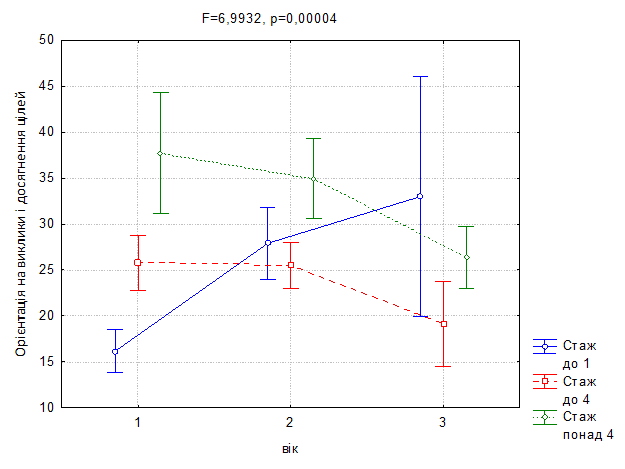
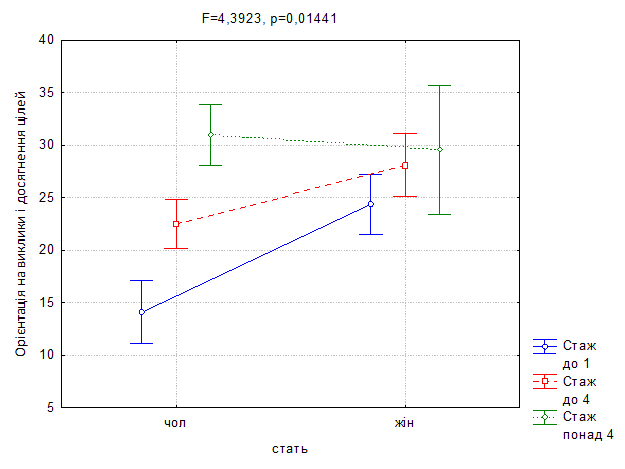
Thus, the factor of long tenure compensates for the factor of young age in terms of the development of orientation to challenges and achievement of goals, which on average across the sample is most strongly expressed with the longest tenure and lowest among young people. These data are corroborated by the fact that the combination of the youngest age and the shortest tenure results in the lowest level of orientation to challenges and achievement of goals. Thus, short volunteer tenure in the youngest part of the sample negatively affects orientation to challenges and achievement of goals.
In men with short tenure, orientation to challenges and achievement of goals is the lowest in the sample. In female volunteers, orientation to challenges and achievement of goals is generally higher, especially with less experience of activity. Thus, the youngest age and shortest tenure are, for men, in contrast to women, conditions for a reduction of orientation to challenges and achievement of goals in volunteers as a whole.
The combination of the factors of long volunteer tenure and younger age (belonging to the period of early adulthood) predicts the highest indicators of self-control and the ability to overcome difficulties (Fig. 2.2).
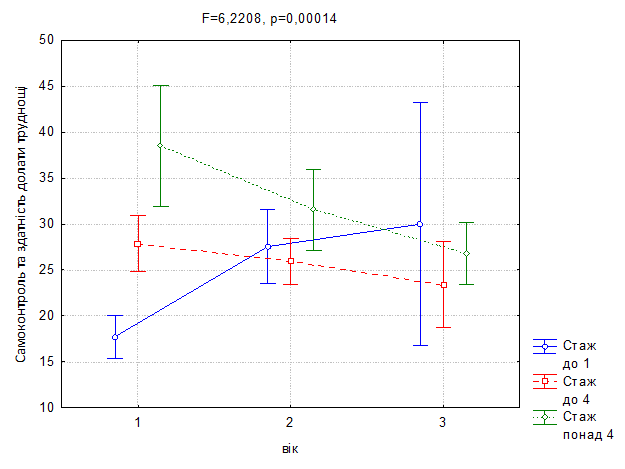
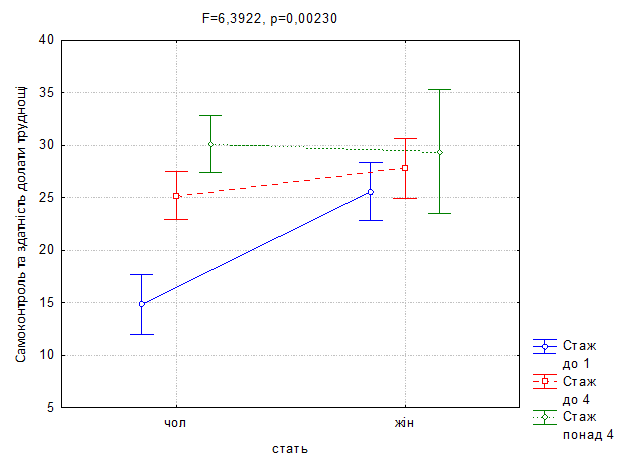
In men with short tenure, however, self-control and the ability to overcome difficulties are the lowest in the volunteer sample. In women, regardless of length of activity as volunteers, the indicators of self-control of resilience do not differ. Thus, the youngest age and shortest tenure are, for men, in contrast to women, conditions for a reduction of self-control and the ability to overcome difficulties in volunteers as a whole.
The combination of the factors of long volunteer tenure and younger age (belonging to the period of early and middle adulthood) predicts the highest indicators of self-determination and meaningfulness of life (Fig. 2.3).
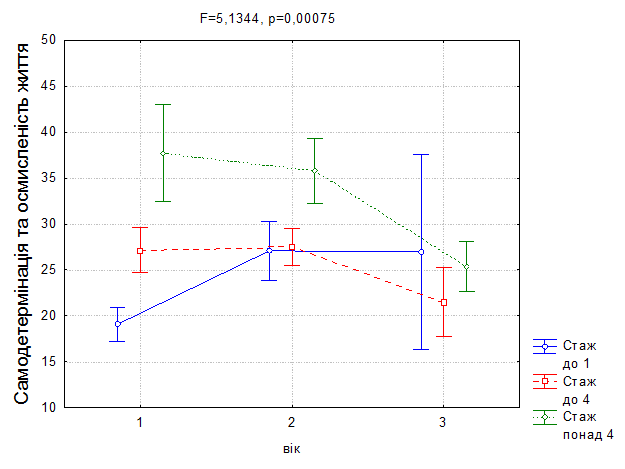
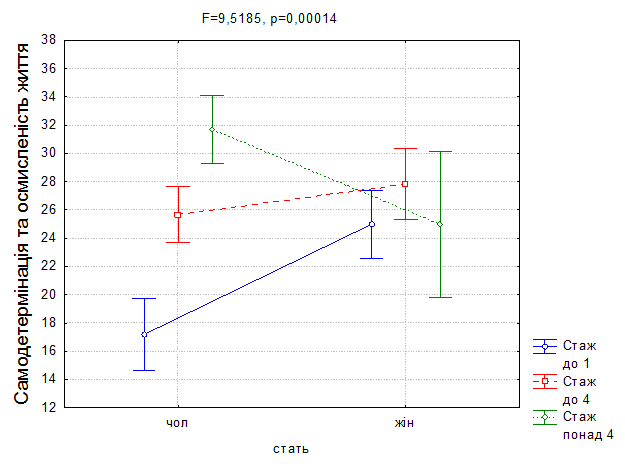
In men with short tenure, self-determination and meaningfulness of life are the lowest in the volunteer sample. In women, regardless of length of activity as volunteers, the indicators of self-determination and meaningfulness of life do not differ.
The lowest indicators of stress resistance are characteristic of the period of early adulthood in persons with the shortest tenure as a volunteer. In men with the shortest volunteer tenure, the indicators of stress resistance are also the lowest in comparison with women of various volunteer tenure (Fig. 2.4).
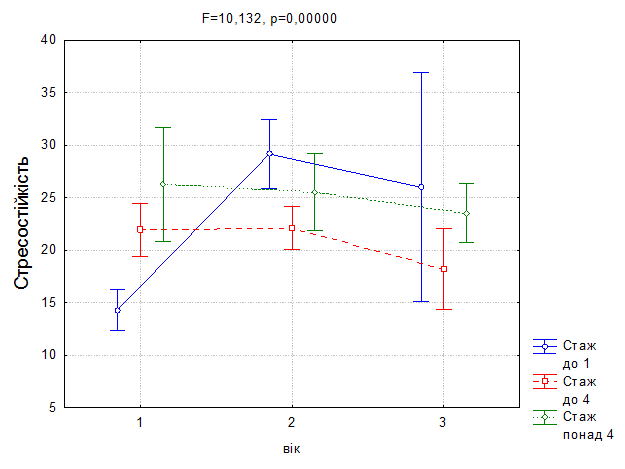
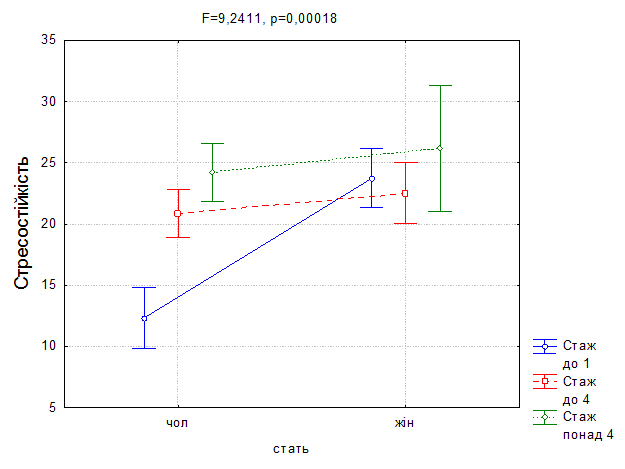
With short volunteering tenure, in persons of the middle adulthood period (25–40 years) the indicators of constructive coping are higher than in other categories of participants. In addition, in women in general, and especially at the longest tenure, the indicators of constructive coping are the highest (Fig. 2.5).
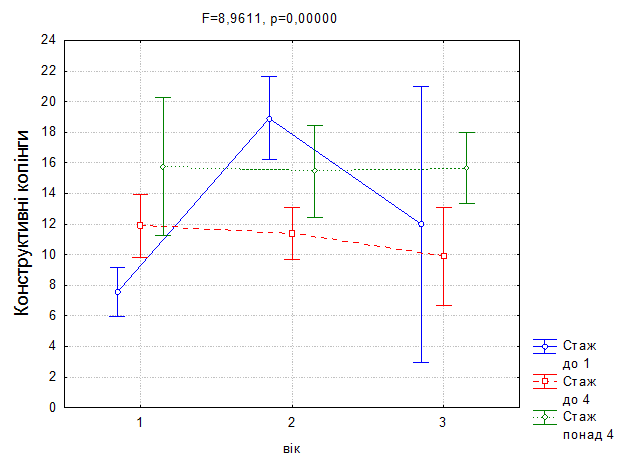
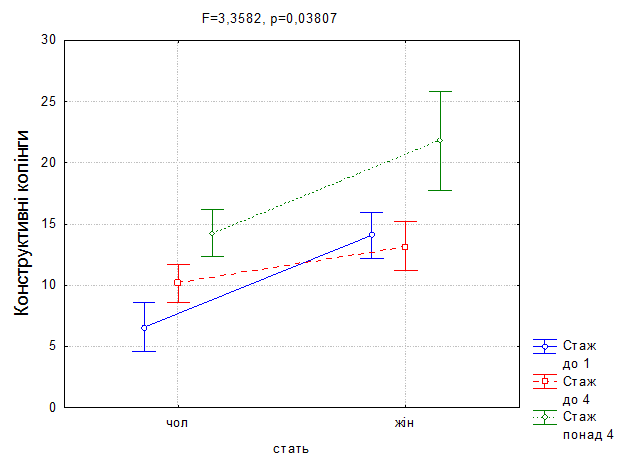
The longest volunteer tenure is, in itself, a significant factor in the development of social connectedness; however, in the period of early adulthood its role proved to be more significant (Fig. 2.6).
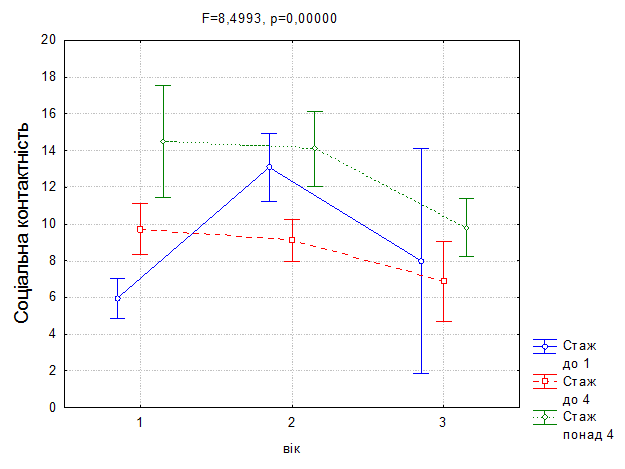
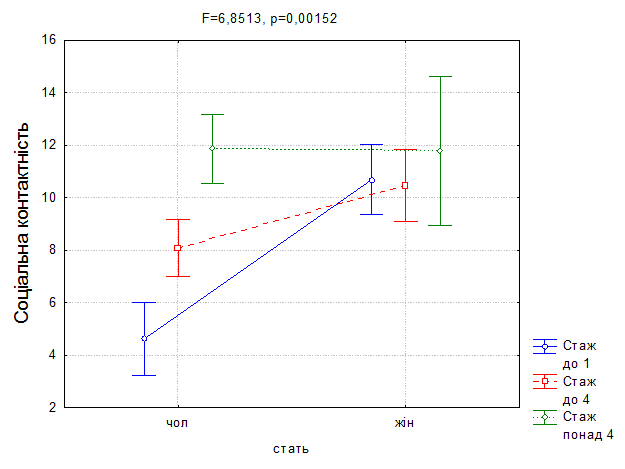
Social connectedness as an indicator of resilience is lowest in men with short volunteer tenure. Optimal regulation is likewise lower with short tenure in the period of early adulthood and in men (Fig. 2.7).
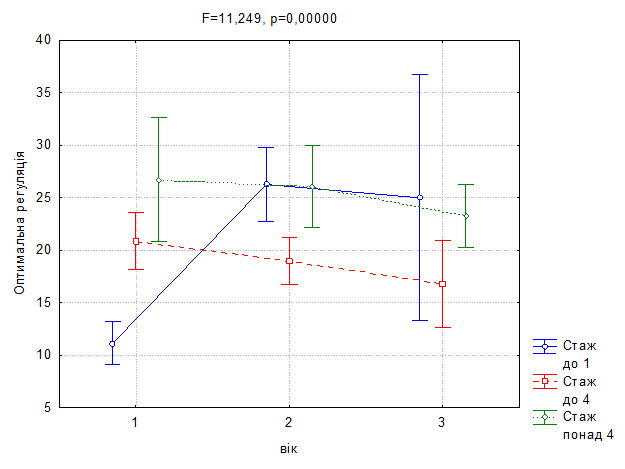
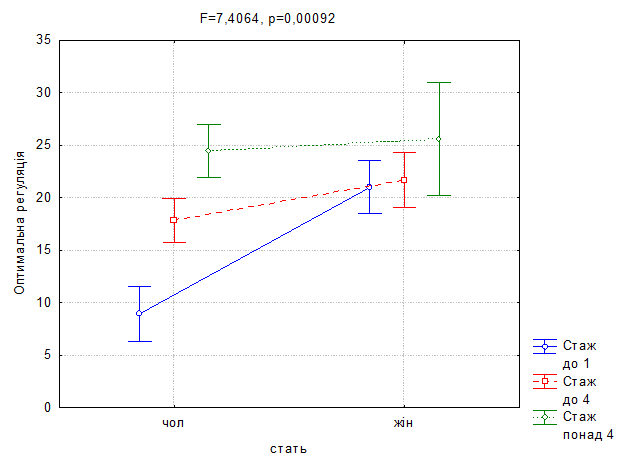
Openness to life experience is also lower with short tenure in the period of early adulthood and in men (Fig. 2.8).
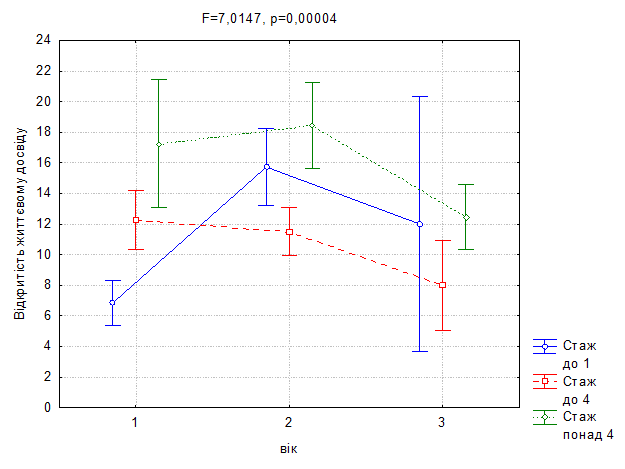
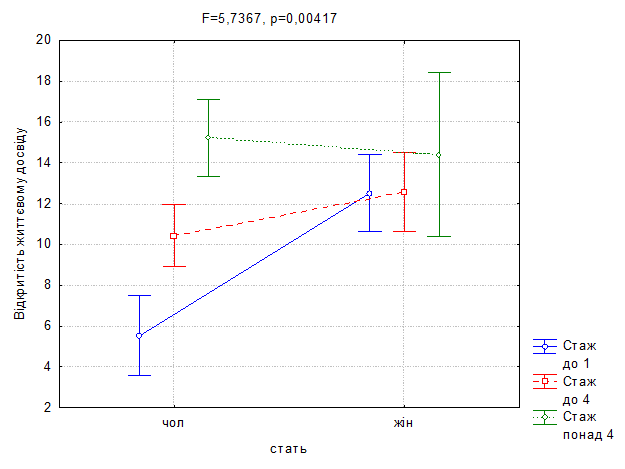
General resilience is likewise lower with short tenure in the period of early adulthood and in men (Fig. 2.9).
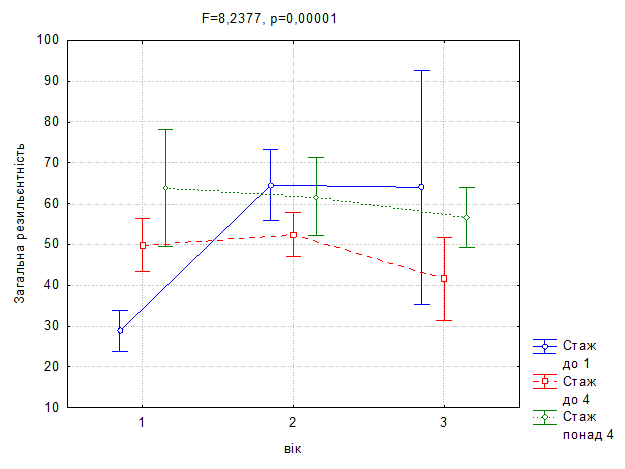
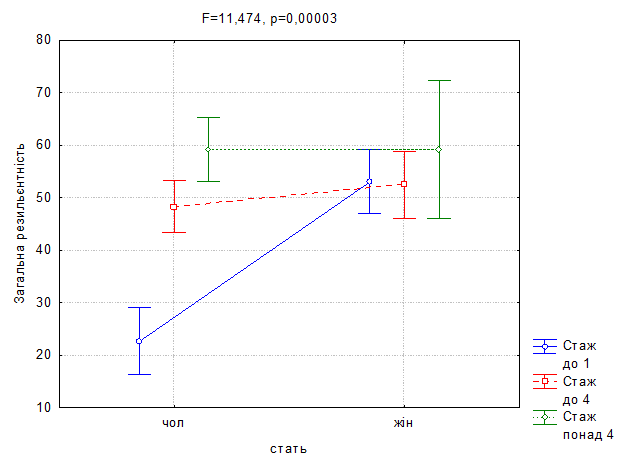
Thus, among the factors of reduced resilience are age, activity-related and sex factors: male volunteers in comparison with female volunteers have lower resilience indicators under conditions of short tenure of activity. It can be assumed that women adapt more quickly to the demands of volunteer activity and that the content and procedural characteristics of resilience — the ability to resist stress, to be decisive, to exercise volitional self-control, and to choose constructive strategies of coping with difficult situations in life and activity — develop more rapidly in them.
In addition, the combined influence of short tenure of activity and young age has a significant impact on the reduction of resilience: novice volunteers of younger age master the ability to resist stress much more slowly and with greater difficulty than their older colleagues.
2.3. Psychological features of resilience in volunteers
This section presents the results of the study of such psychological features of resilience in volunteers as the level of personal maturity, existentiality, altruistic motivation, leading coping strategies, emotional stability and anxiety.
2.3.1. Personal maturity as a factor of resilience in volunteers
Table 2.8 shows the correlations between resilience and the indicators of personal maturity in volunteers.
Table 2.8
Correlations of resilience and personal maturity in volunteers
| Indicators | Responsibility | Decentration | Depth of experience | Life philosophy | Tolerance | Autonomy | Contactness | Self-acceptance | Creativity | Synergy | Personal maturity |
|---|---|---|---|---|---|---|---|---|---|---|---|
| Orientation to challenges and achievement of goals | 0.27** | 0.63**** | 0.61**** | 0.71**** | 0.65**** | 0.61**** | 0.60**** | 0.57**** | 0.57**** | 0.55**** | 0.80**** |
| Self-control and the ability to overcome difficulties | 0.51**** | 0.47**** | 0.46**** | 0.59**** | 0.48**** | 0.45**** | 0.49**** | 0.43**** | 0.37**** | 0.41**** | 0.64**** |
| Self-determination and meaningfulness of life | 0.26** | 0.71**** | 0.72**** | 0.84**** | 0.59**** | 0.76**** | 0.57**** | 0.51**** | 0.52**** | 0.49**** | 0.83**** |
| Stress resistance | 0.09 | 0.39**** | 0.46**** | 0.49**** | 0.59**** | 0.39**** | 0.53**** | 0.76**** | 0.45**** | 0.69**** | 0.67**** |
| Constructive coping | 0.21* | 0.28** | 0.32*** | 0.35**** | 0.58**** | 0.27** | 0.55**** | 0.66**** | 0.49**** | 0.63**** | 0.61**** |
| Social connectedness | 0.26** | 0.53**** | 0.53**** | 0.59**** | 0.76**** | 0.53**** | 0.75**** | 0.67**** | 0.63**** | 0.64**** | 0.82**** |
| Optimal regulation | 0.21* | 0.45**** | 0.47**** | 0.52**** | 0.62**** | 0.41**** | 0.60**** | 0.64**** | 0.53**** | 0.56**** | 0.70**** |
| Openness to life experience | 0.23** | 0.56**** | 0.57**** | 0.64**** | 0.67**** | 0.59**** | 0.60**** | 0.57**** | 0.75**** | 0.52**** | 0.79**** |
| General resilience | 0.08 | 0.44**** | 0.52**** | 0.54**** | 0.58**** | 0.45**** | 0.52**** | 0.72**** | 0.44**** | 0.60**** | 0.68**** |
Orientation to challenges and achievement of goals positively correlates with the general indicator of personal maturity and such parameters as life philosophy, tolerance, decentration, autonomy, contactness, self-acceptance, creativity, synergy, and to a lesser extent — responsibility.
Self-control and the ability to overcome difficulties positively correlate with all indicators of personal maturity, particularly with life philosophy. The weakest correlation is found with the indicator of creativity.
Self-determination and meaningfulness of life positively correlate with all indicators of personal maturity, particularly with life philosophy and autonomy.
Stress resistance does not correlate only with the responsibility indicator, while with other indicators of personal maturity it has medium-strength relationships, and with self-acceptance — a strong relationship.
Constructive coping correlates weakly with responsibility, autonomy and decentration in the structure of personal maturity, with which it is generally positively related, particularly with the indicator of self-acceptance.
Social connectedness has a number of strong relationships with personal maturity, particularly with the indicators of tolerance and contactness.
Optimal regulation and openness to life experience correlate weakly with responsibility and moderately with the other indicators of personal maturity.
General resilience does not correlate only with the responsibility indicator, while with other indicators of personal maturity it has medium-strength relationships, and with self-acceptance — a strong relationship.
Thus, there exists a strong direct correspondence between personal maturity — expressed in indicators of responsibility for one's actions, the ability to view a situation from the outside while overcoming egocentrism, the ability to deeply experience various higher feelings, to possess and convey one's own life philosophy and wisdom, to display tolerance in communication and interaction with others, to be independent and have adequate self-acceptance, to display communicative abilities, to have close relationships, to display creativity in life and activity, to harmoniously combine various spheres of one's life — and the procedural and content sides of resilience.
Table 2.9 shows that volunteers with a critical level of personal maturity lag significantly behind persons with a necessary, and especially a high, level of personal maturity in resilience.
Table 2.9
Resilience indicators in volunteers with different levels of personal maturity
| Indicators | Participant groups | H | |||||
|---|---|---|---|---|---|---|---|
| Critical | Necessary | High | |||||
| M | σ | M | σ | M | σ | ||
| Orientation to challenges and achievement of goals | 15.55 | 5.14 | 25.35 | 6.83 | 34.79 | 5.89 | 59.45 |
| Self-control and the ability to overcome difficulties | 18.94 | 7.02 | 25.19 | 6.30 | 35.16 | 6.42 | 43.99 |
| Self-determination and meaningfulness of life | 18.79 | 4.29 | 25.95 | 4.99 | 35.89 | 5.75 | 66.03 |
| Stress resistance | 14.61 | 3.83 | 22.63 | 6.62 | 26.16 | 5.34 | 45.28 |
| Constructive coping | 7.45 | 2.46 | 13.12 | 5.86 | 15.37 | 3.99 | 40.04 |
| Social connectedness | 5.15 | 1.95 | 9.91 | 3.39 | 13.53 | 2.46 | 60.17 |
| Optimal regulation | 10.88 | 5.61 | 21.07 | 6.49 | 25.53 | 4.56 | 51.92 |
| Openness to life experience | 6.30 | 2.64 | 12.08 | 4.75 | 17.42 | 3.31 | 55.92 |
| General resilience | 28.94 | 13.26 | 53.16 | 16.05 | 61.16 | 11.98 | 47.65 |
Orientation to challenges and achievement of goals (U = 345, Z = 5.97, p < 0.0001), self-control and the ability to overcome difficulties (U = 625, Z = 4.08, p < 0.0001), self-determination and meaningfulness of life (U = 319, Z = 6.12, p < 0.0001), stress resistance (U = 364, Z = 5.82, p < 0.0001), constructive coping (U = 454, Z = 5.22, p < 0.0001), social connectedness (U = 274, Z = 6.42, p < 0.0001), optimal regulation (U = 341, Z = 5.97, p < 0.0001), openness to life experience (U = 312, Z = 6.16, p < 0.0001), and general resilience (U = 345, Z = 5.95, p < 0.0001) are lower at a critical level of personal maturity in comparison with the necessary level.
In contrast, the high level of personal maturity also has advantages over the necessary level in the level of resilience, in particular on the indicators of orientation to challenges and achievement of goals (U = 171, Z = 5.09, p < 0.0001), self-control and the ability to overcome difficulties (U = 177, Z = 5.04, p < 0.0001), self-determination and meaningfulness of life (U = 100, Z = 5.76, p < 0.0001), stress resistance (U = 443, Z = 2.53, p < 0.05), constructive coping (U = 424, Z = 2.71, p < 0.01), social connectedness (U = 279, Z = 4.08, p < 0.0001), optimal regulation (U = 340, Z = 3.50, p < 0.001), openness to life experience (U = 276, Z = 4.10, p < 0.0001), and general resilience (U = 413, Z = 2.81, p < 0.01).
Thus, a direct linear relationship has been revealed between the indicators of resilience and personal maturity. A critical level of personal maturity development entails the lowest resilience, its sufficient level manifests with sufficient personal maturity, and only a high level of personal maturity entails high resilience in volunteers. The obtained results provide grounds for defining personal maturity as an important factor of the development of resilience in volunteers.
The shortest tenure as a volunteer with a high level of personal maturity entails lower indicators of orientation to challenges in comparison with sufficient tenure (Fig. 2.10).
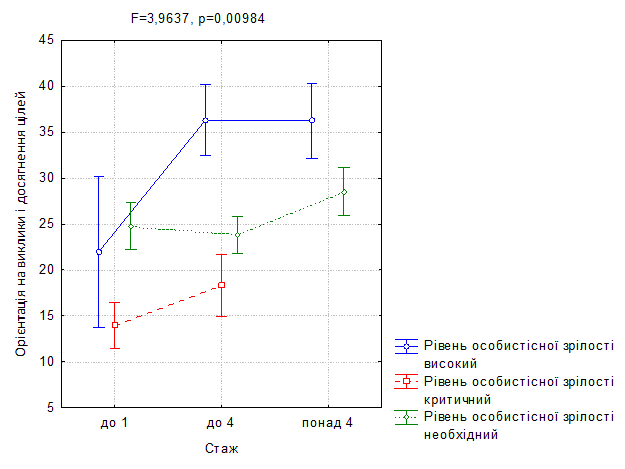
At a critical level of personal maturity, with the shortest tenure of activity, the lowest indicators of self-control and the ability to overcome difficulties are found in volunteers, whereas sufficient and long tenure at a high level of personal maturity entail the highest indicators of self-control and the ability to overcome difficulties (Fig. 2.11).
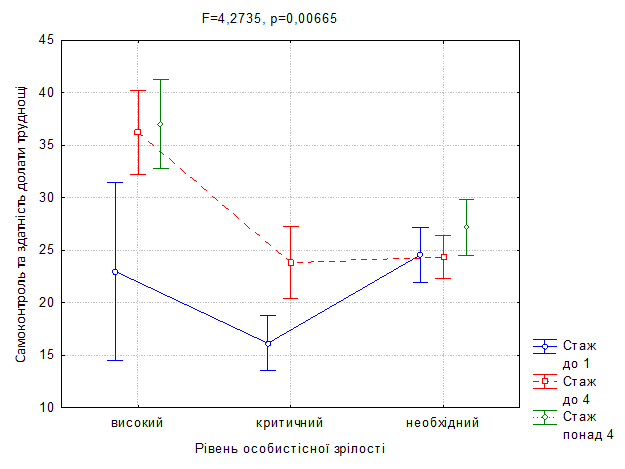
At a critical level of personal maturity, with the shortest tenure of activity, the lowest indicators of self-determination and meaningfulness of life are found in volunteers, whereas sufficient and long tenure at a high level of personal maturity entail the highest indicators of self-determination and meaningfulness of life (Fig. 2.12).
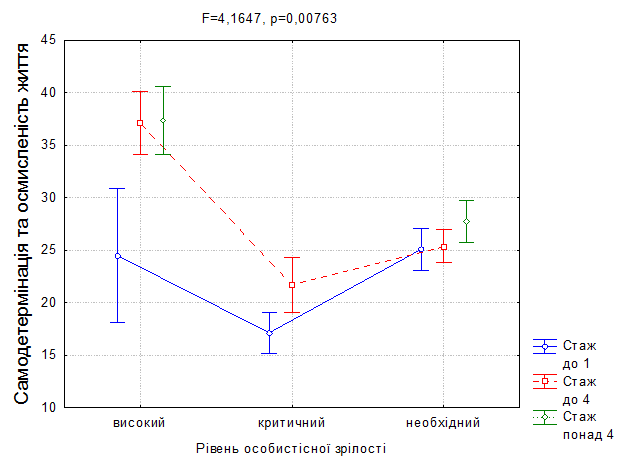
Sufficient and long tenure at a high level of personal maturity entail the highest indicators of stress resistance in volunteers (Fig. 2.13).
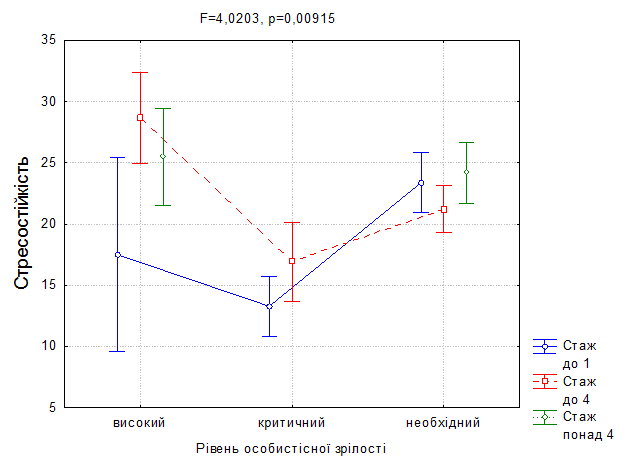
Sufficient and long tenure at a high level of personal maturity entail the highest indicators of constructive coping in volunteers (Fig. 2.14).
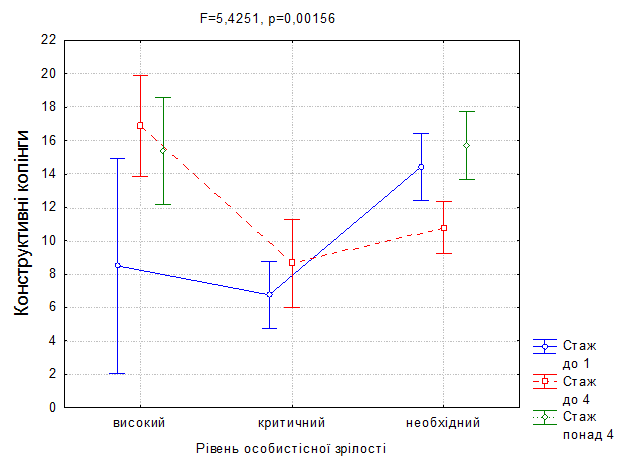
Sufficient and long tenure at a high level of personal maturity entail the highest indicators of social connectedness in volunteers (Fig. 2.15).
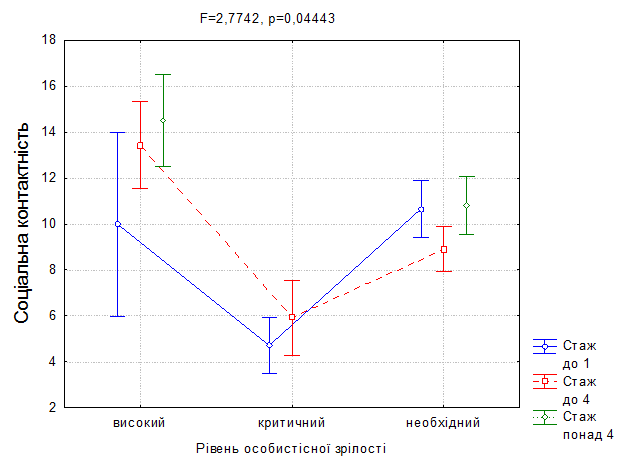
At a critical level of personal maturity, with the shortest tenure of activity, the lowest indicators of optimal regulation are found in volunteers (Fig. 2.16).
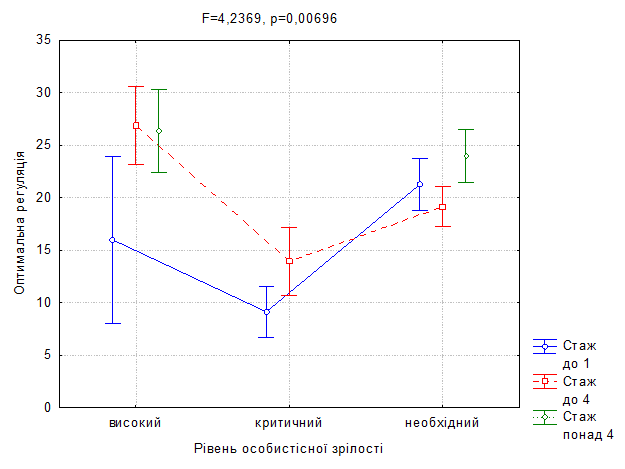
Sufficient and long tenure at a high level of personal maturity entail the highest indicators of openness to life experience in volunteers (Fig. 2.17).
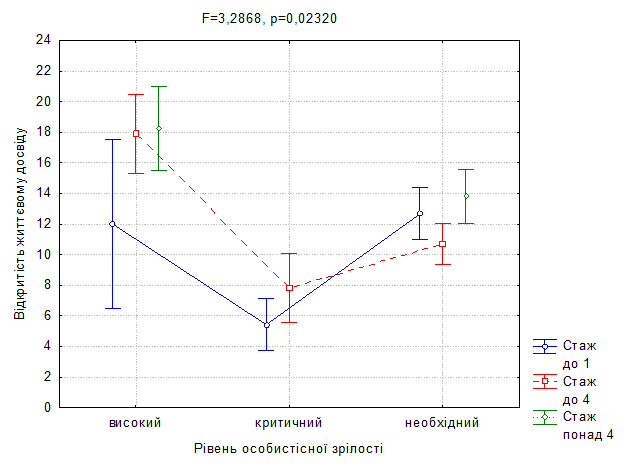
At a critical level of personal maturity, with the shortest tenure of activity, the lowest indicators of general resilience are found in volunteers, whereas sufficient and long tenure at a high level of personal maturity entail the highest indicators of resilience (Fig. 2.18).
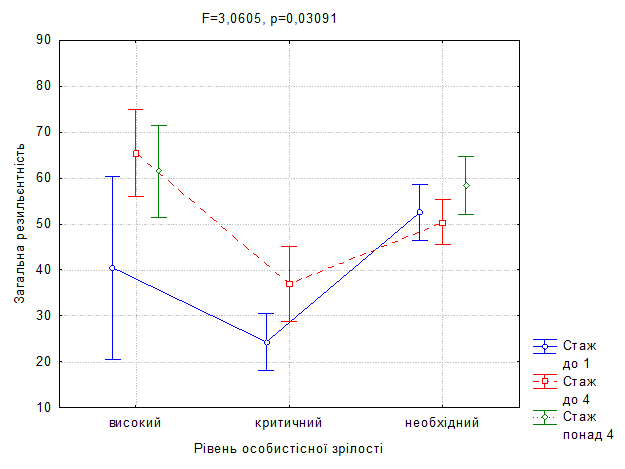
Thus, a high level of personal maturity is a sufficient condition for the development of resilience only in volunteers with sufficient tenure, whereas a high level of personal maturity in novice volunteers is not sufficient to be considered a condition for the development of higher resilience. The obtained data impose certain limitations on regarding personal maturity as a universal factor of the development of resilience in volunteers, specifically with regard to young age.
2.3.2. Existentiality as a factor of resilience in volunteers
Table 2.10 shows the correlations between resilience and the indicators of existentiality in volunteers.
Table 2.10
Correlations of resilience and existentiality in volunteers
| Indicators | Self-distancing | Self-transcendence | Freedom | Responsibility | Existentiality |
|---|---|---|---|---|---|
| Orientation to challenges and achievement of goals | 0.63** | 0.68** | 0.60** | 0.69** | 0.68** |
| Self-control and the ability to overcome difficulties | 0.52** | 0.53** | 0.54** | 0.56** | 0.56** |
| Self-determination and meaningfulness of life | 0.76** | 0.80** | 0.72** | 0.81** | 0.81** |
| Stress resistance | 0.48** | 0.46** | 0.50** | 0.49** | 0.50** |
| Constructive coping | 0.33* | 0.35** | 0.32* | 0.35** | 0.36** |
| Social connectedness | 0.56** | 0.61** | 0.51** | 0.61** | 0.61** |
| Optimal regulation | 0.54** | 0.52** | 0.55** | 0.55** | 0.56** |
| Openness to life experience | 0.58** | 0.65** | 0.50** | 0.66** | 0.63** |
| General resilience | 0.63** | 0.68** | 0.60** | 0.69** | 0.68** |
* — p < 0.001 ** — p < 0.0001
Orientation to challenges and achievement of goals positively correlates with the general indicator of existentiality and such parameters as responsibility, self-transcendence, self-distancing and freedom.
Self-control and the ability to overcome difficulties positively correlates with all indicators of existentiality — such parameters as responsibility, self-transcendence, self-distancing and freedom, and self-determination and meaningfulness of life is characterised by the strongest relationships with existentiality.
Stress resistance, constructive coping, social connectedness, optimal regulation, openness to life experience and general resilience correlate with all indicators of existentiality — such parameters as responsibility, self-transcendence, self-distancing and freedom.
Thus, there is concordance between the indicators of resilience and existentiality as the ability to dispassionately reflect on one's life, to live with inner accord and in harmony with oneself, to be able to find correspondence between the essence of one's life and one's decisions and actions, and to be able to bring good into one's life.
Orientation to challenges and achievement of goals concords most strongly with such existential capacities as self-transcendence and responsibility.
The ability to openly defend oneself and one's rights in situations of life's challenges, to set and achieve goals as characteristics of resilience presuppose the capacity to feel values and clarity in one's own feelings, the capacity to feel values, to be emotionally moved, displaying free emotionality through feelings of closeness to something or someone, the ability to empathise, to live for the sake of something or someone, the capacity to be oriented in action toward meaning rather than only toward purpose, to experience captivation by value, to respond emotionally, to perceive deep inner relations, the existential significance of what is happening.
In addition, such orientation toward achievement in the absence of fear of failure, which constitutes the content of this resilience indicator, presupposes the capacity to carry out decisions made on the basis of personal values in volunteers.
Self-determination and meaningfulness of life as indicators of resilience are most strongly concordant with self-distancing, self-transcendence, freedom and responsibility. Thus, meaningfulness of life, the ability to determine one's place in one's own life, one's roles, the internality of the locus of control and responsibility, are connected with the capacity to create an inner free space, to establish an inner distance towards oneself, with objectivity, with the ability to step back from oneself.
An understanding of one's own leading role and responsibility for successfully exiting and resolving complex life tasks presupposes greater freedom in one's actions, decisiveness and the ability to bear responsibility for decisions made on the basis of one's own values.
Stress resistance, social connectedness, optimal regulation, self-control and the ability to overcome difficulties as volitional and behavioural aspects of resilience as a whole moderately correlate with the indicators of existentiality, while constructive coping — as a means of rational thinking in situations of stress and corresponding behaviour — correlates weakly.
The obtained results provide grounds for asserting that existentiality is a more significant factor specifically for those components of resilience that actualise its motivational force, while concording less with the emotional-volitional and cognitive components of resilience.
Table 2.11 shows that volunteers with a low level of existentiality lag significantly behind persons with a medium and especially a high level of existentiality in the level of resilience.
Orientation to challenges and achievement of goals (U = 58, Z = 6.95, p < 0.0001), self-control and the ability to overcome difficulties (U = 123, Z = 6.39, p < 0.0001), self-determination and meaningfulness of life (U = 0, Z = 7.45, p < 0.0001), stress resistance (U = 110, Z = 6.51, p < 0.0001), constructive coping (U = 188, Z = 5.84, p < 0.0001), social connectedness (U = 177, Z = 5.94, p < 0.0001), optimal regulation (U = 143, Z = 6.23, p < 0.0001), openness to life experience (U = 32, Z = 7.18, p < 0.0001), and general resilience (U = 98, Z = 6.61, p < 0.0001) are lower at a low level of existentiality in comparison with a medium one.
In contrast, a high level of existentiality also has advantages over a medium one in the level of resilience, in particular on the indicators of orientation to challenges and achievement of goals (U = 354, Z = 5.63, p < 0.0001), self-control and the ability to overcome difficulties (U = 641, Z = 3.57, p < 0.0001), self-determination and meaningfulness of life (U = 259, Z = 6.32, p < 0.0001), stress resistance (U = 769, Z = 2.65, p < 0.01), constructive coping (U = 781, Z = 2.56, p < 0.01), social connectedness (U = 501, Z = 4.58, p < 0.0001), optimal regulation (U = 639, Z = 3.59, p < 0.001), openness to life experience (U = 460, Z = 4.87, p < 0.0001), and general resilience (U = 745, Z = 2.82, p < 0.01).
Table 2.11
Resilience indicators in volunteers with different levels of existentiality
| Indicators | Participant groups | H | |||||
|---|---|---|---|---|---|---|---|
| Low | Medium | High | |||||
| M | σ | M | σ | M | σ | ||
| Orientation to challenges and achievement of goals | 12.58 | 3.25 | 24.52 | 5.21 | 32.50 | 7.19 | 73.88 |
| Self-control and the ability to overcome difficulties | 15.00 | 4.71 | 25.79 | 5.19 | 31.29 | 8.00 | 55.03 |
| Self-determination and meaningfulness of life | 15.62 | 2.32 | 25.27 | 2.40 | 33.79 | 5.99 | 84.65 |
| Stress resistance | 12.19 | 3.68 | 22.45 | 5.80 | 25.15 | 5.43 | 53.42 |
| Constructive coping | 6.35 | 1.92 | 12.84 | 5.78 | 14.62 | 4.30 | 48.53 |
| Social connectedness | 4.62 | 1.72 | 9.21 | 3.20 | 12.74 | 2.97 | 59.22 |
| Optimal regulation | 8.77 | 4.38 | 20.45 | 6.27 | 24.29 | 5.27 | 55.82 |
| Openness to life experience | 5.00 | 0.98 | 11.27 | 4.11 | 16.47 | 4.24 | 70.66 |
| General resilience | 21.85 | 10.58 | 52.81 | 13.87 | 58.76 | 13.23 | 55.30 |
Thus, there is a linear correspondence between the level of existentiality and resilience in volunteers, which provides grounds for defining the former as a factor of the development of the latter.
At the longest tenure of activity of volunteers, under the condition of a high level of existentiality, the indicators of orientation to challenges and achievement of goals are the highest (Fig. 2.19). In general, the level of existentiality is a more influential factor of orientation to challenges than is tenure of activity.
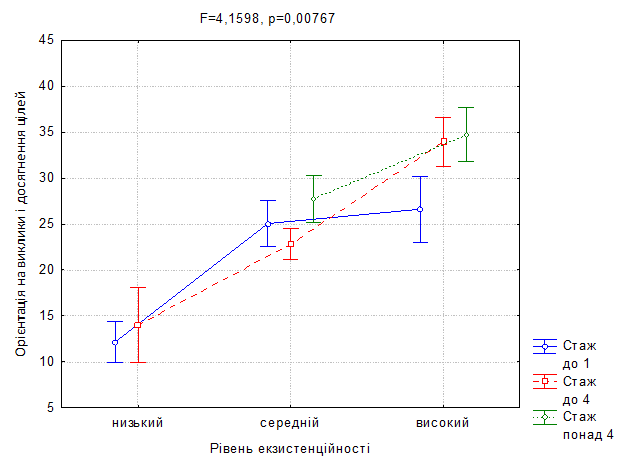
At the longest tenure of activity of volunteers, under the condition of a high level of existentiality, the indicators of self-control and the ability to overcome difficulties are the highest (Fig. 2.20).
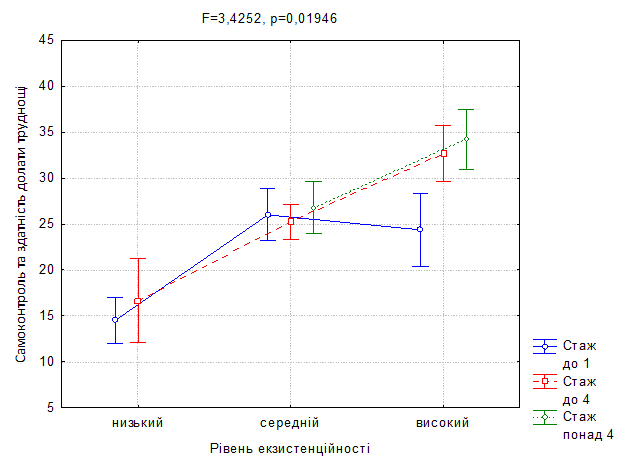
At the longest tenure of activity of volunteers, under the condition of a high level of existentiality, the indicators of self-determination and meaningfulness of life are the highest (Fig. 2.21).
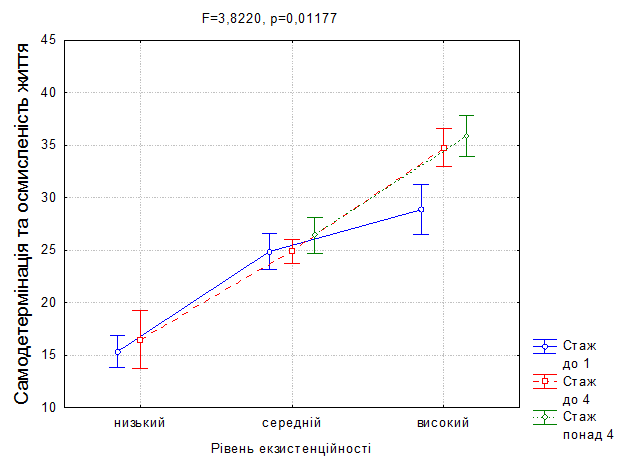
With shorter tenure of activity of volunteers, under the condition of a low level of existentiality, the indicators of stress resistance are the lowest (Fig. 2.22).
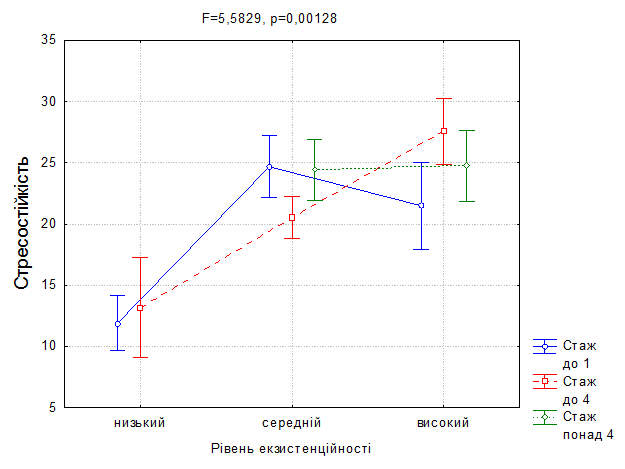
With shorter tenure of activity of volunteers, under the condition of a low level of existentiality, the indicators of constructive coping are the lowest (Fig. 2.23).
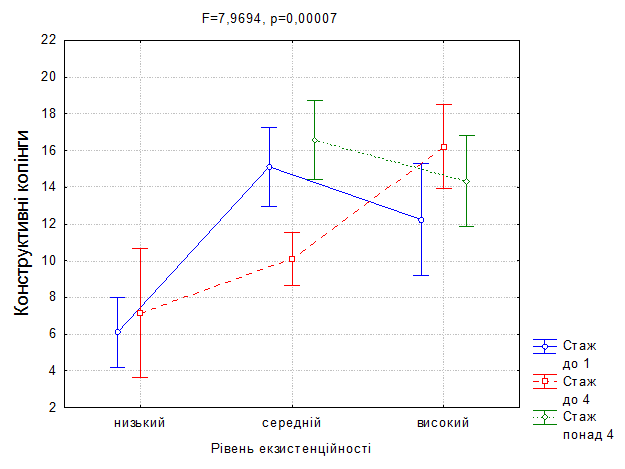
Social connectedness in volunteers with shorter tenure and a low level of existentiality is the lowest (Fig. 2.24).
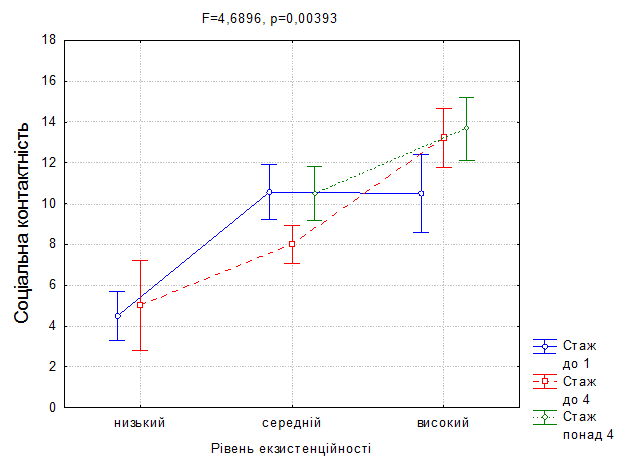
Optimal regulation in volunteers with shorter tenure and a low level of existentiality is the lowest (Fig. 2.25).
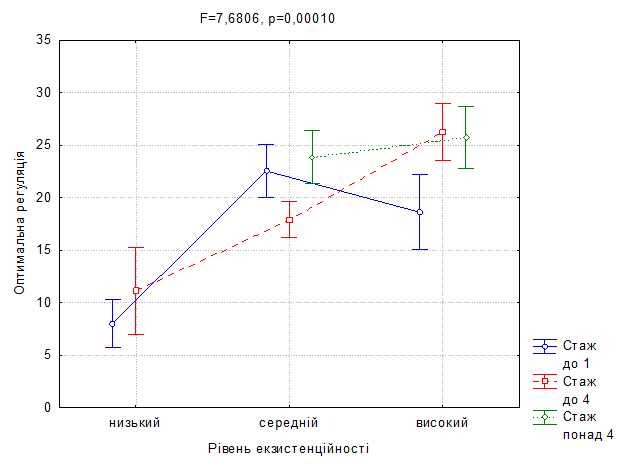
Openness to life experience in volunteers with shorter tenure and a low level of existentiality is the lowest (Fig. 2.26).
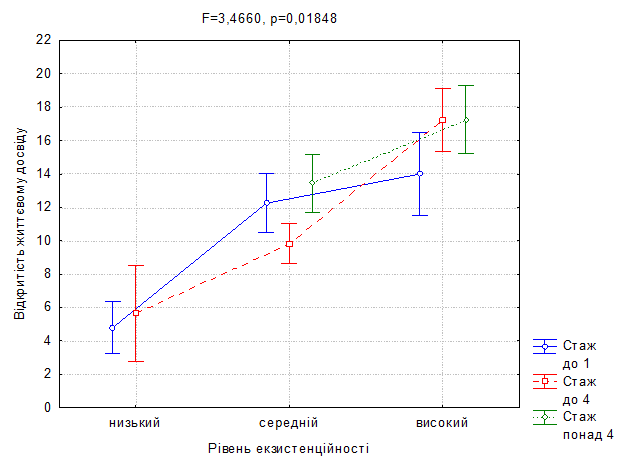
General resilience in volunteers with shorter tenure and a low level of existentiality is the lowest (Fig. 2.27).
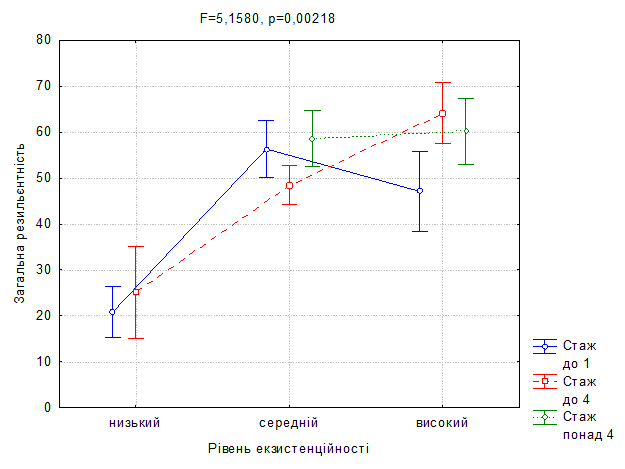
Thus, analysing all the resilience indicators in volunteers with different tenure of activity and level of existentiality, it can be said that the latter is a significant factor in the level of resilience at the start of engagement in volunteering and at little volunteering experience. The low existentiality of novice volunteers has a negative effect on the level of their resilience.
Table 2.12 shows the correlations of resilience and existential motivation of volunteers. All the relationships indicated in the table are significant at the level p < 0.0001. Orientation to challenges and achievement of goals is positively related with existential fulfilment, the indicators of the presence of support, feeling of security and an inner positive space, the presence of a feeling of relatedness, a sense of time and closeness, with interested attention, fair treatment, recognition of value, and also with the presence of resources for activity and involvement in interrelations.
Self-control and the ability to overcome difficulties is positively related with existential fulfilment, the indicators of the presence of support, feeling of security and an inner positive space, the presence of a feeling of relatedness, a sense of time and closeness, with interested attention, fair treatment, recognition of value, and also with the presence of resources for activity and involvement in interrelations.
Table 2.12
Correlations of resilience and existential motivation in volunteers
| Indicators | Support, security, space | Relatedness, time, closeness | Interested attention, fair treatment, recognition of value | Opportunity for activity, involvement in interrelations | Existential fulfilment |
|---|---|---|---|---|---|
| Orientation to challenges and achievement of goals | 0.61 | 0.61 | 0.61 | 0.53 | 0.76 |
| Self-control and the ability to overcome difficulties | 0.53 | 0.48 | 0.49 | 0.47 | 0.63 |
| Self-determination and meaningfulness of life | 0.53 | 0.52 | 0.54 | 0.46 | 0.66 |
| Stress resistance | 0.62 | 0.58 | 0.56 | 0.44 | 0.70 |
| Constructive coping | 0.68 | 0.57 | 0.50 | 0.44 | 0.70 |
| Social connectedness | 0.68 | 0.72 | 0.59 | 0.57 | 0.82 |
| Optimal regulation | 0.68 | 0.66 | 0.64 | 0.52 | 0.80 |
| Openness to life experience | 0.57 | 0.60 | 0.65 | 0.51 | 0.75 |
| General resilience | 0.59 | 0.58 | 0.60 | 0.45 | 0.71 |
Self-determination and meaningfulness of life is positively related with existential fulfilment, the indicators of interested attention, fair treatment, recognition of value, the presence of support, feeling of security and an inner positive space, the presence of a feeling of relatedness, a sense of time and closeness, and also with the presence of resources for activity and involvement in interrelations.
Stress resistance positively correlates with existential fulfilment, the indicators of the presence of support, feeling of security and an inner positive space, the presence of a feeling of relatedness, a sense of time and closeness, with interested attention, fair treatment, recognition of value, and also with the presence of resources for activity and involvement in interrelations.
Constructive coping positively correlates with existential fulfilment, the indicators of the presence of support, feeling of security and an inner positive space, the presence of a feeling of relatedness, a sense of time and closeness, with interested attention, fair treatment, recognition of value, and also with the presence of resources for activity and involvement in interrelations.
Social connectedness positively correlates with existential fulfilment, the indicators of the presence of a feeling of relatedness, a sense of time and closeness, with interested attention, the presence of support, feeling of security and an inner positive space, fair treatment, recognition of value, and also with the presence of resources for activity and involvement in interrelations.
Optimal regulation is positively related with existential fulfilment, the indicators of the presence of support, feeling of security and an inner positive space, the presence of a feeling of relatedness, a sense of time and closeness, with interested attention, fair treatment, recognition of value, and also with the presence of resources for activity and involvement in interrelations.
General resilience and openness to life experience are positively related with existential fulfilment, the indicators of interested attention, fair treatment, recognition of value, the presence of a feeling of relatedness, a sense of time and closeness, the presence of support, feeling of security and an inner positive space, and also with the presence of resources for activity and involvement in interrelations.
Thus, all fundamental existential motivations are moderately related with all indicators of resilience. The higher the first fundamental motivation — which presupposes a feeling of trust in the world, experienced as a readiness to find in the world many supports, including spiritual ones, which extend beyond the bounds of a single individual life, beyond the bounds of the rational — the higher the resilience, particularly constructive coping, social connectedness and optimal regulation.
The higher the second fundamental motivation, which presupposes the ability to be emotionally open and involved in life, the higher the resilience, especially social connectedness. The higher the third motivation, which consists in the ability to evaluate oneself through reconciling the situation, one's own actions in it and the value of what is happening with oneself, one's own essence, through conscience and the preservation of fidelity to oneself, the higher the resilience, especially openness to life experience.
The higher the fourth motivation, which consists in the capacity to realise one's essence amid the challenges of a restless world, to be active, "to become alive", the higher the resilience, especially social connectedness.
Table 2.13 shows the dependence of resilience on the level of existential motivation of volunteers. Orientation to challenges and achievement of goals (U = 294, Z = 5.44, p < 0.0001), self-control and the ability to overcome difficulties (U = 247, Z = 5.79, p < 0.0001), self-determination and meaningfulness of life (U = 545, Z = 3.57, p < 0.0001), stress resistance (U = 275, Z = 5.58, p < 0.0001), constructive coping (U = 188, Z = 6.22, p < 0.0001), social connectedness (U = 71, Z = 7.09, p < 0.0001), optimal regulation (U = 128, Z = 6.67, p < 0.0001), openness to life experience (U = 272, Z = 5.61, p < 0.0001), and general resilience (U = 280, Z = 5.54, p < 0.0001) are lower at a low level of existential motivation in comparison with a medium one.
Table 2.13
Resilience indicators in volunteers with different levels of existential motivation (fulfilment)
| Indicators | Participant groups | H | |||||
|---|---|---|---|---|---|---|---|
| Low | Medium | High | |||||
| M | σ | M | σ | M | σ | ||
| Orientation to challenges and achievement of goals | 14.69 | 4.81 | 24.86 | 7.16 | 33.14 | 6.57 | 51.26 |
| Self-control and the ability to overcome difficulties | 15.73 | 6.00 | 26.53 | 6.40 | 30.77 | 7.50 | 41.80 |
| Self-determination and meaningfulness of life | 19.15 | 5.58 | 25.76 | 5.96 | 32.50 | 6.54 | 30.22 |
| Stress resistance | 13.50 | 3.96 | 21.95 | 6.28 | 26.86 | 4.96 | 47.24 |
| Constructive coping | 6.23 | 1.21 | 12.47 | 5.00 | 17.05 | 5.28 | 55.25 |
| Social connectedness | 4.12 | 1.34 | 9.58 | 2.90 | 13.91 | 2.58 | 72.08 |
| Optimal regulation | 8.23 | 2.93 | 20.87 | 6.20 | 25.50 | 4.18 | 60.63 |
| Openness to life experience | 5.92 | 1.74 | 11.62 | 4.82 | 16.95 | 3.93 | 54.25 |
| General resilience | 26.85 | 13.49 | 51.23 | 16.42 | 61.77 | 10.55 | 46.64 |
In contrast, a high level of existential motivation also has advantages over a medium one in the level of resilience, in particular on the indicators of orientation to challenges and achievement of goals (U = 314, Z = 4.56, p < 0.0001), self-control and the ability to overcome difficulties (U = 630, Z = 1.96, p < 0.05), self-determination and meaningfulness of life (U = 426, Z = 3.64, p < 0.001), stress resistance (U = 446, Z = 3.47, p < 0.001), constructive coping (U = 380, Z = 4.02, p < 0.01), social connectedness (U = 228, Z = 5.27, p < 0.0001), optimal regulation (U = 384, Z = 3.98, p < 0.0001), openness to life experience (U = 305, Z = 4.64, p < 0.0001), and general resilience (U = 447, Z = 3.47, p < 0.001).
Thus, resilience is linearly related with the levels of existential fulfilment as a measure of the manifestation of the four existential motivations.
Orientation to challenges and achievement of goals in volunteers with the longest tenure of activity and a high level of existential motivation (fulfilment) is the highest in the volunteer sample and the lowest in those volunteers who have the shortest tenure and the lowest level of existential motivation (Fig. 2.28).
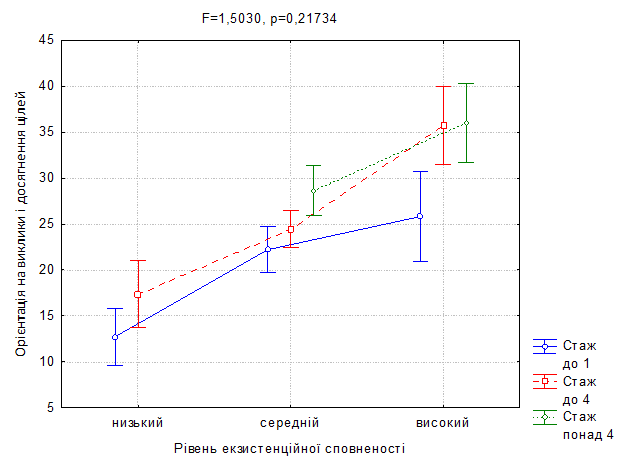
Self-control and the ability to overcome difficulties in volunteers with the longest tenure of activity and a high level of existential motivation (fulfilment) is the highest in the volunteer sample and the lowest in those volunteers who have the shortest tenure and the lowest level of existential motivation (Fig. 2.29).
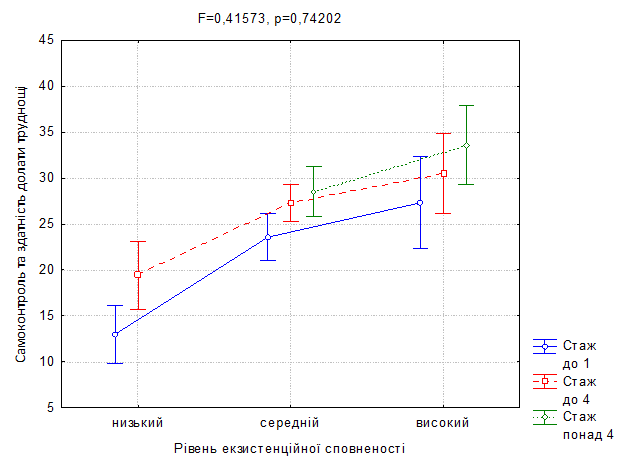
Self-determination and meaningfulness of life in volunteers with the longest tenure of activity and a high level of existential motivation (fulfilment) is the highest in the volunteer sample and the lowest in those volunteers who have the shortest tenure and the lowest level of existential motivation (Fig. 2.30).
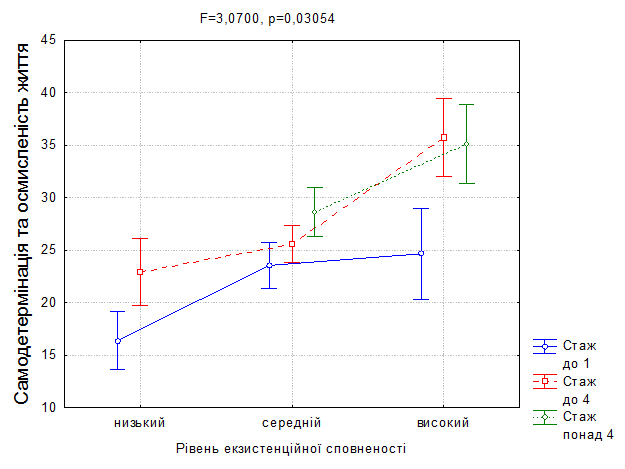
Stress resistance in volunteers with a high level of existential motivation (fulfilment) is the highest in the sample, and the lowest — in those volunteers who have the shortest tenure and the lowest level of existential motivation (Fig. 2.31). In general, the tenure of activity in volunteers with different levels of existential fulfilment does not substantially affect their stress resistance.
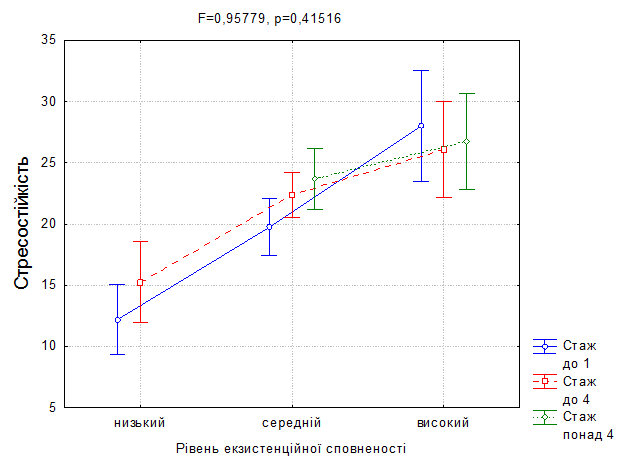
Constructive coping in volunteers with a high level of existential motivation (fulfilment) is the highest in the sample, and the lowest — in those volunteers who have the lowest level of existential motivation (Fig. 2.32). In general, the tenure of activity in volunteers with different levels of existential fulfilment does not substantially affect their level of development of constructive coping.
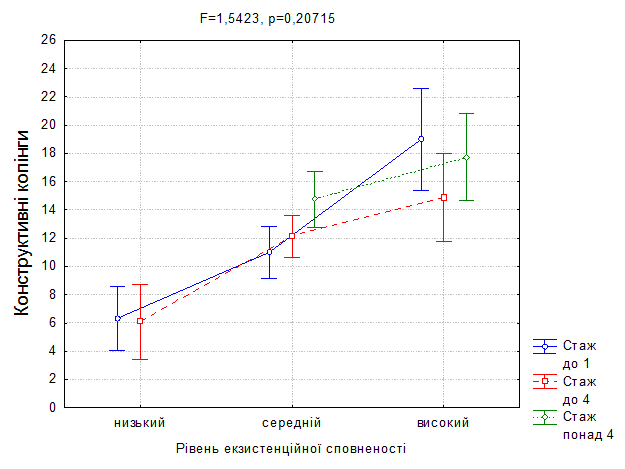
Social connectedness in volunteers with a high level of existential motivation (fulfilment) is the highest in the sample, and the lowest — in those volunteers who have the lowest level of existential motivation (Fig. 2.33). In general, the tenure of activity in volunteers with different levels of existential fulfilment does not substantially affect their level of development of social connectedness.
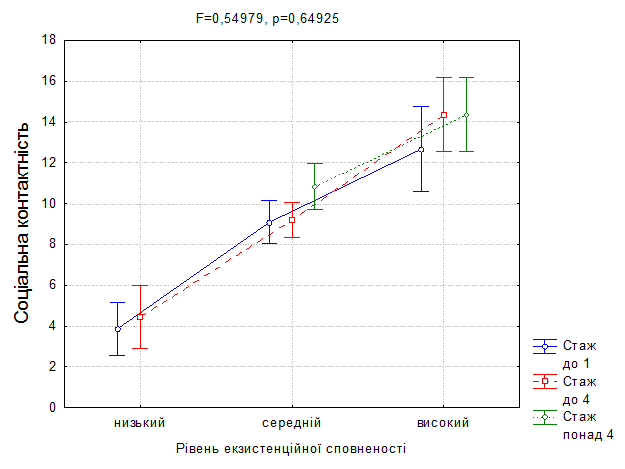
Optimal regulation in volunteers with a high level of existential motivation (fulfilment) is the highest in the sample, and the lowest — in those volunteers who have the lowest level of existential motivation (Fig. 2.34). In general, the tenure of activity in volunteers with different levels of existential fulfilment does not substantially affect their level of development of optimal regulation.
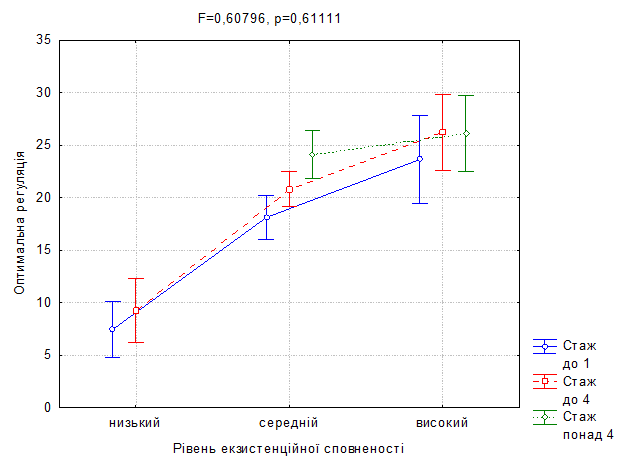
Openness to life experience in volunteers with a high level of existential motivation (fulfilment) is the highest in the sample, and the lowest — in those volunteers who have the lowest level of existential motivation (Fig. 2.35). In general, the tenure of activity in volunteers with different levels of existential fulfilment does not substantially affect their level of openness to life experience.
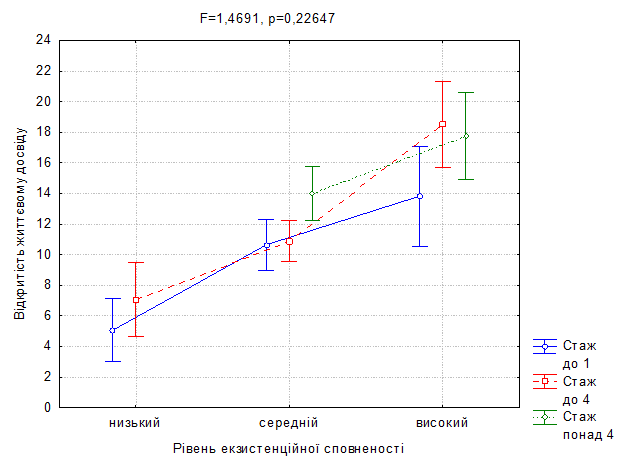
General resilience in volunteers with a high level of existential motivation (fulfilment) is the highest in the sample, and the lowest — in those volunteers who have the lowest level of existential motivation (Fig. 2.36). In general, the tenure of activity in volunteers with different levels of existential fulfilment does not substantially affect their level of general resilience.
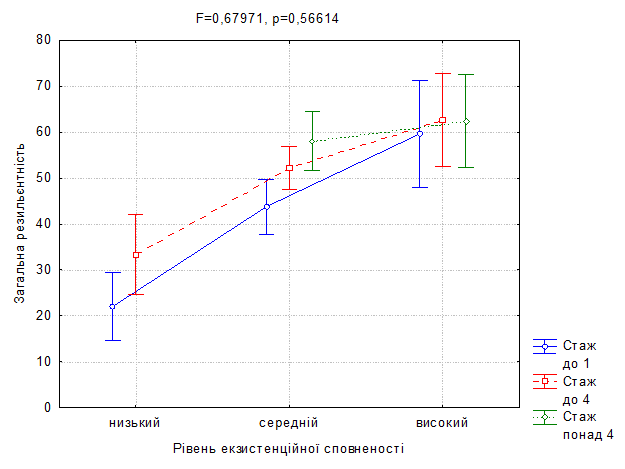
Thus, existential fulfilment is a significant factor of the development of resilience in volunteers. Its particular significance is revealed at the start of volunteer activity, since it is precisely at this time that its reduction has a negative effect on the level of resilience.
2.3.3. Altruistic motivation as a factor of resilience in volunteers
Table 2.14 shows that altruistic motivation for volunteering is positively related with all the indicators of resilience in volunteers (p < 0.0001).
The strongest relationships of altruistic orientation toward volunteering were established for the indicators of social connectedness and optimal regulation. Thus, the higher the level of striving to do good for people who have found themselves in difficult life circumstances, to help those who need it under conditions of war, the more volunteers are characterised by the ability to establish social contacts in order to solve complex tasks, to regulate their own psycho-emotional states, to be open to life's challenges, stress-resistant, and ready to achieve goals and overcome obstacles.
Table 2.14
Correlations of resilience and altruistic motivation for volunteering
| Indicators | Altruistic motivation for volunteering |
|---|---|
| Orientation to challenges and achievement of goals | 0.67 |
| Self-control and the ability to overcome difficulties | 0.66 |
| Self-determination and meaningfulness of life | 0.62 |
| Stress resistance | 0.67 |
| Constructive coping | 0.66 |
| Social connectedness | 0.73 |
| Optimal regulation | 0.72 |
| Openness to life experience | 0.68 |
| General resilience | 0.68 |
Table 2.15 shows the differences in the level of resilience of volunteers with different levels of altruistic orientation.
Orientation to challenges and achievement of goals (U = 273, Z = 4.64, p < 0.0001), self-control and the ability to overcome difficulties (U = 220, Z = 5.09, p < 0.0001), self-determination and meaningfulness of life (U = 301, Z = 4.41, p < 0.0001), stress resistance (U = 213, Z = 5.14, p < 0.0001), constructive coping (U = 251, Z = 4.82, p < 0.0001), social connectedness (U = 229, Z = 5.00, p < 0.0001), optimal regulation (U = 232, Z = 4.98, p < 0.0001), openness to life experience (U = 434, Z = 5.04, p < 0.0001), and general resilience (U = 416, Z = 5.20, p < 0.0001) are lower at a low level of existential motivation in comparison with a medium one.
Table 2.15
Resilience indicators in volunteers with different levels of altruistic motivation for volunteering
| Indicators | Participant groups | H | |||||
|---|---|---|---|---|---|---|---|
| Low | Medium | High | |||||
| M | σ | M | σ | M | σ | ||
| Orientation to challenges and achievement of goals | 14.45 | 5.41 | 24.89 | 8.27 | 30.00 | 5.56 | 33.51 |
| Self-control and the ability to overcome difficulties | 15.05 | 5.25 | 25.78 | 7.12 | 30.88 | 6.22 | 37.84 |
| Self-determination and meaningfulness of life | 18.20 | 4.92 | 26.29 | 6.73 | 29.25 | 6.41 | 24.54 |
| Stress resistance | 12.70 | 3.63 | 21.35 | 6.08 | 27.08 | 5.60 | 43.86 |
| Constructive coping | 6.60 | 1.93 | 11.84 | 4.91 | 16.96 | 5.88 | 39.14 |
| Social connectedness | 4.70 | 1.92 | 9.36 | 3.66 | 12.46 | 2.83 | 41.20 |
| Optimal regulation | 9.00 | 3.32 | 19.72 | 7.31 | 25.29 | 3.10 | 43.21 |
| Openness to life experience | 5.70 | 1.53 | 11.71 | 5.31 | 14.96 | 3.91 | 37.52 |
| General resilience | 24.00 | 10.69 | 49.70 | 17.11 | 62.46 | 8.29 | 46.28 |
A high level of existential motivation also has advantages over a medium one in the level of resilience, in particular on the indicators of orientation to challenges and achievement of goals (U = 613, Z = 2.85, p < 0.01), self-control and the ability to overcome difficulties (U = 601, Z = 2.95, p < 0.01), stress resistance (U = 487, Z = 3.79, p < 0.001), constructive coping (U = 510, Z = 3.63, p < 0.001), social connectedness (U = 529, Z = 3.48, p < 0.001), optimal regulation (U = 490, Z = 3.77, p < 0.001), openness to life experience (U = 641, Z = 2.65, p < 0.01), and general resilience (U = 446, Z = 4.10, p < 0.0001).
Thus, there is a linear correspondence between the level of altruistic orientation of volunteers and their resilience, which provides grounds for defining the former as a factor of the development of the latter. This is confirmed by the data presented below, from which it can be seen that, in general, medium and high levels of altruistic orientation are characteristic only of experienced volunteers and "volunteer veterans", among whom there was not a single person with a low level of altruistic orientation.
Orientation to challenges and achievement of goals in volunteers does not depend on the combined action of the factors of tenure of activity and level of altruistic motivation for volunteering (Fig. 2.37).
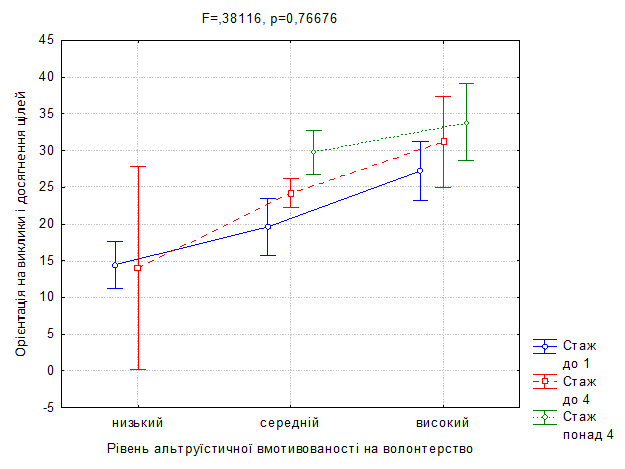
Self-control and the ability to overcome difficulties in volunteers does not depend on the combined action of the factors of tenure of activity and level of altruistic motivation for volunteering (Fig. 2.38).
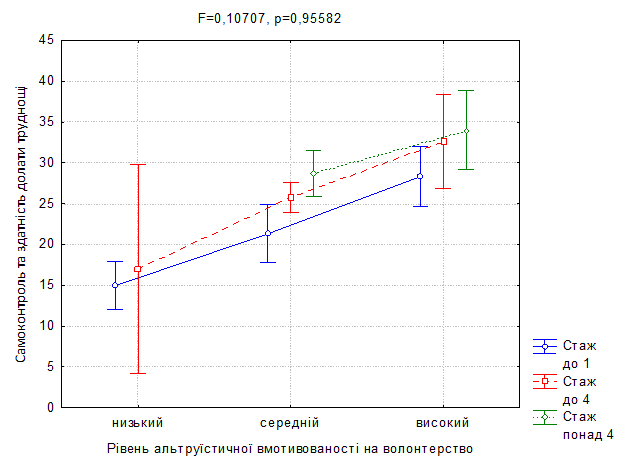
Self-determination and meaningfulness of life in volunteers does not depend on the combined action of the factors of tenure of activity and level of altruistic motivation for volunteering (Fig. 2.39).
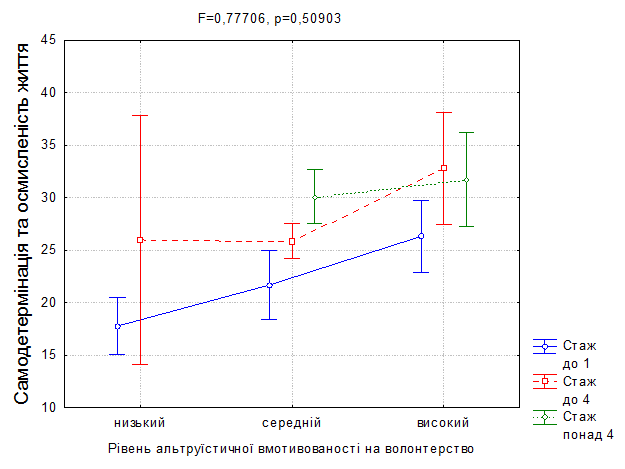
Stress resistance in volunteers does not depend on the combined action of the factors of tenure of activity and level of altruistic motivation for volunteering (Fig. 2.40).
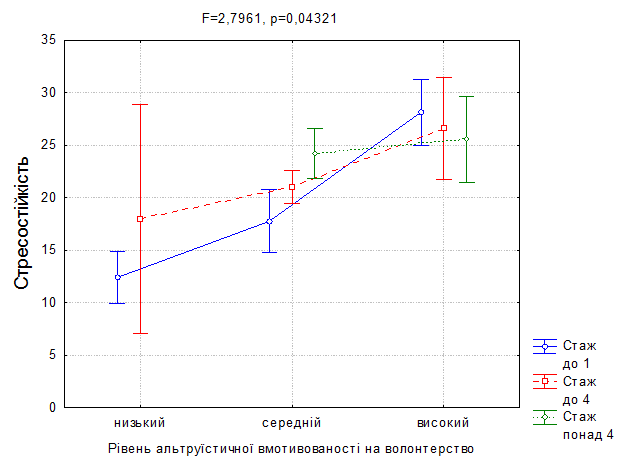
Constructive coping in volunteers does not depend on the combined action of the factors of tenure of activity and level of altruistic motivation for volunteering (Fig. 2.41).
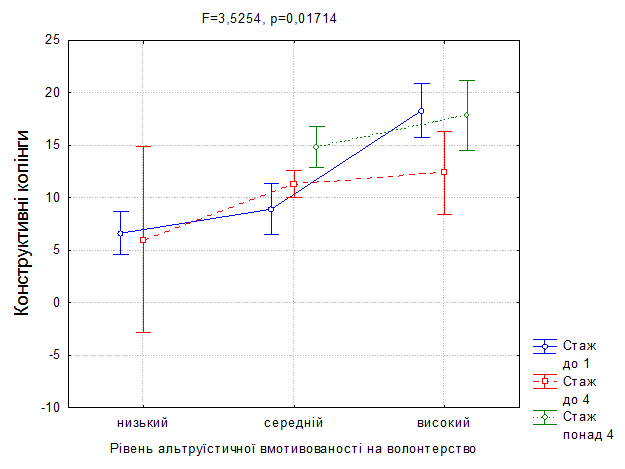
Social connectedness in volunteers does not depend on the combined action of the factors of tenure of activity and level of altruistic motivation for volunteering (Fig. 2.42).
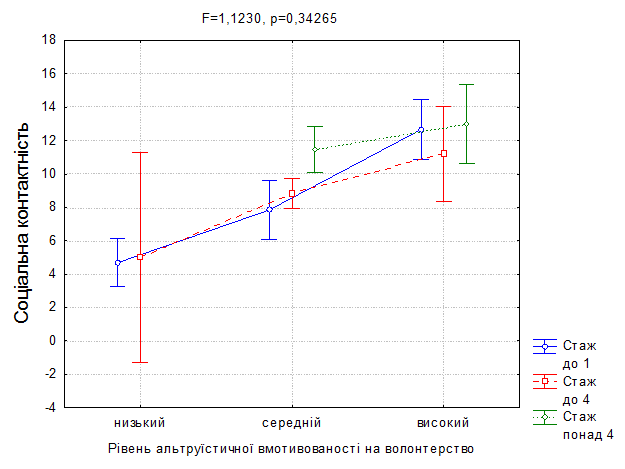
Optimal regulation in volunteers does not depend on the combined action of the factors of tenure of activity and level of altruistic motivation for volunteering (Fig. 2.43).
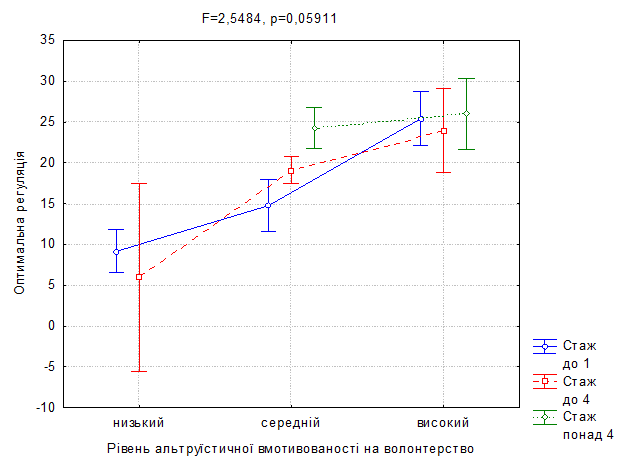
Openness to life experience in volunteers does not depend on the combined action of the factors of tenure of activity and level of altruistic motivation for volunteering (Fig. 2.44).
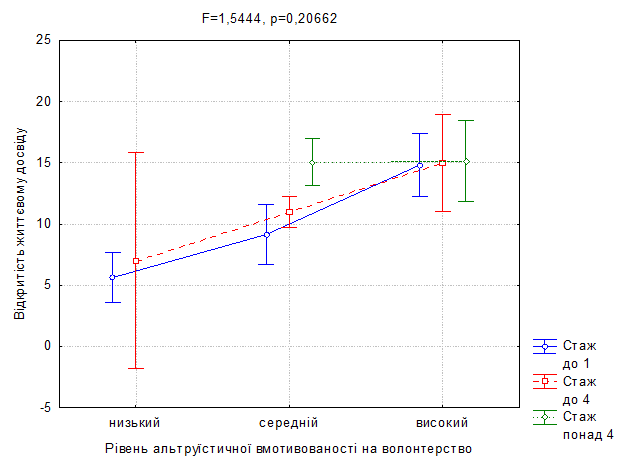
General resilience, determined according to Z. Kireieva's method, is characterised by the lowest level under the conditions of the action of two factors — low level of altruistic orientation and short tenure of activity as a volunteer (Fig. 2.45).
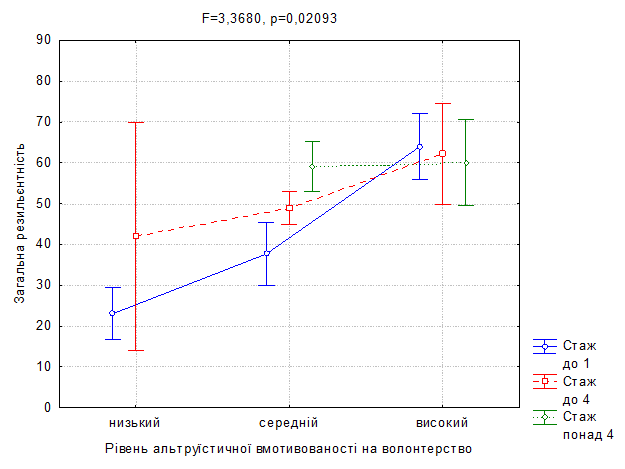
In general, the level of altruistic orientation proved to be a significant factor of resilience only for novice volunteers: in them, the higher the level of altruistic orientation, the higher the resilience. Medium and high levels of altruistic orientation in more experienced volunteers entail the highest resilience.
2.3.4. Emotional stability as a factor of resilience in volunteers
Table 2.16 shows that the indicators of resilience negatively correlate with the indicator of neuroticism (emotional instability) at the level p < 0.0001.
Table 2.16
Correlations of resilience and emotional stability in volunteers
| Indicators | Emotional instability (neuroticism) |
|---|---|
| Orientation to challenges and achievement of goals | -0.67 |
| Self-control and the ability to overcome difficulties | -0.67 |
| Self-determination and meaningfulness of life | -0.56 |
| Stress resistance | -0.64 |
| Constructive coping | -0.57 |
| Social connectedness | -0.69 |
| Optimal regulation | -0.76 |
| Openness to life experience | -0.60 |
| General resilience | -0.65 |
The strongest negative correlations were revealed for the indicators of optimal regulation and social connectedness. Thus, the higher the level of emotional instability in volunteers, the less they are capable of emotional self-regulation, the less they are able to establish social contacts in order to solve complex tasks of activity, to be open to life's challenges, stress-resistant, and ready to achieve goals and overcome obstacles and professional and life challenges.
Thus, emotional stability is a significant factor of resilience in volunteers, particularly of their optimal regulation.
A high level of emotional stability also has advantages over neuroticism in the indicators of resilience; in particular, on the indicators of self-control and the ability to overcome difficulties (U = 46, Z = 2.32, p < 0.05), stress resistance (U = 45, Z = 2.34, p < 0.05), optimal regulation (U = 4, Z = 3.76, p < 0.0001), openness to life experience (U = 49, Z = 2.20, p < 0.05), and general resilience (U = 38, Z = 2.29, p < 0.001), persons with extremely weakly expressed neuroticism exceed persons with weakly expressed neuroticism.
A higher level of emotional stability also has advantages over neuroticism in the indicators of resilience; in particular, on the indicator of optimal regulation (U = 418, Z = 3.65, p < 0.001), persons with weakly expressed neuroticism exceed persons with moderately expressed neuroticism.
A moderate level of emotional stability, in turn, also has advantages over neuroticism in the indicators of resilience; in particular, on the indicators of self-determination and meaningfulness of life (U = 193, Z = 2.48, p < 0.05), stress resistance (U = 176, Z = 2.77, p < 0.01), social connectedness (U = 152, Z = 3.19, p < 0.001), openness to life experience (U = 160, Z = 3.06, p < 0.01), and general resilience (U = 170, Z = 2.88, p < 0.01), persons with moderately expressed neuroticism exceed persons with rather expressed neuroticism. Rather expressed neuroticism likewise entails higher indicators of resilience than expressed neuroticism: on the indicators of orientation to challenges and achievement of goals (U = 39, Z = 2.13, p < 0.05), social connectedness (U = 36, Z = 2.31, p < 0.05), and optimal regulation (U = 35, Z = 2.37, p < 0.05).
Expressed neuroticism also has advantages over very strongly expressed neuroticism in the indicators of optimal regulation (U = 7.50, Z = 3.74, p < 0.001).
Table 2.17
Resilience indicators in volunteers with different levels of neuroticism
| Indicators | Participant groups | H | |||||||||||
|---|---|---|---|---|---|---|---|---|---|---|---|---|---|
| Extremely weakly expressed neuroticism, n = 6 | Weakly expressed neuroticism, n = 38 | Moderate neuroticism, n = 42 | Rather expressed neuroticism, n = 16 | Expressed neuroticism, n = 10 | Extremely expressed neuroticism, n = 15 | ||||||||
| M | σ | M | σ | M | σ | M | σ | M | σ | M | σ | ||
| Orientation to challenges and achievement of goals | 33.67 | 4.76 | 28.24 | 8.01 | 26.40 | 6.81 | 14.50 | 4.09 | 21.38 | 7.56 | 13.60 | 2.82 | 51.12 |
| Self-control and the ability to overcome difficulties | 37.67 | 0.52 | 27.79 | 7.73 | 27.43 | 4.71 | 19.60 | 8.76 | 21.38 | 6.97 | 14.00 | 2.27 | 48.79 |
| Self-determination and meaningfulness of life | 33.83 | 5.27 | 27.79 | 7.30 | 27.55 | 5.72 | 19.60 | 4.62 | 22.75 | 5.69 | 18.13 | 5.18 | 35.67 |
| Stress resistance | 29.67 | 3.14 | 24.00 | 6.67 | 23.26 | 4.80 | 14.20 | 3.22 | 17.56 | 6.44 | 12.40 | 3.27 | 56.00 |
| Constructive coping | 17.67 | 5.43 | 14.53 | 6.01 | 12.81 | 4.87 | 6.70 | 1.34 | 10.25 | 4.06 | 6.33 | 1.29 | 45.31 |
| Social connectedness | 13.17 | 1.47 | 11.13 | 3.71 | 10.62 | 2.86 | 4.40 | 1.58 | 7.19 | 2.97 | 4.20 | 0.94 | 61.42 |
| Optimal regulation | 28.83 | 0.75 | 22.71 | 6.78 | 22.17 | 3.46 | 9.20 | 1.14 | 16.50 | 7.04 | 6.73 | 0.96 | 72.55 |
| Openness to life experience | 17.50 | 3.27 | 13.68 | 4.95 | 12.60 | 5.04 | 7.10 | 4.07 | 8.38 | 3.48 | 5.73 | 1.75 | 47.80 |
| General resilience | 67.00 | 1.67 | 55.03 | 16.80 | 55.71 | 10.85 | 29.60 | 11.02 | 40.37 | 18.89 | 21.93 | 11.23 | 56.32 |
Extremely weakly expressed neuroticism has advantages in the level of optimal regulation and achievement of goals in volunteers regardless of tenure of activity, and with expressed and weakly expressed neuroticism the level of optimal regulation is directly proportional to the tenure of activity (Fig. 2.46). The lowest indicators of orientation to challenges and achievement of goals are characteristic of volunteers with shorter tenure under rather expressed and extremely expressed neuroticism.
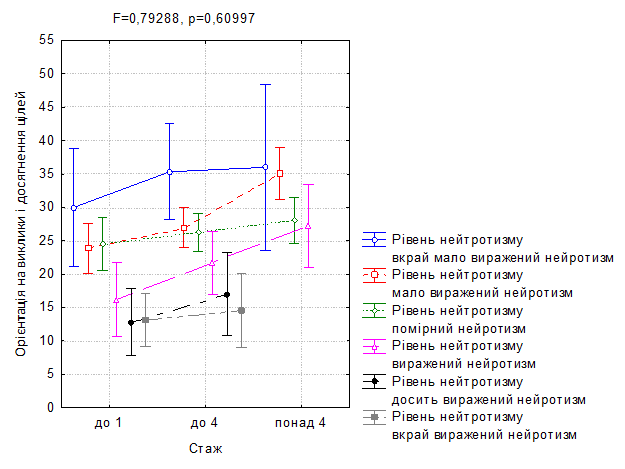
Extremely weakly expressed neuroticism has advantages in the level of self-control and the ability to overcome difficulties in volunteers regardless of tenure of activity, and with rather expressed and weakly expressed neuroticism the level of optimal regulation is directly proportional to the tenure of activity (Fig. 2.47). The lowest indicators of orientation to challenges and achievement of goals are characteristic of volunteers with shorter tenure under extremely expressed neuroticism.
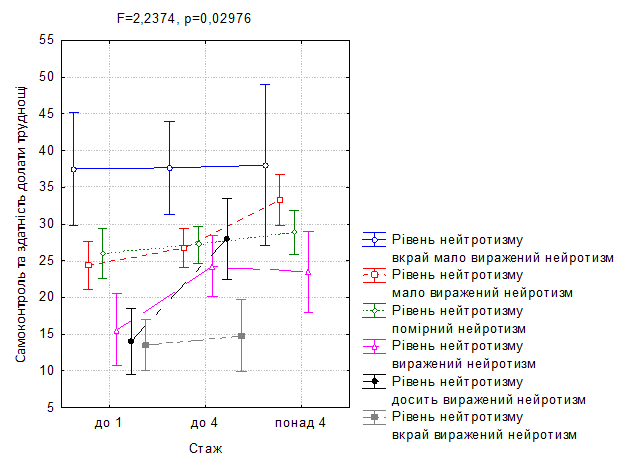
Self-determination and meaningfulness of life in volunteers with different tenure and level of neuroticism rises directly in proportion to the tenure of activity and regardless of the level of neuroticism (Fig. 2.48).
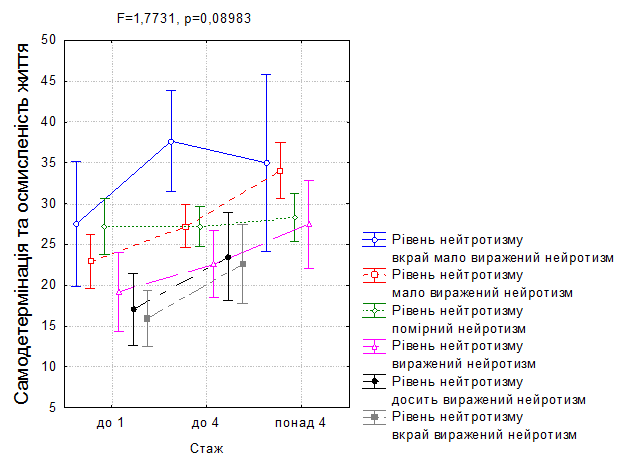
Stress resistance in volunteers with different levels of neuroticism almost does not depend on the tenure of activity (Fig. 2.49).
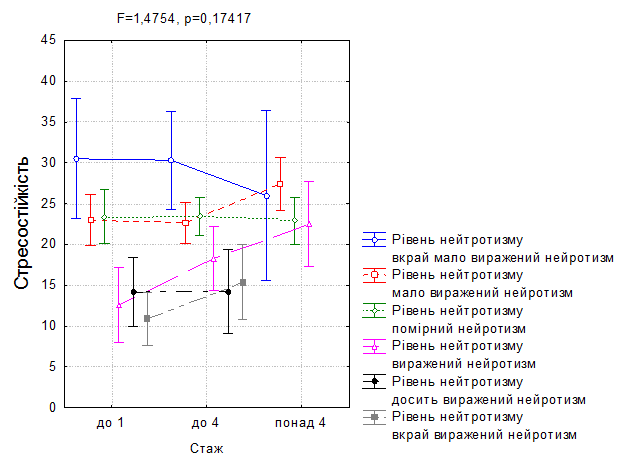
Constructive coping in volunteers with short tenure and an extremely weakly expressed level of neuroticism is the highest in the sample (Fig. 2.50).
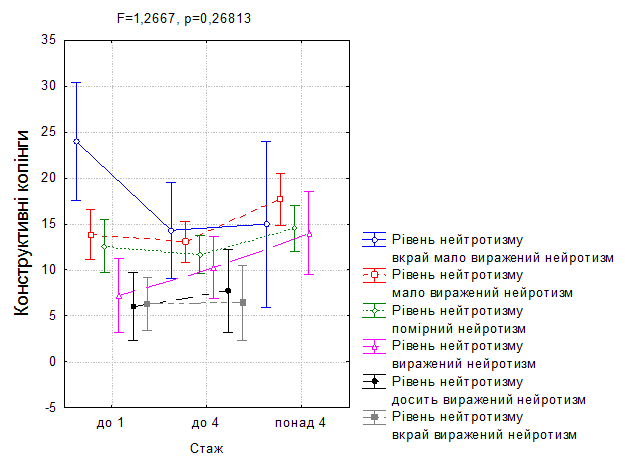
Social connectedness in volunteers with different levels of neuroticism almost does not depend on the experience of activity (tenure), and in persons with extremely weakly expressed neuroticism and weakly expressed neuroticism it is the highest in the sample (Fig. 2.51).
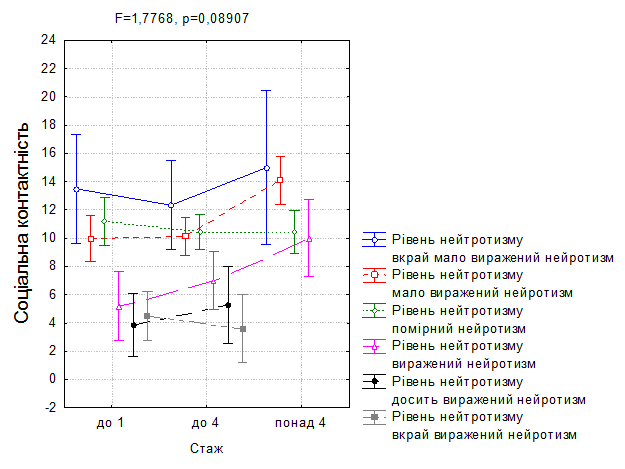
Tenure of activity positively affects the level of optimal regulation only of volunteers with expressed neuroticism (Fig. 2.52).
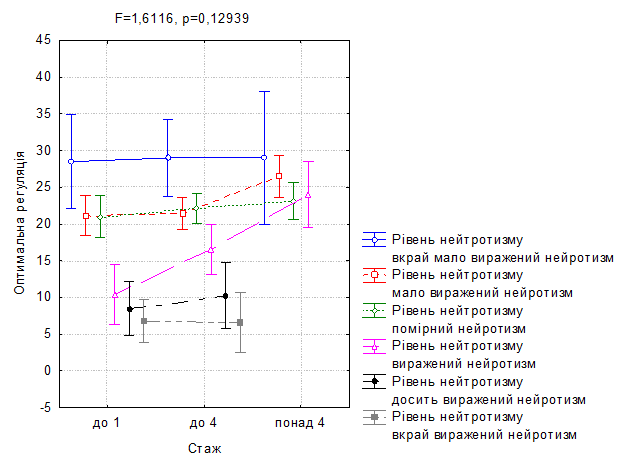
Openness to life experience in volunteers with different tenure and level of neuroticism almost does not differ (Fig. 2.53).
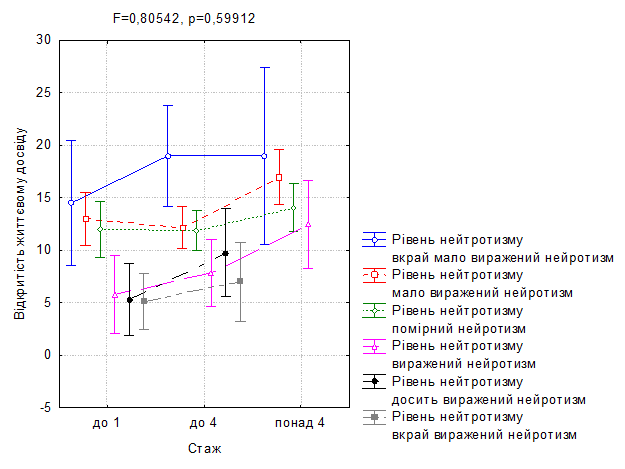
Tenure of activity positively affects the level of general resilience only of volunteers with expressed neuroticism (Fig. 2.54), while extremely expressed neuroticism with the shortest tenure of activity entails the lowest indicators of general resilience.
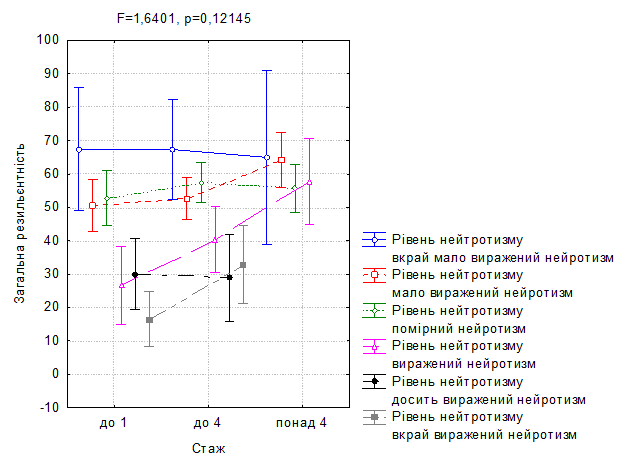
Thus, the level of neuroticism is a significant factor of resilience in volunteers regardless of their tenure, and for novice volunteers emotional stability is the most substantial factor of mastery of constructive coping as an indicator of resilience.
2.3.5. Coping strategies as a factor of resilience in volunteers
The next task of the empirical study was to determine the relationship between resilience and the coping strategies of volunteers (Table 2.18).
Confrontation as a coping strategy involving opposition, which characterises volunteers who attempt to solve a problem not through purposeful behavioural activity aimed at changing the situation, but through the discharge of negative emotions in connection with the difficulties that have arisen, is negatively related with orientation to challenges and achievement of goals, self-control and the ability to overcome difficulties, self-determination and meaningfulness of life, stress resistance, constructive coping, social connectedness, optimal regulation, openness to life experience, and general resilience.
Thus, the more developed the resilience in volunteers, the less inclined they are toward this strategy of coping with stress, which presupposes impulsiveness in behaviour, hostility, conflict, difficulties in planning actions and predicting their outcome. High resilience may obstruct unjustified persistence. The controlling actions of highly resilient volunteers actualise the goal-directedness of activity and block the aggressive release of emotional stress.
Table 2.18
Correlations of resilience and coping strategies in volunteers
| Indicators | Confrontation | Distancing | Self-control | Seeking social support | Accepting responsibility | Avoidance | Problem-solving planning | Positive reappraisal |
|---|---|---|---|---|---|---|---|---|
| Orientation to challenges and achievement of goals | -0.36**** | 0.02 | 0.33*** | 0.84**** | 0.39**** | -0.03 | 0.53**** | 0.36**** |
| Self-control and the ability to overcome difficulties | -0.34**** | 0.00 | 0.29** | 0.75**** | 0.40**** | -0.08 | 0.53**** | 0.34**** |
| Self-determination and meaningfulness of life | -0.38**** | 0.03 | 0.33*** | 0.81**** | 0.47**** | -0.15 | 0.50**** | 0.34**** |
| Stress resistance | -0.46**** | 0.06 | 0.37**** | 0.80**** | 0.21* | 0.05 | 0.56**** | 0.37**** |
| Constructive coping | -0.38**** | 0.07 | 0.24** | 0.72**** | 0.16 | 0.06 | 0.51**** | 0.30*** |
| Social connectedness | -0.46**** | 0.03 | 0.26** | 0.84**** | 0.26** | -0.03 | 0.50**** | 0.27** |
| Optimal regulation | -0.41**** | 0.03 | 0.32*** | 0.84**** | 0.25** | 0.04 | 0.50**** | 0.31*** |
| Openness to life experience | -0.35**** | 0.01 | 0.28** | 0.81**** | 0.25** | -0.03 | 0.48**** | 0.25** |
| General resilience | -0.44**** | 0.08 | 0.39**** | 0.80**** | 0.24** | 0.05 | 0.54**** | 0.37**** |
Self-control as a coping strategy, which presupposes attempts to overcome the negative experience associated with a problem through the purposeful suppression and restraint of emotions, minimising their influence on the assessment of the situation, is weakly related with resilience in volunteers. Highly resilient volunteers are inclined toward the choice of behavioural strategy that presupposes high control over one's own behaviour.
Seeking social support as a coping strategy proved to be the most strongly related with resilience in volunteers. It presupposes attempts to solve a problem through the involvement of external (social) resources, through the search for necessary information and emotional support. The greater the resilience in volunteers, particularly social connectedness, orientation to challenges, and openness to life experience, the more they are inclined toward interaction with other people, expecting attention, advice and empathy.
Accepting responsibility as a coping strategy is moderately positively related with resilience. Thus, high resilience, particularly self-control and the ability to overcome difficulties, presupposes recognition of one's role in the emergence of the problem and of responsibility for its solution, in some cases with a clear element of self-criticism. Higher resilience presupposes the person's desire to understand the relationship between their own actions and their consequences, their readiness to analyse their own behaviour and to seek the causes of corresponding difficulties in personal shortcomings and mistakes.
Problem-solving planning is characterised by moderate correlations with resilience, particularly stress resistance. Thus, higher resilience presupposes attempts to overcome the problem through purposeful analysis of the situation and possible variants of behaviour, the development of a problem-solving strategy, and the planning of one's own actions taking into account objective conditions, past experience, and available resources.
Positive reappraisal is characterised by weak relationships with resilience. The striving to overcome the negative experience associated with a problem through its positive reinterpretation, regarding it as a stimulus for personal growth, is characteristic of volunteers with sufficiently high resilience. Higher resilience as a whole presupposes a greater inclination toward a philosophical understanding of the problem situation and its inclusion within the broader context of the personality's self-development.
The diversity and multi-directional nature of coping strategies according to R. Lazarus's model conditions the necessity of determining their types in volunteers for the purpose of further analysis of the role of these types in the development of resilience. Figure 2.55 shows the cluster profiles of coping strategies in volunteers.
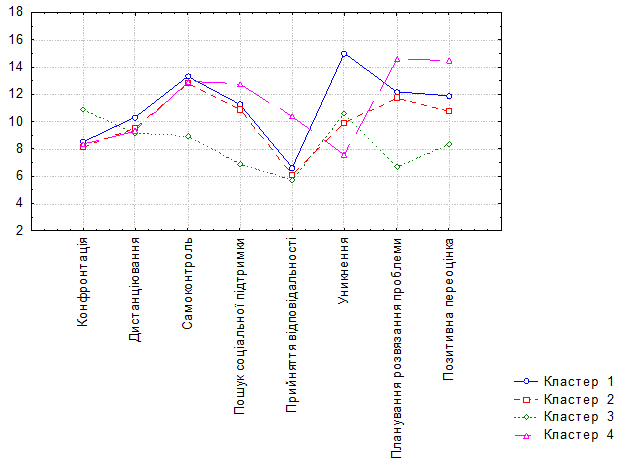
Cluster 1 — "Dominance of avoidance coping" — the cluster was named this way because the leading coping strategy here is avoidance, while all other coping strategies are expressed at a medium level (self-control, seeking social support, distancing, problem-solving planning and positive reappraisal), or at a low level (accepting responsibility, confrontation).
Cluster 2 — "Distancing of responsibility for problem-solving" — is characterised by a moderate level of development of all coping strategies, except accepting responsibility. The highest level in this profile is reached by the indicators of problem-solving planning and positive reappraisal.
Cluster 3 — "Dominance of confrontation coping" — moderate indicators of confrontation and avoidance combined with low indicators on the other coping strategies.
Cluster 4 — "Dominance of constructive coping" — high indicators of problem-solving planning and positive reappraisal, seeking social support against the background of low values on the coping strategies of avoidance, confrontation, distancing. Moreover, only in this profile does the coping strategy of accepting responsibility have medium values.
The resilience indicators in volunteers with different types of coping strategies are shown in Table 2.19.
Table 2.19
Resilience indicators in volunteers with different types of coping strategies
| Indicators | Participant groups | H | |||||||
|---|---|---|---|---|---|---|---|---|---|
| "Dominance of avoidance coping" | "Distancing of responsibility for problem-solving" | "Dominance of confrontation coping" | "Dominance of constructive coping" | ||||||
| M | σ | M | σ | M | σ | M | σ | ||
| Orientation to challenges and achievement of goals | 23.20 | 7.64 | 25.20 | 8.56 | 18.20 | 9.53 | 28.94 | 8.43 | 12.67** |
| Self-control and the ability to overcome difficulties | 23.70 | 7.47 | 26.14 | 7.95 | 21.53 | 8.72 | 28.28 | 8.94 | 6.15 |
| Self-determination and meaningfulness of life | 23.68 | 6.54 | 27.18 | 6.99 | 22.27 | 8.01 | 28.50 | 7.03 | 11.58** |
| Stress resistance | 20.80 | 8.23 | 21.62 | 5.82 | 16.47 | 6.14 | 24.06 | 6.35 | 10.59* |
| Constructive coping | 11.95 | 6.08 | 12.14 | 5.29 | 8.80 | 3.88 | 14.28 | 5.91 | 9.19* |
| Social connectedness | 8.91 | 3.86 | 9.44 | 3.93 | 7.67 | 4.20 | 10.61 | 4.13 | 4.30 |
| Optimal regulation | 18.86 | 7.62 | 19.88 | 7.43 | 13.93 | 8.71 | 21.72 | 7.61 | 9.35* |
| Openness to life experience | 11.14 | 5.17 | 11.72 | 5.36 | 8.87 | 5.85 | 13.11 | 5.29 | 6.46 |
| General resilience | 47.02 | 19.93 | 50.52 | 16.38 | 34.07 | 20.29 | 55.44 | 15.89 | 10.37** |
Volunteers of the "Dominance of avoidance coping" type lag behind volunteers of the "Distancing of responsibility for problem-solving" type only on the indicator of self-determination and meaningfulness of life (U = 800, Z = 2.26, p < 0.05). On the same indicator they lag behind volunteers of the "Dominance of constructive coping" type (U = 249, Z = 2.27, p < 0.05), and also on the indicator of orientation to challenges and achievement of goals (U = 219, Z = 2.74, p < 0.01).
Volunteers of the "Distancing of responsibility for problem-solving" type exceed volunteers of the "Dominance of confrontation coping" type on the indicators of orientation to challenges and achievement of goals (U = 220, Z = 2.40, p < 0.05), self-determination and meaningfulness of life (U = 219, Z = 2.42, p < 0.05), stress resistance (U = 201, Z = 2.70, p < 0.01), constructive coping (U = 235, Z = 2.17, p < 0.01), optimal regulation (U = 226, Z = 2.31, p < 0.05), openness to life experience (U = 228, Z = 2.28, p < 0.05), and general resilience (U = 205, Z = 2.64, p < 0.01).
Volunteers of the "Dominance of confrontation coping" type lag behind volunteers of the "Dominance of constructive coping" type on the indicators of orientation to challenges and achievement of goals (U = 53, Z = 2.94, p < 0.01), self-determination and meaningfulness of life (U = 71, Z = 2.29, p < 0.05), stress resistance (U = 53, Z = 2.96, p < 0.01), constructive coping (U = 58, Z = 2.78, p < 0.01), optimal regulation (U = 64, Z = 2.54, p < 0.01), openness to life experience (U = 74, Z = 2.18, p < 0.05), and general resilience (U = 52, Z = 3.00, p < 0.01).
Orientation to challenges and achievement of goals in volunteers of the "Dominance of confrontation coping" type with the longest tenure of activity is higher than in other volunteers (Fig. 2.56).
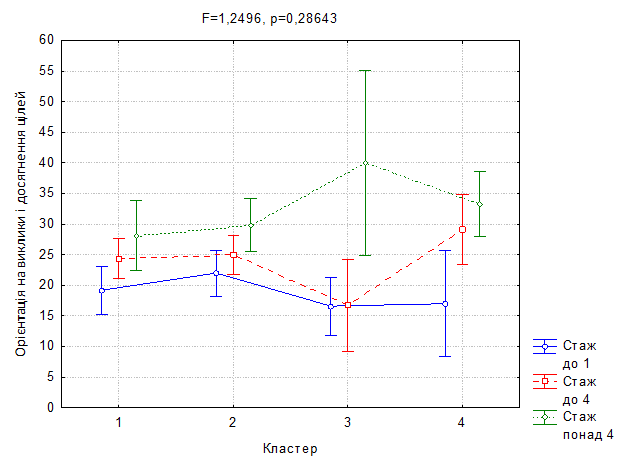
Within sufficient tenure of activity, in volunteers of the "Dominance of constructive coping" type the indicators of orientation to challenges and achievement of goals are higher.
Self-control and the ability to overcome difficulties in volunteers of the "Dominance of confrontation coping" type with the longest tenure of activity is higher than in other volunteers (Fig. 2.57). Within sufficient tenure of activity, in volunteers of the "Dominance of constructive coping" type the indicators of self-control and the ability to overcome difficulties are higher.
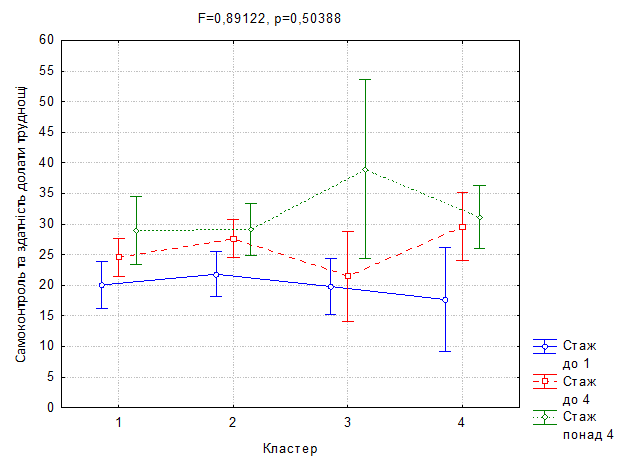
Self-determination and meaningfulness of life in volunteers of the "Dominance of confrontation coping" type with the longest tenure of activity is higher than in other volunteers (Fig. 2.58). Within sufficient tenure of activity, in volunteers of the "Dominance of constructive coping" type the indicators of self-determination and meaningfulness of life are higher.
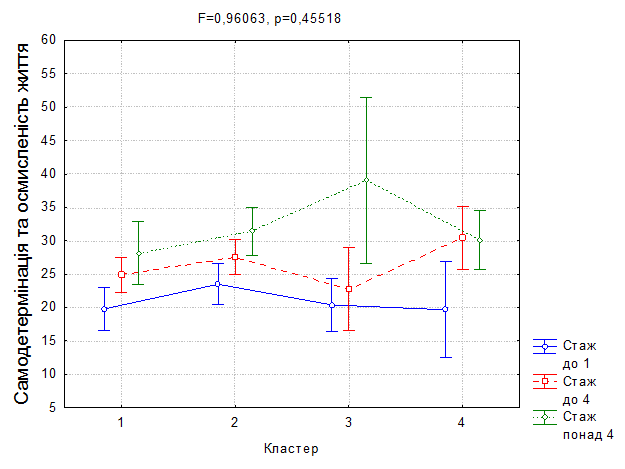
Stress resistance in volunteers with different tenure and type of coping strategies almost does not differ (Fig. 2.59).
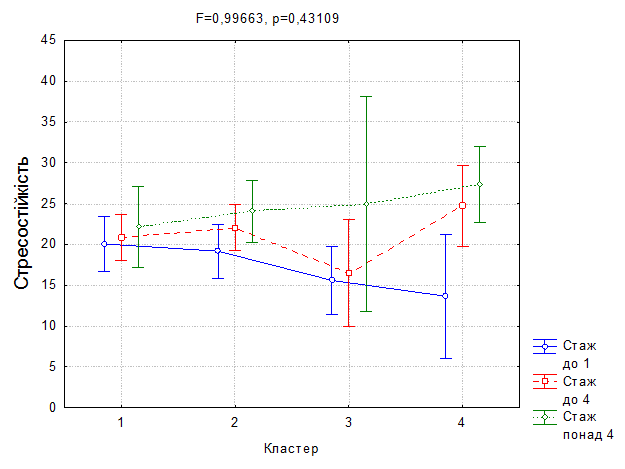
Constructive coping as an indicator of resilience in volunteers with different tenure and type of coping strategies has its own specifics: it is higher in cases of "Dominance of constructive coping" in volunteers with the longest tenure of activity (Fig. 2.60).
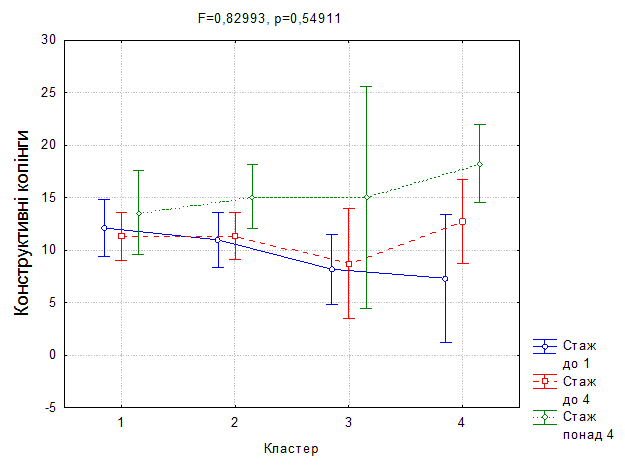
Social connectedness in volunteers with different tenure and type of coping strategies almost does not differ (Fig. 2.61).
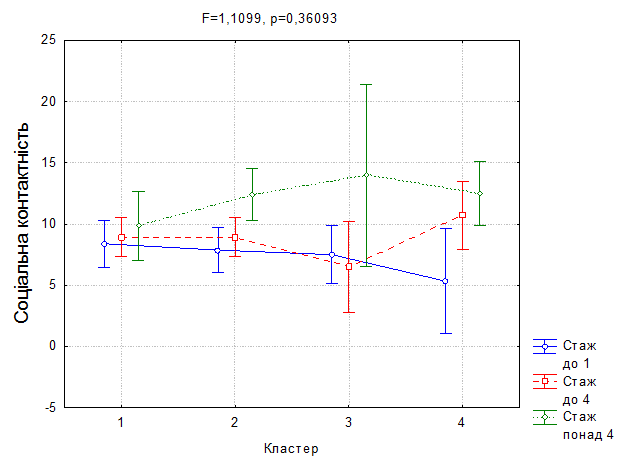
Optimal regulation in volunteers with different tenure and type of coping strategies almost does not differ (Fig. 2.62).
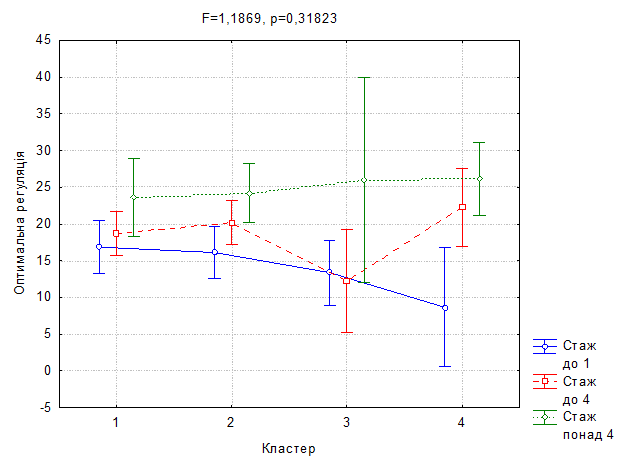
Openness to life experience in volunteers with different tenure and type of coping strategies almost does not differ (Fig. 2.63).
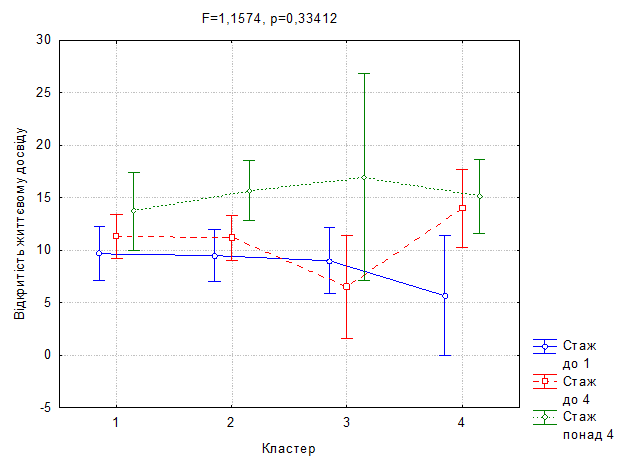
General resilience in volunteers with different tenure and type of coping strategies almost does not differ (Fig. 2.64).
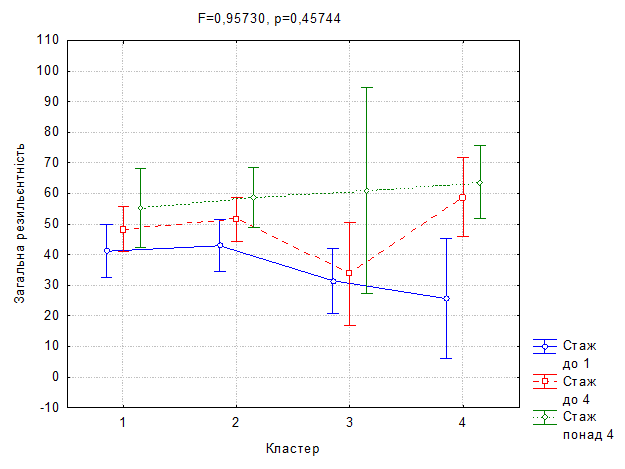
Thus, in volunteers with extensive tenure of activity, in the case of "Dominance of constructive coping", which is characterised by high indicators of problem-solving planning and positive reappraisal, seeking social support against the background of low values on the coping strategies of avoidance, confrontation, and distancing, the indicators of resilience are higher. Such results provide grounds for asserting that the combination of preference for the coping strategies of problem-solving planning and positive reappraisal, seeking social support against the background of refusal of avoidance, confrontation, and distancing coping strategies is an important stylistic factor of the development of resilience in volunteers with extensive tenure of activity.
2.3.6. Anxiety as a factor of resilience in volunteers
Table 2.20 shows the correlations between resilience and anxiety in volunteers.
Table 2.20
Correlations of resilience and anxiety in volunteers
| Indicators | State anxiety | Trait anxiety |
|---|---|---|
| Orientation to challenges and achievement of goals | -0.36**** | -0.47**** |
| Self-control and the ability to overcome difficulties | -0.37**** | -0.43**** |
| Self-determination and meaningfulness of life | -0.33*** | -0.41**** |
| Stress resistance | -0.29*** | -0.39**** |
| Constructive coping | -0.23* | -0.32 |
| Social connectedness | -0.30*** | -0.41**** |
| Optimal regulation | -0.38**** | -0.50**** |
| Openness to life experience | -0.37**** | -0.43**** |
| General resilience | -0.30*** | -0.41**** |
State anxiety is characterised by weak negative correlations with resilience in volunteers. The strongest of the number of negative correlations was revealed with optimal regulation. Thus, the more difficult it is for volunteers to regulate their state, the greater the anxiety they experience in situations of danger and uncertainty. In addition, greater situational anxiety corresponds to reduced indicators of self-control and the ability to overcome difficulties, openness to life experience, orientation to challenges and achievement of goals, self-determination and meaningfulness of life, general resilience, social connectedness, stress resistance, and constructive coping.
Trait anxiety is characterised by stronger negative relationships with resilience, especially on the indicators of optimal regulation and orientation to challenges and achievement of goals. In addition, the higher the trait anxiety in volunteers, the less developed in them are such qualities of resilience as self-control and the ability to overcome difficulties, openness to life experience, self-determination and meaningfulness of life, social connectedness, general resilience, stress resistance, and constructive coping.
Thus, resilience, especially the capacities for self-regulation of psychic states, may obstruct the actualisation of anxiety; at the same time, high trait anxiety may serve as a negative factor of the formation of resilience in volunteers.
To study typical levels of anxiety in volunteers, a procedure of cluster analysis was carried out, the results of which yielded three cluster profiles (Fig. 2.65). The first cluster was formed by moderate indicators of trait and state anxiety and was named "Moderate anxiety", the second — by high indicators of trait and state anxiety and was accordingly named "High anxiety", and the third cluster is represented by low indicators of trait and state anxiety and was therefore named "Low anxiety".
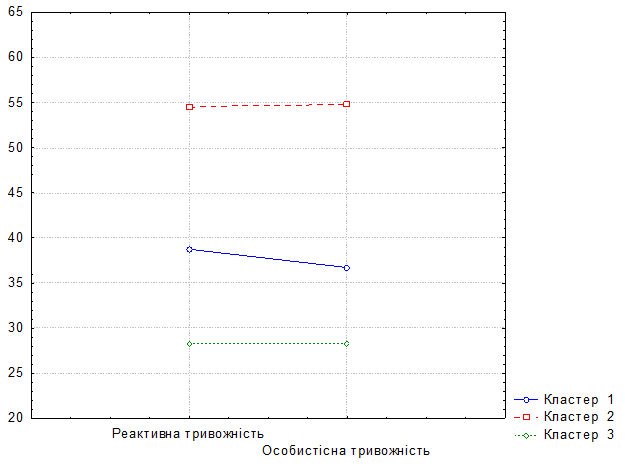
Table 2.21 shows the specifics of resilience depending on the level of volunteers' anxiety.
Table 2.21
Resilience indicators in volunteers with different levels of anxiety
| Indicators | Participant groups | H | |||||
|---|---|---|---|---|---|---|---|
| Low | Medium | High | |||||
| M | σ | M | σ | M | σ | ||
| Orientation to challenges and achievement of goals | 23.88 | 10.77 | 26.86 | 6.11 | 11.81 | 2.56 | 34.57 |
| Self-control and the ability to overcome difficulties | 24.53 | 10.79 | 27.62 | 5.05 | 13.44 | 3.05 | 36.31 |
| Self-determination and meaningfulness of life | 25.84 | 9.43 | 27.18 | 5.22 | 17.13 | 4.87 | 20.91 |
| Stress resistance | 20.69 | 7.69 | 23.13 | 5.65 | 11.69 | 3.70 | 31.85 |
| Constructive coping | 11.47 | 6.21 | 13.38 | 5.18 | 6.13 | 1.02 | 29.12 |
| Social connectedness | 8.78 | 4.89 | 10.42 | 3.04 | 4.13 | 0.96 | 33.97 |
| Optimal regulation | 18.09 | 9.74 | 22.09 | 4.36 | 6.25 | 0.45 | 42.04 |
| Openness to life experience | 12.03 | 6.30 | 12.34 | 4.72 | 5.31 | 1.40 | 28.95 |
| General resilience | 46.38 | 20.25 | 54.24 | 13.95 | 20.94 | 10.83 | 32.03 |
Volunteers with low and medium levels of anxiety do not have statistically significant differences in the indicators of resilience, while at a high level of anxiety significantly lower are the indicators of orientation to challenges and achievement of goals (U = 77, Z = 3.90, p < 0.0001), self-control and the ability to overcome difficulties (U = 102, Z = 3.36, p < 0.001), self-determination and meaningfulness of life (U = 126, Z = 2.84, p < 0.01), stress resistance (U = 84, Z = 3.75, p < 0.0001), constructive coping (U = 129, Z = 2.76, p < 0.01), social connectedness (U = 129, Z = 2.77, p < 0.01), optimal regulation (U = 0, Z = 5.59, p < 0.0001), openness to life experience (U = 102, Z = 3.35, p < 0.0001), and general resilience (U = 77, Z = 3.91, p < 0.0001) in comparison with volunteers with a low level of anxiety.
In comparison with volunteers with a medium level of anxiety, highly anxious volunteers lag in the indicators of orientation to challenges and achievement of goals (U = 28, Z = 6.00, p < 0.0001), self-control and the ability to overcome difficulties (U = 0, Z = 6.28, p < 0.0001), self-determination and meaningfulness of life (U = 150, Z = 4.79, p < 0.0001), stress resistance (U = 53, Z = 5.75, p < 0.0001), constructive coping (U = 68, Z = 5.60, p < 0.0001), social connectedness (U = 17, Z = 6.11, p < 0.0001), optimal regulation (U = 0, Z = 6.28, p < 0.0001), openness to life experience (U = 57, Z = 5.71, p < 0.0001), and general resilience (U = 52, Z = 5.76, p < 0.0001).
Thus, a moderate level of anxiety in volunteers is optimal from the standpoint of a higher level of development of resilience.
A low level of anxiety with sufficiently high experience of activity in volunteers, as well as a moderate level of anxiety regardless of experience, entail higher indicators of orientation to challenges and achievement of goals, whereas a high level of anxiety in volunteers is associated with the lowest indicators of orientation to challenges and achievement of goals (Fig. 2.66). The shortest tenure of activity at a moderate level of anxiety in volunteers entails low indicators of orientation to challenges and achievement of goals.
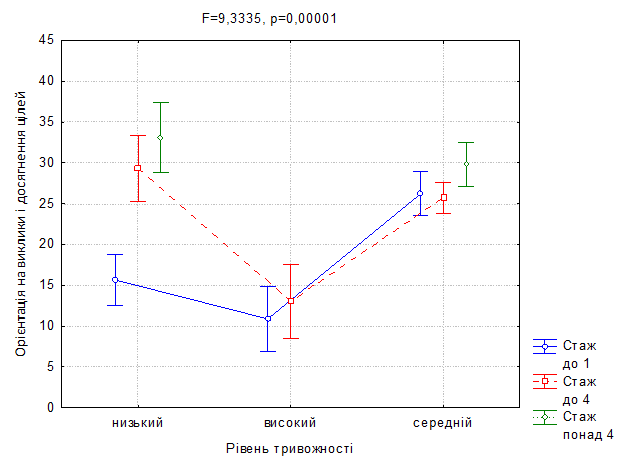
A low level of anxiety with sufficiently high experience of activity in volunteers, as well as a moderate level of anxiety regardless of experience, entail higher indicators of self-control and the ability to overcome difficulties, whereas a high level of anxiety in volunteers is associated with the lowest indicators of self-control and the ability to overcome difficulties (Fig. 2.67). The shortest tenure of activity at a low level of anxiety in volunteers entails low indicators of self-control and the ability to overcome difficulties.
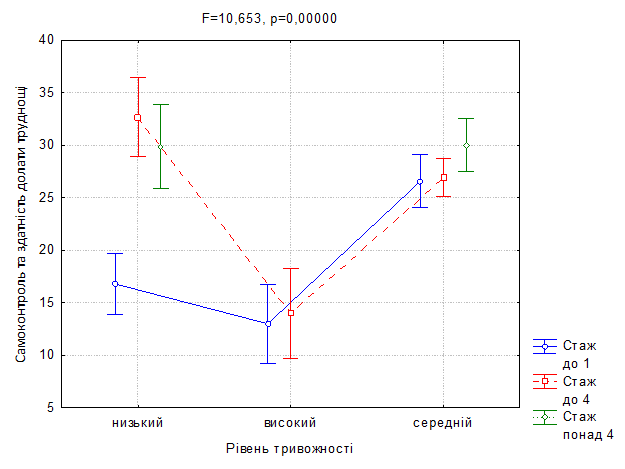
A low level of anxiety with sufficiently high experience of activity in volunteers, as well as a moderate level of anxiety regardless of experience, entail higher indicators of self-determination and meaningfulness of life, whereas a high level of anxiety in volunteers is associated with the lowest indicators of self-determination and meaningfulness of life in volunteers with different tenure and level of anxiety (Fig. 2.68). The shortest tenure of activity at a low level of anxiety in volunteers entails low indicators of self-determination and meaningfulness of life.
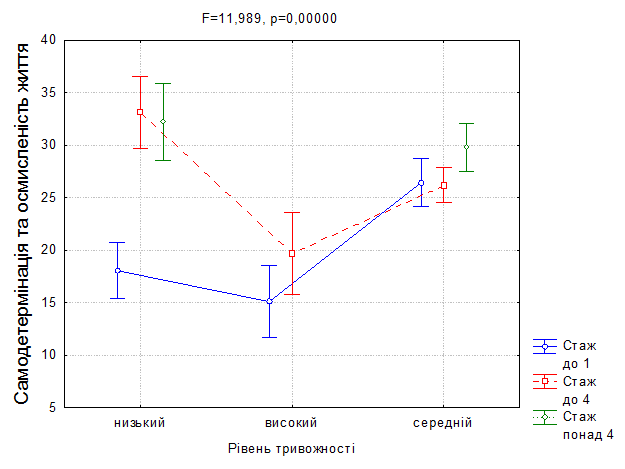
A low level of anxiety with sufficiently high experience of activity in volunteers, as well as a moderate level of anxiety regardless of experience, entail higher indicators of stress resistance, whereas a high level of anxiety in volunteers is associated with the lowest indicators of stress resistance in volunteers with different tenure and level of anxiety (Fig. 2.69). The shortest tenure of activity at a low level of anxiety in volunteers entails low indicators of stress resistance.
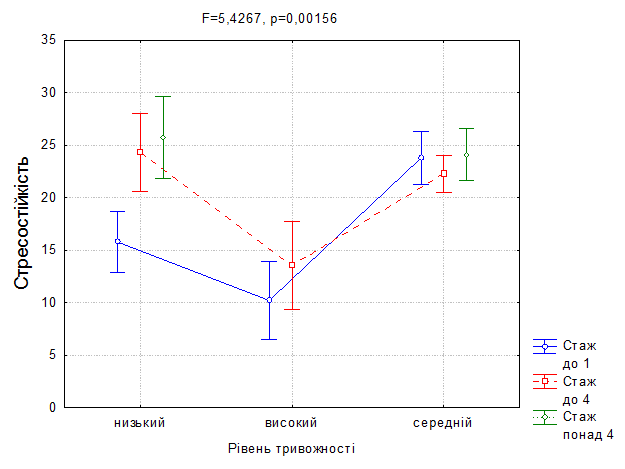
A low level of anxiety with high experience of activity in volunteers, as well as a moderate level of anxiety regardless of experience, entail higher indicators of constructive coping, whereas a high level of anxiety in volunteers is associated with the lowest indicators of constructive coping in volunteers with different tenure and level of anxiety (Fig. 2.70). The shortest tenure of activity at low and high levels of anxiety in volunteers entails low indicators of constructive coping.
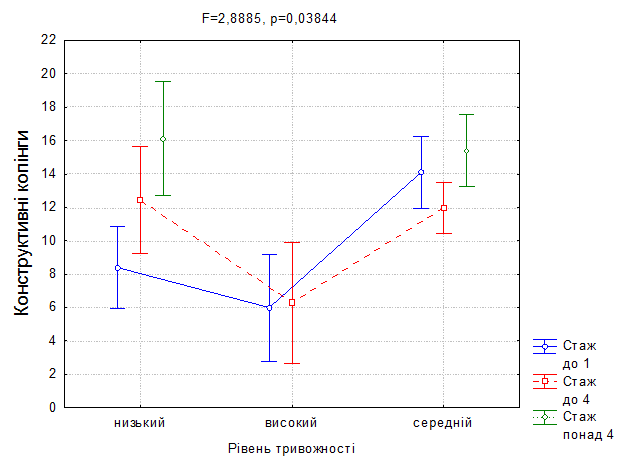
A low level of anxiety with high experience of activity in volunteers, as well as a medium level of anxiety regardless of experience, entail higher indicators of social connectedness, whereas a high level of anxiety in volunteers is associated with the lowest indicators of social connectedness in volunteers with different tenure and level of anxiety (Fig. 2.71). The shortest tenure of activity at low and high levels of anxiety in volunteers entails low indicators of social connectedness.
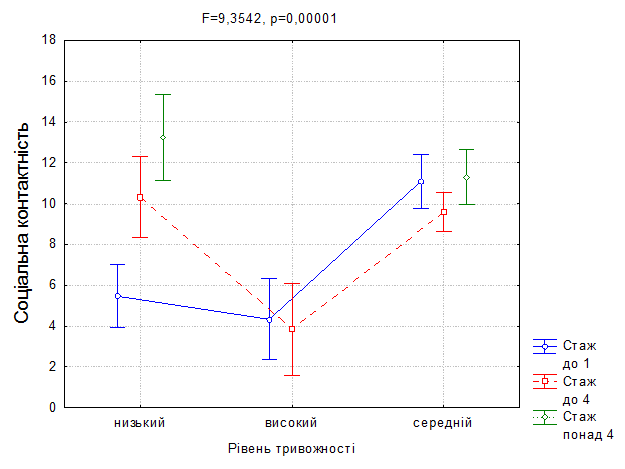
A low level of anxiety with high experience of activity in volunteers, as well as a medium level of anxiety regardless of experience, entail higher indicators of optimal regulation, whereas a high level of anxiety in volunteers is associated with the lowest indicators of optimal regulation in volunteers with different tenure and level of anxiety (Fig. 2.72). The shortest tenure of activity at low and high levels of anxiety in volunteers entails low indicators of optimal regulation.
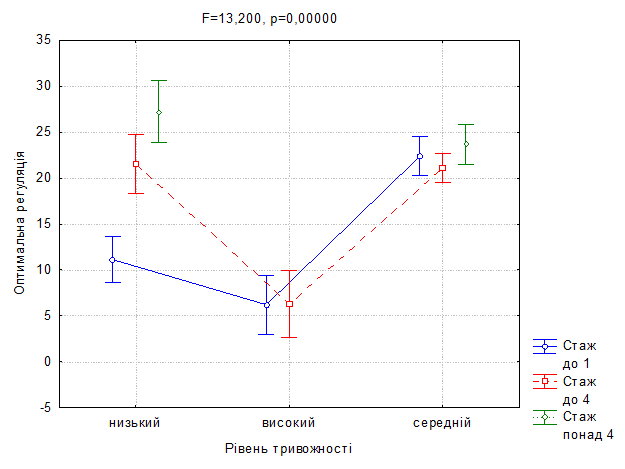
A low level of anxiety with high experience of activity in volunteers, as well as a medium level of anxiety regardless of experience, entail higher indicators of openness to life experience, whereas a high level of anxiety in volunteers is associated with the lowest indicators of openness to life experience in volunteers with different tenure and level of anxiety (Fig. 2.73). The shortest tenure of activity at low and high levels of anxiety in volunteers entails low indicators of openness to life experience.
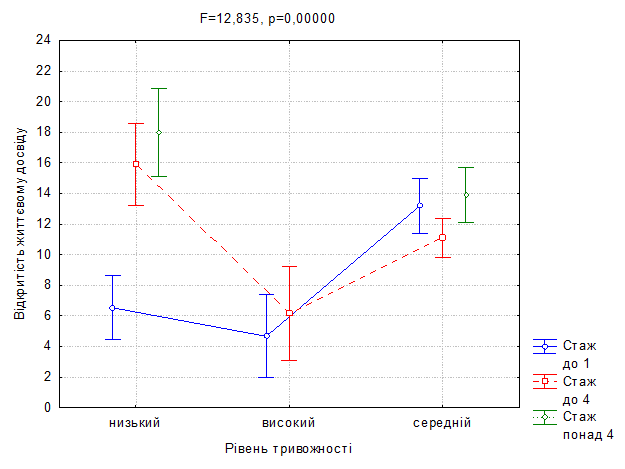
A low level of anxiety with high experience of activity in volunteers, as well as a medium level of anxiety regardless of experience, entail higher indicators of general resilience, whereas a high level of anxiety in volunteers is associated with the lowest indicators of general resilience in volunteers with different tenure and level of anxiety (Fig. 2.74). The shortest tenure of activity at low and high levels of anxiety in volunteers entails low indicators of general resilience.
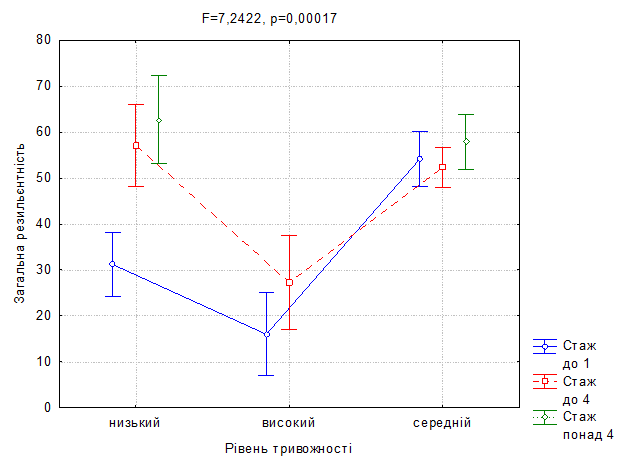
Thus, high anxiety is a factor of reduction of resilience in volunteers regardless of tenure of activity; in contrast, a medium level of anxiety conditions the growth of resilience in volunteers regardless of tenure of activity, while its low level — only in experienced volunteers.
2.4. Psychological predictors of resilience in volunteers
The next task of the empirical study was to identify the psychological predictors of the content (component) and procedural (integral) indicators of resilience. For this purpose, a series of regression models was constructed, described below.
Table 2.22 shows the predictors for the indicator of orientation to challenges and achievement of goals in volunteers. The obtained regression model explains 82.5% of the variance. On the basis of the equation we constructed a regression equation that has the form:
Orientation to challenges and achievement of goals = 0.30 Seeking social support coping + 0.34 Self-transcendence + 0.48 Self-distancing − 0.14 Neuroticism.
Table 2.22
Regression model of the indicator of orientation to challenges and achievement of goals in volunteers
| Indicators | BETA | Std. Err. | B | Std. Err. | t | p |
|---|---|---|---|---|---|---|
| Constant | -1.09 | 4.88 | -0.22 | 0.822 | ||
| Seeking social support | 0.29 | 0.105 | 0.99 | 0.35 | 2.84 | 0.005 |
| Neuroticism | -0.14 | 0.06 | -0.23 | 0.09 | -2.38 | 0.019 |
| Self-distancing | 0.49 | 0.216 | 0.42 | 0.18 | 2.30 | 0.023 |
| Self-transcendence | 0.35 | 0.15 | 0.23 | 0.09 | 2.31 | 0.022 |
Thus, the most significant predictor for the development of orientation to challenges and achievement of goals in volunteers is the coping strategy of social support, the positive action of which is complemented by the indicators of emotional stability (reduced neuroticism), as well as such indicators of existentiality as self-distancing and self-transcendence.
Thus, the mastery of a stress-coping strategy that manifests in the ability to seek help from others in crisis and stressful situations, the maintenance of emotional stability, and the development of the ability to respond emotionally to the values and meanings of life, the ability to organise a free harmonious inner space, may contribute to the development of greater orientation of volunteers toward accepting the challenges of life and activity and to setting and realising their goals.
Table 2.23 shows the predictors for self-control and the ability to overcome difficulties in volunteers. The obtained regression model explains 83.6% of the variance.
Table 2.23
Regression model of the indicator of self-control and the ability to overcome difficulties in volunteers
| Indicators | BETA | Std. Err. | B | Std. Err. | t | p |
|---|---|---|---|---|---|---|
| Constant | 11.71 | 5.14 | 2.28 | 0.024 | ||
| Neuroticism | -0.31 | 0.07 | -0.46 | 0.09 | -4.71 | 0.000008 |
| Creativity | 0.38 | 0.19 | 1.32 | 0.66 | 1.99 | 0.049 |
| Autonomy | 0.488 | 0.21 | 1.65 | 0.72 | 2.30 | 0.023 |
| Freedom | 0.3 | 0.15 | 0.28 | 0.14 | 2.07 | 0.041 |
On the basis of the equation we constructed a regression equation that has the form:
Self-control and the ability to overcome difficulties = 11.71 + 0.38 Creativity + 0.48 Autonomy + 0.30 Freedom − 0.31 Neuroticism.
Thus, the most significant predictor of self-control and the ability to overcome difficulties is emotional stability, the positive action of which is supported by the factors of creativity and autonomy as indicators of personal maturity, and freedom as an indicator of existentiality. The maintenance of emotional stability, supported by the qualities of creativity and independence in life and activity, and the development of freedom of meaning-making in life, may positively affect the ability to control oneself under stress and overcome difficulties and obstacles in activity.
Table 2.24 shows the predictors for self-determination and meaningfulness of life in volunteers. The obtained regression model explains 90.4% of the variance.
On the basis of the equation we constructed a regression equation that has the form:
Self-determination and meaningfulness of life = 7.34 − 0.08 Distancing coping + 0.24 Seeking social support coping + 0.11 Accepting responsibility coping.
Table 2.24
Regression model of the indicator of self-determination and meaningfulness of life in volunteers
| Indicators | BETA | Std. Err. | B | Std. Err. | t | p |
|---|---|---|---|---|---|---|
| Constant | 7.35 | 3.01 | 2.44 | 0.016 | ||
| Distancing | -0.08 | 0.03 | -0.23 | 0.09 | -2.46 | 0.015 |
| Seeking social support | 0.24 | 0.07 | 0.67 | 0.21 | 3.11 | 0.002 |
| Accepting responsibility | 0.11 | 0.04 | 0.30 | 0.09 | 3.12 | 0.002 |
Thus, the most significant predictor of self-determination and meaningfulness of life is the seeking social support and accepting responsibility coping strategies together, whose action is reinforced by a reduction in the distancing coping strategy. The formation of constructive coping and the overcoming of the inclination to distance oneself from problems may positively condition the development of capacities for self-determination and internality in solving problems and reflecting on a stressful situation.
Table 2.25 shows the predictors for stress resistance in volunteers. The obtained regression model explains 89.2% of the variance.
Table 2.25
Regression model of the indicator of stress resistance in volunteers
| Indicators | BETA | Std. Err. | B | Std. Err. | t | p |
|---|---|---|---|---|---|---|
| Constant | 2.49 | 3.59 | 0.69 | 0.488 | ||
| Seeking social support | 0.36 | 0.09 | 0.98 | 0.26 | 3.82 | 0.0002 |
| Responsibility | 0.49 | 0.15 | 1.39 | 0.46 | 3.02 | 0.003 |
| Decentration | 0.53 | 0.18 | 1.53 | 0.51 | 2.99 | 0.003 |
| Depth of experience | 0.52 | 0.16 | 1.68 | 0.513 | 3.28 | 0.001 |
| Life philosophy | 0.71 | 0.19 | 1.90 | 0.49 | 3.81 | 0.0002 |
| Tolerance | 0.51 | 0.17 | 1.43 | 0.47 | 3.02 | 0.003 |
| Autonomy | 0.49 | 0.17 | 1.45 | 0.49 | 2.89 | 0.004 |
| Contactness | 0.6 | 0.18 | 1.65 | 0.48 | 3.41 | 0.0009 |
| Self-acceptance | 1.08 | 0.18 | 2.96 | 0.49 | 5.99 | 0.000000 |
| Creativity | 0.51 | 0.15 | 1.52 | 0.46 | 3.29 | 0.001 |
| Synergy | 0.72 | 0.18 | 2.16 | 0.54 | 3.99 | 0.0001 |
| Relatedness, time, closeness | 0.11 | 0.05 | 0.13 | 0.06 | 2.05 | 0.043 |
On the basis of the equation we constructed a regression equation that has the form:
Stress resistance = 0.45 Responsibility + 0.36 Seeking social support coping + 0.53 Decentration + 0.52 Depth of experience + 0.71 Life philosophy + 0.50 Tolerance + 0.49 Autonomy + 0.60 Contactness + 1.07 Self-acceptance + 0.51 Creativity + 0.72 Synergy + 0.10 Relatedness – time – closeness.
Thus, the most significant predictor of stress resistance as an indicator of resilience is self-acceptance as an indicator of personal maturity. In addition, the action of synergy, life philosophy and creativity as indicators of personal maturity proves significant. The other indicators of personal maturity are also significant factors of the development of stress resistance together with the seeking social support coping strategy and the second fundamental existential motivation.
Table 2.26 shows the predictors for constructive coping in volunteers. The obtained regression model explains 79.2% of the variance.
Table 2.26
Regression model of the indicator of constructive coping in volunteers
| Indicators | BETA | Std. Err. | B | Std. Err. | t | p |
|---|---|---|---|---|---|---|
| Constant | -11.48 | 3.99 | -2.88 | 0.004 | ||
| Seeking social support | 0.47 | 0.13 | 1.00 | 0.28 | 3.54 | 0.000 |
| Support, security, space | 0.27 | 0.07 | 0.28 | 0.07 | 3.90 | 0.0001 |
On the basis of the equation we constructed a regression equation that has the form:
Constructive coping = 0.27 Support, security, space + 0.47 Seeking social support coping − 11.48.
The seeking social support coping strategy and the first fundamental motivation, which provides a feeling of support, security and space, proved to be significant factors of the actualisation of constructive coping as an indicator of resilience.
Table 2.27 shows the predictors for social connectedness in volunteers. The obtained regression model explains 93.5% of the variance.
On the basis of the equation we constructed a regression equation that has the form:
Social connectedness = 0.10 Altruistic orientation of a volunteer − 0.11 Confrontation coping − 0.09 Trait anxiety − 0.10 Neuroticism + 0.17 Responsibility + 0.15 Relatedness, time, closeness + 0.13 Seeking social support coping.
Thus, the second fundamental existential motivation and refusal of the confrontation coping strategy are the most important factors of social connectedness as an indicator of resilience. In addition, their positive action is reinforced by the factors of reduced trait anxiety, refusal of confrontation as a coping strategy, the development of altruistic orientation in volunteering, the seeking social support coping strategy, emotional stability, and existential responsibility.
Table 2.27
Regression model of the indicator of social connectedness in volunteers
| Indicators | BETA | Std. Err. | B | Std. Err. | t | p |
|---|---|---|---|---|---|---|
| Constant | 0.39 | 1.57 | 0.25 | 0.803 | ||
| Trait anxiety | -0.09 | 0.057 | -0.04 | 0.02 | -1.73 | 0.0473 |
| Confrontation | -0.11 | 0.037 | -0.17 | 0.05 | -3.303 | 0.0013 |
| Altruistic orientation of a volunteer | 0.12 | 0.05 | 0.02 | 0.009 | 2.293 | 0.024 |
| Seeking social support | 0.13 | 0.07 | 0.20 | 0.11 | 1.803 | 0.05 |
| Neuroticism | -0.10 | 0.04 | -0.08 | 0.03 | -2.533 | 0.013 |
| Responsibility | 0.17 | 0.081 | 0.05 | 0.023 | 2.136 | 0.035 |
| Relatedness, time, closeness | 0.15 | 0.041 | 0.10 | 0.03 | 3.693 | 0.0003 |
Table 2.28 shows the predictors for optimal regulation in volunteers. The obtained regression model explains 88.9% of the variance.
On the basis of the equation we constructed a regression equation that has the form:
Optimal regulation = 0.27 Self-acceptance + 0.26 Freedom − 0.20 Trait anxiety − 0.23 Neuroticism + 0.11 Support, security, space + 0.13 Relatedness, time, closeness + 0.30 Seeking social support coping + 0.12 Interested attention, fair treatment, recognition of value.
Table 2.28
Regression model of the indicator of optimal regulation in volunteers
| Indicators | BETA | Std. Err. | B | Std. Err. | t | p |
|---|---|---|---|---|---|---|
| Constant | 3.79 | 3.53 | 1.07 | 0.286 | ||
| Trait anxiety | -0.19 | 0.064 | -0.16 | 0.05 | -3.04 | 0.003 |
| Seeking social support | 0.31 | 0.08 | 0.92 | 0.25 | 3.65 | 0.0004 |
| Neuroticism | -0.23 | 0.05 | -0.33 | 0.07 | -4.92 | 0.000004 |
| Self-acceptance | 0.27 | 0.16 | 0.84 | 0.49 | 1.71 | 0.049 |
| Freedom | 0.26 | 0.10 | 0.24 | 0.09 | 2.53 | 0.013 |
| Support, security, space | 0.11 | 0.04 | 0.16 | 0.06 | 2.45 | 0.016 |
| Relatedness, time, closeness | 0.131 | 0.05 | 0.18 | 0.06 | 2.88 | 0.004 |
| Interested attention, fair treatment, recognition of value | 0.12 | 0.04 | 0.18 | 0.06 | 2.93 | 0.004 |
Thus, the most significant factor of the development of optimal regulation in volunteers is emotional stability, whose action is complemented by reduced trait anxiety, the social support coping strategy, self-acceptance of personal maturity, freedom of existentiality, and three of the four existing fundamental existential motivations.
Table 2.29 shows the predictors for openness to life experience in volunteers. The obtained regression model explains 89.5% of the variance.
On the basis of the equation we constructed a regression equation that has the form:
Openness to life experience = 0.15 Altruistic orientation of a volunteer + 0.12 Contactness + 0.40 Creativity + 0.43 Seeking social support coping + 0.09 Interested attention, fair treatment, recognition of value.
Table 2.29
Regression model of the indicator of openness to life experience in volunteers
| Indicators | BETA | Std. Err. | B | Std. Err. | t | p |
|---|---|---|---|---|---|---|
| Constant | -4.28 | 2.68 | -1.59 | 0.113 | ||
| Altruistic orientation of a volunteer | 0.15 | 0.06 | 0.04 | 0.02 | 2.54 | 0.012 |
| Seeking social support | 0.43 | 0.09 | 0.88 | 0.19 | 4.59 | 0.00001 |
| Contactness | 0.12 | 0.06 | 0.25 | 0.12 | 2.01 | 0.047 |
| Creativity | 0.40 | 0.06 | 0.95 | 0.13 | 7.14 | 0.000000 |
| Interested attention, fair treatment, recognition of value | 0.09 | 0.05 | 0.09 | 0.05 | 2.04 | 0.044 |
Thus, openness to life experience as an indicator of resilience is most substantially conditioned by creativity of personal maturity and the seeking social support coping strategy. In addition, this content component of resilience is positively affected by the indicators of altruistic orientation toward volunteer activity, contactness, and the third fundamental existential motivation.
Table 2.30 shows the predictors for general resilience in volunteers. The obtained regression model explains 87.5% of the variance.
On the basis of the equation we constructed a regression equation that has the form:
General resilience = 0.10 Responsibility + 0.52 Self-acceptance + 0.25 Self-transcendence + 0.15 Synergy + 0.32 Freedom + 0.31 Seeking social support coping + 0.11 Interested attention, fair treatment, recognition of value + 0.11 Relatedness, time, closeness.
Table 2.30
Regression model of the indicator of general resilience in volunteers
| Indicators | BETA | Std. Err. | B | Std. Err. | t | p |
|---|---|---|---|---|---|---|
| Constant | 1.92 | 10.20 | 0.19 | 0.85 | ||
| Seeking social support | 0.31 | 0.10 | 2.18 | 0.73 | 2.98 | 0.003 |
| Responsibility | 0.09 | 0.05 | 0.77 | 0.38 | 2.02 | 0.045 |
| Self-acceptance | 0.52 | 0.07 | 3.83 | 0.51 | 7.55 | 0.000 |
| Self-transcendence | 0.25 | 0.13 | 0.09 | 0.05 | 1.86 | 0.046 |
| Synergy | 0.15 | 0.06 | 1.19 | 0.52 | 2.31 | 0.023 |
| Freedom | 0.32 | 0.13 | 0.69 | 0.27 | 2.52 | 0.013 |
| Relatedness, time, closeness | 0.11 | 0.06 | 0.35 | 0.18 | 1.92 | 0.047 |
| Interested attention, fair treatment, recognition of value | 0.11 | 0.05 | 0.37 | 0.18 | 2.087 | 0.039 |
Thus, the most significant factor of the procedural (integral) indicator of resilience is self-acceptance of personal maturity, whose positive action is reinforced by the seeking social support coping strategy, responsibility, self-transcendence of existentiality, synergy, freedom, and the second and third fundamental existential motivations.
Conclusions to Chapter 2
The study of resilience in volunteers was carried out using two adapted methods — the full and short versions of the Connor–Davidson questionnaires — on a sample of volunteers evenly represented by sex, age (early, middle, late adulthood) and tenure of activity ("volunteer veterans" whose activity began before the full-scale invasion, experienced volunteers who began their activity in 2022, and novice volunteers with tenure of up to 1 year). Within the framework of the development of the psychodiagnostic complex, an author's questionnaire of the altruistic orientation of a volunteer was created, whose validity and reliability have been empirically demonstrated.
As a result of comparative analysis, it was determined that the most experienced volunteers, whose activity began long before the start of the full-scale invasion, have the highest indicators of resilience, on which they significantly exceed less experienced volunteers. Female volunteers lag behind male volunteers on most resilience indicators: orientation to challenges and achievement of goals, stress resistance, constructive coping, optimal regulation, and openness to life experience.
There exists a non-linear age-related specificity of resilience in volunteers: volunteers of the middle adulthood period are characterised by higher resilience indicators in comparison with volunteers of early and late adulthood; however, long volunteer tenure at a young age is associated with higher resilience indicators, especially orientation to challenges and achievement of goals in men and constructive coping in women.
Positive correlations have been identified between resilience and the indicators of personal maturity in volunteers. Orientation to challenges and achievement of goals positively correlates with the general indicator of personal maturity and such parameters as life philosophy, tolerance, decentration, autonomy, contactness, self-acceptance, creativity, synergy, and to a lesser extent — responsibility. Self-control and the ability to overcome difficulties, self-determination and meaningfulness of life positively correlate with all indicators of personal maturity, especially with life philosophy.
Stress resistance and general resilience have a strong relationship with self-acceptance; social connectedness is strongly related with the indicators of tolerance and contactness. Optimal regulation and openness to life experience correlate moderately with the indicators of personal maturity. Volunteers with a critical level of personal maturity lag significantly behind persons with a necessary, and especially a high, level of personal maturity in resilience.
At a critical level of personal maturity with the shortest tenure of activity, the lowest indicators of self-control, optimal regulation and the ability to overcome difficulties, self-determination and meaningfulness of life, and general resilience are found. Sufficient and long tenure at a high level of personal maturity entail the highest indicators of resilience in volunteers.
Positive correlations have been identified between resilience and the indicators of existentiality in volunteers, especially self-determination and meaningfulness of life. Orientation to challenges and achievement of goals, self-control and the ability to overcome difficulties, stress resistance, constructive coping, social connectedness, optimal regulation, openness to life experience and general resilience positively correlate with the general indicator of existentiality and such parameters as responsibility, self-transcendence, self-distancing and freedom.
Volunteers with a low level of existentiality lag significantly behind persons with a medium, and especially a high, level of existentiality in the level of resilience.
At the longest tenure of activity of volunteers, under the condition of a high level of existentiality, the indicators of orientation to challenges and achievement of goals, self-control and the ability to overcome difficulties, and self-determination and meaningfulness of life are the highest. With shorter tenure of activity of volunteers, under the condition of a low level of existentiality, the indicators of stress resistance, constructive coping, social connectedness, optimal regulation, openness to life experience and general resilience are the lowest.
Positive correlations have been identified between resilience and the existential motivation of volunteers; thus, orientation to challenges and achievement of goals, self-control and the ability to overcome difficulties, constructive coping, social connectedness, and general resilience are positively related with existential fulfilment, the indicators of the presence of support, feeling of security and an inner positive space, the presence of a feeling of relatedness, a sense of time and closeness, with interested attention, fair treatment, recognition of value, and also with the presence of resources for activity and involvement in interrelations.
Self-determination and meaningfulness of life, stress resistance, and optimal regulation in volunteers are also positively related with the existential motivation of the personality.
Orientation to challenges and achievement of goals, self-control and the ability to overcome difficulties, self-determination and meaningfulness of life, stress resistance, constructive coping, social connectedness, optimal regulation, openness to life experience, and general resilience are lower at a low level of existential motivation in comparison with a medium one, and a high level of existential motivation also has advantages over a medium one in the level of resilience.
Orientation to challenges and achievement of goals, self-control and the ability to overcome difficulties, and self-determination and meaningfulness of life in volunteers with the longest tenure of activity and a high level of existential motivation are the highest in the volunteer sample, and the lowest — in those volunteers who have the shortest tenure and the lowest level of existential motivation.
It has been determined that altruistic motivation for volunteering is positively related with all the indicators of resilience in volunteers. The strongest relationships of altruistic orientation toward volunteering have been established for the indicators of social connectedness and optimal regulation.
Orientation to challenges and achievement of goals, self-control and the ability to overcome difficulties, self-determination and meaningfulness of life, stress resistance, constructive coping, social connectedness, optimal regulation, openness to life experience, and general resilience are lower at a low level of existential motivation in comparison with a medium one, and a high level of existential motivation also has advantages over a medium one in the level of resilience. General resilience is characterised by the lowest level under the conditions of the action of two factors — a low level of altruistic orientation and a short tenure of activity as a volunteer.
Resilience negatively correlates with the indicator of neuroticism (emotional instability) on all parameters. The level of emotional stability is in direct correspondence with the level of resilience; thus, extremely weakly expressed neuroticism has advantages in the level of optimal regulation and achievement of goals, self-control and the ability to overcome difficulties, and self-determination and meaningfulness of life in volunteers. Tenure of activity positively affects the level of general resilience only of volunteers with expressed neuroticism, while extremely expressed neuroticism with the shortest tenure of activity entails the lowest indicators of general resilience.
Confrontation as a coping strategy is negatively related with orientation to challenges and achievement of goals, self-control and the ability to overcome difficulties, self-determination and meaningfulness of life, stress resistance, constructive coping, social connectedness, optimal regulation, openness to life experience, and general resilience. Self-control and positive reappraisal as coping strategies are weakly related with resilience, while the seeking social support coping strategy, on the contrary, proved to be the most strongly related with resilience in volunteers. Accepting responsibility and problem-solving planning as coping strategies are moderately positively related with resilience.
Cluster analysis enabled the identification of a typology of coping behaviour in volunteers: "Dominance of avoidance coping", "Dominance of confrontation coping", "Distancing of responsibility for problem-solving", "Dominance of constructive coping", where the former lag in the level of resilience behind the latter two.
Extensive tenure of activity in volunteers of the "Dominance of constructive coping" type entails higher indicators of orientation to challenges and achievement of goals, self-control and the ability to overcome difficulties, self-determination and meaningfulness of life, and constructive coping.
State anxiety is characterised by weak negative correlations with resilience in volunteers, and trait anxiety — by stronger ones, especially on the indicators of optimal regulation and orientation to challenges and achievement of goals.
The analysis of typical ratios of state and trait anxiety in volunteers enabled the identification of three clusters — moderate anxiety, formed by moderate indicators of trait and state anxiety; high anxiety — high indicators of trait and state anxiety; low anxiety — represented by low indicators of trait and state anxiety.
It has been determined that volunteers with low and medium levels of anxiety do not have statistically significant differences in the indicators of resilience, while at a high level of anxiety significantly lower are the indicators of orientation to challenges and achievement of goals, self-control and the ability to overcome difficulties, self-determination and meaningfulness of life, stress resistance, constructive coping, social connectedness, optimal regulation, openness to life experience, and general resilience in comparison with volunteers with a low level of anxiety.
A low level of anxiety with sufficiently high experience of activity in volunteers, as well as a moderate level of anxiety regardless of experience, entail higher indicators of orientation to challenges and achievement of goals, whereas a high level of anxiety in volunteers is associated with the lowest indicators of orientation to challenges and achievement of goals, self-control and the ability to overcome difficulties, self-determination and meaningfulness of life, stress resistance, constructive coping, social connectedness, optimal regulation, openness to life experience, and general resilience. At the shortest tenure of activity in volunteers, the lowest indicators of resilience have been identified.
On the basis of regression analysis data, in which the resilience indicators served as dependent variables, it has been determined that orientation to challenges and achievement of goals is positively conditioned by the seeking social support coping strategy, self-transcendence, self-distancing, and negatively — by neuroticism; self-control and the ability to overcome difficulties is positively conditioned by creativity, autonomy, freedom, and negatively — by neuroticism; self-determination and meaningfulness of life is negatively conditioned by the distancing coping strategy, and positively — by the seeking social support and accepting responsibility coping strategies; stress resistance is positively conditioned by responsibility, the seeking social support coping strategy, decentration, depth of experience, life philosophy, tolerance, autonomy, contactness, self-acceptance, creativity, synergy, and the relatedness of time and closeness; constructive coping is positively conditioned by support, security, space, and the seeking social support coping strategy; social connectedness is positively conditioned by the altruistic orientation of a volunteer, the confrontation coping strategy, self-transcendence, responsibility, the relatedness of time and closeness, the seeking social support coping strategy, and negatively — by trait anxiety, neuroticism; optimal regulation is positively conditioned by self-acceptance, space, the relatedness of time and closeness, the seeking social support coping strategy, interested attention, fair treatment, recognition of value, and negatively — by trait anxiety, neuroticism; openness to life experience is positively conditioned by the altruistic orientation of a volunteer, contactness, creativity, the seeking social support coping strategy, interested attention, fair treatment, recognition of value; general resilience is positively conditioned by responsibility, self-acceptance, self-transcendence, synergy, freedom, the seeking social support coping strategy, interested attention, fair treatment, recognition of value, and the relatedness of time and closeness.
The results of the study presented in Chapter 2 are reflected in the following publications of the author:
- Antonovych M., Aralova O., Barinov S. Features of psychological resilience of female volunteers of the call centre of the Territorial Defence Forces of the Armed Forces of Ukraine and of the National Information Bureau // Psychological Counselling and Psychotherapy. 2022. Issue 18. P. 6–14. DOI:
2. Fedosieiev V., Kharchenko A., Lisenaia A., Lisenyi Ye., Kabarhina V., Barinov S. Psychological features of the emotional sphere of internally displaced persons of the first and second waves // Psychological Counselling and Psychotherapy. 2024. Issue 21. P. 35–45. DOI:
3. Barinov S., Shandruk S. Psychodiagnosis of altruistic orientation of a volunteer. Bulletin of H. S. Skovoroda Kharkiv National Pedagogical University. Psychology. 2025. Issue 73. P. 465–474. doi: https://doi.org/10.34142/23129387.2025.73.30
Chapter 3. Psychological programme for resilience formation in volunteers and evaluation of its effectiveness
3.1. Theoretical-methodological grounding of the psychological programme for resilience formation in volunteers
The results of the empirical study presented in the second chapter of this work demonstrated that the resilience of volunteers is a complex, multidimensional psychological construct whose level of formation is conditioned by a combination of personal, regulatory and meaning-of-life factors. Statistical analysis of the examination results of the volunteers surveyed enabled us to establish statistically significant links between the level of resilience and such psychological variables as personal maturity, coping strategies, emotional stability, existential fulfilment, existential motivations and the altruistic orientation of volunteer activity.
The data obtained provide grounds for regarding these variables not only as correlates of resilience but as psychological factors that may potentially serve as targets of purposeful development. This approach is consistent with contemporary understandings of resilience as a dynamic process that is formed in the interaction of the personality with life challenges, rather than as a fixed trait or stable disposition. On this basis, the empirical investigation was continued through a formative stage aimed at the development and piloting of a psychological resilience-formation programme for volunteers.
The theoretical-methodological foundation for the development of this programme was provided by the propositions of leading psychological approaches and conceptions which, taken together, allow a holistic understanding of the psychological mechanisms of coping with difficult life situations and ensure the multidimensional character of psychological influence.
The humanistic approach, theories of personal growth, self-actualisation and personal maturity
The formation and development of volunteers' resilience presupposes not only the acquisition of stress-coping skills but also deeper internal changes connected with awareness of one's own values, acceptance of personal responsibility, preservation of the integrity of the "I" and the capacity for personal growth under conditions of prolonged psycho-emotional load. Volunteer activity carried out in situations of uncertainty, high emotional involvement and moral challenges actualises the need for authenticity, inner consistency and self-realisation of the personality, which directly links the development of resilience with the humanistic understanding of personal potential.
In this context, the theoretical-methodological foundation for the development of the psychological resilience-formation programme for volunteers is the humanistic approach, according to which the human being is regarded as an active subject of one's own development, endowed with an internal tendency towards growth, self-acceptance and the realisation of one's own potentialities, while psychological assistance is directed at creating conditions in which this potential can be recognised, supported and developed.
In G. Allport's humanistic conception, personal maturity is regarded as an integrated state of development characterised by the broadening of the boundaries of the "I", the capacity for warm interpersonal relations, emotional stability and inner autonomy. Allport linked personal maturity to going beyond egocentric needs and to the formation of a stable prosocial orientation. Altruistic orientation in his approach is regarded as an indicator of psychological health and the integrative character of personality, rather than as a form of self-renunciation or compensation for inner conflicts [1].
In the works of E. Fromm, which develop the humanistic tradition, the maturity of personality is connected with the capacity for a productive life orientation comprising responsibility, care and respect for the other person. Fromm distinguished mature altruism from destructive self-sacrifice, emphasising that psychologically mature help to others is grounded in inner freedom and in the preservation of one's own autonomy. From this position, altruistic orientation acts as a factor of psychological stability, since it sustains the sense of significance of one's own actions and reduces the risk of emotional exhaustion [147].
In the humanistically oriented developmental theory of Ch. Bühler, personal maturity is regarded as the outcome of holistic integration of life experience, values and personal goals. Bühler emphasised that the mature personality is characterised by the capacity to maintain orientation towards meaningfully significant activity, in particular activity of social and prosocial value. Altruistic activity in this context acts as an indicator of inner integrity and of the coherence of the life path, which is directly linked to the capacity to overcome crisis situations [133].
According to A. Maslow's humanistic conception, the psychological stability of personality is grounded in the level of satisfaction of basic and higher needs, above all the need for self-actualisation. The scholar regarded the self-actualised personality as one characterised by inner autonomy, acceptance of oneself and others, openness to new experience, tolerance of uncertainty and the capacity to maintain inner equilibrium under conditions of frustration [163]. In this context, the capacity to overcome difficult life situations appears not only as adaptation to stress but as a form of personal growth that allows crisis experience to be integrated without destroying the integrity of the "I" [164].
In the works of C. Rogers, psychological stability and personal maturity are linked to the level of congruence, self-acceptance and openness to one's own experience. Rogers emphasised that maladaptation and inner tension arise in the case of a discrepancy between the actual experiences of the personality and the self-conceptions formed under the influence of external conditions of evaluation. Under such conditions, the capacity for resilient response decreases, since the personality loses contact with one's own needs and values.
Conversely, inner consistency, an empathic self-attitude and acceptance of one's own experience create the psychological conditions for the preservation of stability under emotional tension. Under such conditions, even stressful and traumatic events can be integrated into life experience without the formation of stable maladaptive reactions, which directly links personal maturity with the capacity for resilient response [180].
Thus, within the humanistic approach, personal maturity and altruistic orientation are regarded as interrelated characteristics of a psychologically healthy and stable personality, capable of conscious choice, responsible activity and the preservation of inner equilibrium in the face of difficult life challenges.
Consequently, a psychological resilience-formation programme constructed on the foundations of the humanistic approach must envisage the creation of conditions for volunteers' awareness of their own values, inner resources and personal boundaries, and for the support of the processes of self-acceptance, authenticity and personal growth in the context of volunteer activity. Such an approach is oriented not towards a directive influence but towards the actualisation of the inner potential of the personality, which ensures the preservation of psychological integrity and increases the capacity to overcome difficult life situations. The principal tasks of the resilience-formation programme for volunteers within humanistic psychology should be:
- the development of personal maturity, autonomy and responsibility in the process of volunteer activity;
- the support of the capacity for self-acceptance and the awareness of one's own psychological needs and boundaries;
- the formation of a mature altruistic orientation grounded in internal values and a conscious choice to help;
- the development of openness to life experience and readiness for personal change under conditions of uncertainty;
- the creation of psychological preconditions for the integration of complex emotional experience without loss of inner integrity and psychological stability.
The existential approach
The development of volunteers' resilience in contemporary conditions is connected not only with mastering strategies of coping with stress or mobilising psychological resources, but also with deeper meaning-of-life processes that determine the personality's attitude to one's own existence, suffering, responsibility and choice. Volunteer activity often actualises existential questions associated with the experience of borderline situations, the encounter with human vulnerability, moral dilemmas and the awareness of the fragility of life.
Under such conditions, psychological stability depends to a considerable extent on the personality's capacity to find an inner support, to maintain a sense of meaning and to sustain inner consonance with one's own decisions and actions. For this reason, an important theoretical-methodological foundation for the development of the resilience-formation programme for volunteers is the existential approach, within which resilience is regarded as the capacity to live authentically, responsibly and with meaning-of-life fulness even under conditions of prolonged stress and uncertainty.
According to the existential-analytic conception of A. Längle, which is leading for the present study, the psychological stability of the personality can be determined by the degree of one's existential fulfilment, that is, by the capacity to live in inner consonance with one's own values, decisions and life circumstances. Taking into account the researcher's view, resilience should be regarded not as a defence mechanism against suffering, but as the personality's capacity to bear the tension of reality while maintaining contact with oneself, with other people and with the meaning of one's own activity. In this context, the overcoming of difficult life situations is possible provided that there is an inner "permission to be", an acceptance of reality and a conscious attitude towards one's own life [155].
A central proposition of Längle's existential approach is the conception of the fundamental motivations of existence, which reflect the basic conditions of a full life of the personality. The first fundamental motivation is connected with the sense of support, safety and the possibility of being in the world; the second — with the capacity to enter into relationships, to experience closeness and the value of interaction; the third — with the awareness of one's own significance, self-respect and the recognition of the value of one's own life; the fourth — with the orientation towards finding meanings, with responsibility and with readiness to act in accordance with chosen values. The disturbance of any of these motivations reduces the level of existential fulfilment and increases vulnerability to psychological exhaustion and maladaptation [154; 156].
Particular attention is also given to the capacities for self-distancing and self-transcendence, which are regarded as key mechanisms of coping with stressful and crisis situations. Self-distancing allows the personality to step back from immediate emotional reaction and to become aware of one's own experiences, whereas self-transcendence ensures going beyond one's own difficulties through orientation towards values, meanings and significant activity. In volunteer activity these capacities acquire special importance, since they contribute to the preservation of psychological equilibrium under conditions of constant contact with human suffering [156].
Längle likewise emphasises the role of freedom and responsibility as interrelated characteristics of the mature personality. The capacity to make a conscious choice and to take responsibility for one's own decisions is regarded as a condition for the preservation of inner integrity and psychological stability [153]. For volunteers this means the possibility of being aware of the limits of one's own involvement, of taking decisions about the forms and volume of help, while maintaining a sense of meaning and inner coherence of activity.
In the works of other representatives of this strand, the psychological stability of the personality is analysed through the prism of the experience of freedom, responsibility, anxiety and meaning. Thus, R. May regarded existential anxiety as an inseparable component of human being, arising in response to the awareness of freedom of choice and of responsibility for one's own life. In his view, the avoidance or denial of existential anxiety leads to the loss of authenticity and to a decrease in psychological stability, whereas the capacity to bear the tension associated with choice and uncertainty contributes to the formation of a mature and resilient personality [166].
In I. Yalom's conception, the source of psychological difficulties is the encounter of the personality with the basic existential givens, among them freedom, isolation, death and meaninglessness. Yalom emphasised that the stability of the personality depends not on the avoidance of these givens but on the capacity to recognise them and integrate them into one's own life experience. In the absence of such integration the person may lose inner support, which manifests itself in chronic anxiety, emotional exhaustion and the loss of meaning of activity [196]. In the context of volunteer activity this position helps explain why the regular encounter with the themes of loss and suffering calls for formed existential resources for the preservation of resilience.
The existential-phenomenological approach of M. Boss focuses on the notion of being-in-the-world as a mode of existence of the personality in interaction with reality, with other people and with one's own experience. Boss regarded psychological difficulties as a consequence of the limitation or distortion of this mode of being, which leads to the loss of authenticity and to a decrease in the capacity for flexible response to life challenges. The capacity to remain open to experience, to accept reality as it is and to be aware of one's own boundaries is regarded in this approach as a condition of psychological stability and adaptability [128].
In the works of J. Bugental, existential stability is connected with the quality of existential presence, that is, with the personality's capacity to be consciously involved in one's own experience "here and now", without avoiding difficult experiences and without devaluing one's own feelings. Bugental emphasised that a responsible attitude towards one's own life is formed through the development of awareness, authenticity and inner honesty regarding one's own experiences [132]. In volunteer activity these characteristics create the psychological conditions for the preservation of inner equilibrium and the prevention of emotional exhaustion.
Thus, within the existential approach, the resilience of volunteers is regarded as the result of the personality's capacity to be aware of the existential limits of life, to bear the anxiety associated with freedom and responsibility, to maintain contact with one's own values and to integrate complex experience into a coherent life position. These propositions complement A. Längle's conception of existential fulfilment and provide the theoretical-methodological foundation for the inclusion of existential mechanisms in the psychological resilience-formation programme for volunteers.
A psychological programme grounded in the existential approach must be oriented towards work with the meaning-of-life dimensions of the personality, towards the awareness of existential limits, the development of a responsible attitude towards one's own decisions, and the formation of inner consonance with one's chosen life path. Such an approach will make it possible to develop volunteers' capacity to bear the tension of reality, to maintain contact with their own values and to integrate complex life experience into a coherent life position, which provides the foundation for raising the level of resilience under conditions of prolonged volunteer activity.
The principal tasks of the resilience-formation programme for volunteers in the context of existential psychology should be:
- the development of existential fulfilment as the capacity to live in inner consonance with one's own values and life circumstances;
- the formation of skills of self-distancing and of a reflective attitude towards one's own experiences in situations of emotional tension;
- the support of the capacity for self-transcendence through orientation towards meaningfully significant and value-grounded activity;
- the development of awareness of freedom of choice and of responsibility for one's own decisions within volunteer activity;
- the creation of psychological preconditions for the integration of complex existential experience without loss of inner integrity and psychological stability.
The cognitive-behavioural strand
The development of volunteers' resilience in contemporary conditions is connected not only with the availability of inner resources or value-and-meaning orientations, but also with the modes of cognitive appraisal of stressful events, the regulation of emotional reactions and the choice of behavioural strategies in difficult life situations. Volunteer activity is accompanied by a high level of responsibility, emotional involvement and the need for rapid response under conditions of uncertainty, which actualises the individual particularities of thinking, the interpretation of events and the overcoming of stress.
Under such conditions, psychological stability depends to a considerable extent on the personality's capacity to be aware of one's own cognitive reactions, to reframe situations flexibly and to apply constructive coping strategies. For this reason, an important theoretical-methodological foundation for the development of the resilience-formation programme for volunteers is the cognitive-behavioural strand, within which resilience is regarded as the outcome of adaptive cognitive appraisal, effective emotional self-regulation and a conscious choice of behavioural strategies under conditions of prolonged stress.
According to A. Beck's cognitive-behavioural conception, the psychological vulnerability of the personality in difficult life situations is to a considerable extent conditioned by the particularities of the cognitive interpretation of events, rather than by the events themselves. Beck emphasised that negative automatic thoughts and stable dysfunctional beliefs contribute to the formation of maladaptive emotional reactions and behavioural strategies that reduce the personality's capacity to cope effectively with stress [125].
In the context of volunteer activity, such cognitive schemas may manifest themselves in excessive responsibility, catastrophising of the consequences of one's own mistakes or rigid notions about the duty to help, which raises the risk of emotional exhaustion and the lowering of resilience.
Within rational-emotive behavioural therapy, A. Ellis regarded psychological difficulties as a consequence of irrational beliefs associated with categorical demands placed upon oneself, other people and the world as a whole. In his view, the experience of stress and emotional tension arises when the personality interprets difficult situations through the prism of beliefs of the type "I must", "things must be otherwise", "I have no right to err" [144]. In volunteer activity such beliefs may sustain destructive forms of self-sacrifice and reduce psychological stability, since the emotional reactions are grounded not in the real possibilities of the personality but in inner normative demands.
Thus, in the context of volunteer activity, the cognitive-behavioural approach makes it possible to explain the mechanisms of resilience formation through the development of skills of conscious cognitive appraisal of situations, the correction of maladaptive beliefs and the formation of a flexible repertoire of behavioural models. The capacity to identify one's own automatic thoughts, to reframe them in accordance with real conditions and to choose constructive modes of action acts as an important psychological factor in the preservation of emotional stability and effective functioning under conditions of prolonged stress.
A psychological resilience-formation programme grounded in the cognitive-behavioural approach must envisage purposeful work with the particularities of cognitive appraisal of stressful events, the development of skills of awareness of automatic thoughts and beliefs, and the formation of adaptive behavioural strategies for coping with difficult life situations. Such an approach is oriented towards increasing psychological flexibility, optimising emotional self-regulation and reducing the impact of maladaptive cognitive schemas that may amplify anxiety and emotional exhaustion and lower the level of volunteers' resilience.
The principal tasks of the resilience-formation programme for volunteers in the context of cognitive-behavioural psychology are:
- the development of cognitive flexibility and of a reflective attitude towards one's own thoughts and beliefs;
- the formation of the capacity to recognise, analyse and reframe cognitive appraisals of stressful situations;
- the identification and correction of dysfunctional beliefs and cognitive distortions that sustain maladaptive emotional reactions;
- the development of skills of conscious choice of constructive coping strategies in situations of increased load;
- the creation of psychological preconditions for the stabilisation of emotional state and the maintenance of psychological stability under conditions of prolonged volunteer activity.
Conceptions of self-regulation and self-determination
The development of volunteers' resilience in contemporary conditions is to a considerable extent conditioned by the character of inner motivation, by the capacity for self-regulation and for the conscious management of one's own activity under conditions of increased load. Volunteer activity often requires prolonged effort, the autonomous taking of decisions and the maintenance of engagement in the absence of external reinforcement, which actualises the issue of the inner motivational resources of the personality.
Under such conditions, psychological stability depends on the volunteers' capacity to maintain inner consistency between personal values, goals and actual behaviour, and to effectively regulate their own emotional and behavioural reactions. For this reason, an important theoretical-methodological foundation for the development of the resilience-formation programme for volunteers is the theory of self-determination and self-regulation, within which resilience is regarded as the outcome of autonomous motivation, inner integrity and the capacity for the conscious management of one's own activity under conditions of stress and uncertainty.
According to the self-determination theory of E. Deci and R. Ryan, the psychological stability of the personality is conditioned by the character of motivation and by the degree of satisfaction of basic psychological needs for autonomy, competence and relatedness. The authors emphasise that the human capacity to maintain activity, endurance and psychological well-being under conditions of stress depends not so much on the intensity of external demands as on the extent to which the activity is experienced as internally chosen and value-congruent.
In the case of frustration of basic needs, activity acquires a controlled character that is accompanied by an increase in tension, a decrease in subjective effectiveness and an increase in vulnerability to emotional exhaustion, whereas autonomous motivation contributes to the preservation of resilience and to a stable engagement in activity even under conditions of prolonged load [140].
Within the extended model of self-determination, R. Ryan and E. Deci regard self-regulation as a continuum of forms of motivation, varying from externally controlled to integrated and internally accepted. In their view, psychological difficulties arise in situations where behaviour is grounded in external pressure, internal obligations or internalised demands that are not aligned with personal values. Under such conditions, even socially significant and prosocial activity may be accompanied by inner conflict and by a decrease in psychological stability.
Conversely, integrated self-regulation, in which the goals of activity are accepted as one's own, ensures inner consistency, emotional stability and the capacity for the prolonged overcoming of difficulties without loss of motivational resource, which is of particular importance for volunteer activity [182].
In the context of volunteer activity, self-determination theory makes it possible to explain why orientation towards internally accepted values, an autonomous choice of forms of help and a sense of one's own effectiveness act as important factors of resilience. The disturbance of the processes of self-determination may lead to the experience of activity as a duty or obligation, which raises the risk of emotional exhaustion and the lowering of psychological stability, whereas the support of autonomous motivation and effective self-regulation contributes to the preservation of engagement and of inner equilibrium.
A psychological programme of resilience development grounded in the theory of self-determination and self-regulation should be oriented towards the support of volunteers' autonomous motivation, the development of inner consistency between values, goals and actual activity, and the formation of the capacity for the conscious management of one's own behaviour under conditions of prolonged load. Such an approach will ensure the preservation of the inner motivational resource, an increase in resistance to frustration and the prevention of emotional exhaustion, which are important conditions of resilience formation in volunteer activity.
The principal tasks of the resilience-formation programme for volunteers in the context of the theory of self-determination and self-regulation are:
- the support of autonomous motivation and of the conscious choice of the forms and limits of volunteer activity;
- the development of a sense of competence through the awareness of one's own effectiveness and the resultativeness of help;
- the strengthening of the experience of relatedness through reflection upon the social significance of volunteer activity and the interaction with others;
- the formation of skills of self-regulation of emotional and behavioural reactions in situations of increased load;
- the creation of psychological preconditions for the integration of volunteer activity into the system of personal values without the experience of inner compulsion or excessive obligation.
The coping-oriented approach
The development of volunteers' resilience in contemporary conditions is to a considerable extent determined by the way in which the personality responds to stressful events, regulates one's own emotional states and chooses behavioural strategies for overcoming difficulties. Volunteer activity is accompanied by constant contact with situations of uncertainty, emotional tension and heightened responsibility, which actualises the individual modes of response to stress and to crisis circumstances.
Under such conditions, psychological stability depends not only on the availability of inner resources or motivational factors, but also on the formedness of an effective repertoire of coping strategies that make it possible to maintain adaptive functioning and to prevent emotional exhaustion. For this reason, an important theoretical-methodological foundation for the development of the resilience-formation programme for volunteers is the coping-oriented approach, within which resilience is regarded as the outcome of the dynamic interaction of the cognitive appraisal of the situation, the regulation of emotion and the conscious choice of stress-coping strategies.
According to R. Lazarus's stress-and-coping model, psychological difficulties arise from the interaction between the demands of the situation and the individual cognitive appraisal of one's own resources and coping possibilities. The author emphasised that the stressor as such does not determine the level of psychological tension, since the decisive significance lies with the primary appraisal of the significance of the event and the secondary appraisal of the available means of influencing the situation. When the demands are perceived as exceeding the available resources, maladaptive emotional reactions and ineffective behavioural strategies are activated, which reduces the psychological stability of the personality [158].
Within the joint research of S. Folkman and R. Lazarus, coping is regarded as a dynamic process of conscious cognitive and behavioural efforts aimed at managing internal and external demands that are perceived as stressogenic. The authors distinguish problem-focused and emotion-focused coping strategies, emphasising that their effectiveness depends on the character of the situation and on the possibility of actually influencing it. Under conditions of prolonged stress, the preference for constructive, flexibly adapted coping strategies contributes to the preservation of adaptive potential, whereas the rigid use of avoidant or emotionally disorganising strategies raises the risk of emotional exhaustion and the lowering of resilience [159].
Particular significance within the coping-oriented approach is attached to the process of cognitive reappraisal, which makes it possible to change the subjective meaning of the stressful event and to lower its emotional intensity. Folkman emphasised that the capacity to find positive meaning or value-laden aspects in difficult life circumstances contributes to the restoration of psychological equilibrium and to the maintenance of engagement in activity even under conditions of limited external resources. For volunteer activity this mechanism is particularly important, since it makes it possible to integrate the experience of difficulties into the broader semantic context of helping others without loss of inner support [145].
Within the coping-oriented approach, psychological stability is regarded as the outcome of a formed and flexible repertoire of coping strategies, of the capacity for adequate appraisal of situations and of the conscious choice of modes of response. In the context of volunteer activity this makes it possible to explain why, even at a high level of motivation and value-engagement, an insufficient formedness of coping skills may lead to exhaustion and to a lowering of resilience, whereas the development of adaptive coping strategies sustains effective functioning and psychological equilibrium.
A psychological resilience-formation programme constructed on the foundations of the coping-oriented approach envisages the development of a conscious and flexible repertoire of strategies for coping with stressful and crisis situations, and the formation of the capacity to assess adequately both the demands of the situation and one's own psychological resources. Such an approach is aimed at increasing the effectiveness of volunteers' psychological response in situations of increased load, at lowering the level of emotional tension and at maintaining adaptive functioning in the process of volunteer activity.
The principal tasks of the resilience-formation programme for volunteers in the context of the coping-oriented approach are:
- the development of the capacity to be aware of and to differentiate one's own coping strategies in stressful situations;
- the formation of skills of adequate cognitive appraisal of the demands of the situation and of one's own coping resources;
- the development of flexibility in the choice of problem-focused and emotion-focused coping strategies according to context;
- the reduction of the use of avoidant and maladaptive forms of coping that raise the risk of emotional exhaustion;
- the creation of psychological preconditions for the maintenance of emotional equilibrium and stability in situations of prolonged volunteer load.
The resource approach
The development of volunteers' resilience in situations of prolonged stress and emotional load depends to a considerable extent on the availability, preservation and restoration of psychological resources, which ensure the personality's capacity to function effectively under conditions of heightened demands. Volunteer activity is connected with constant expenditure of emotional, cognitive and personal resources, which, in the absence of mechanisms of their restoration, may lead to exhaustion and to a lowering of psychological stability.
For this reason, an important theoretical-methodological foundation for the development of the resilience-formation programme for volunteers is the resource approach, within which resilience is regarded as the personality's capacity to preserve, replenish and effectively use inner and outer resources in the process of overcoming stressful situations.
According to S. Hobfoll's conservation-of-resources theory, stress arises in situations of threatened loss, actual loss or insufficient gain of significant resources. The researcher emphasised that people strive not only to avoid losses but also to accumulate resources, since it is precisely their availability that ensures stability under stressful impacts. In the case of chronic losses, a so-called "loss spiral" is formed that raises vulnerability to emotional exhaustion and lowers resilience, whereas the availability of resource "reserves" contributes to the formation of a "spiral of resource gain" [148].
Within the resource approach, psychological resources are regarded as a multidimensional system that includes personal characteristics, social support, meaning orientations and self-regulation skills. Researchers emphasise that resources do not exist in isolation but form interconnected clusters capable of mutually amplifying or weakening the adaptive potential of the personality [149]. For volunteers, special significance is acquired by inner resources connected with the sense of competence, control, meaningfulness of activity and social inclusion, which make it possible to withstand prolonged load without loss of psychological equilibrium.
In the context of volunteer activity, the resource approach makes it possible to explain why, even at a high level of motivation and altruistic orientation, a deficit of resources may lead to a lowering of resilience. At the same time, the purposeful development of skills of recognising one's own resources, of their rational use and of their restoration creates the conditions for maintaining psychological stability and preventing emotional exhaustion.
A resilience-formation programme constructed on the foundations of the resource approach must be oriented towards the identification, preservation and purposeful restoration of volunteers' psychological resources, which ensure stability under prolonged stress and emotional load. Such an approach is aimed at increasing awareness of one's own resource possibilities, at preventing their exhaustion and at forming skills of rational use of internal and external resources in the process of volunteer activity. The principal tasks of the resilience-formation programme for volunteers in the context of the resource approach are:
- the development of the capacity to be aware of one's own psychological resources and of their significance for overcoming stressful situations;
- the formation of skills of preserving and restoring emotional, cognitive and personal resources;
- the support of the balance between the expenditure and the replenishment of resources in the process of volunteer activity;
- the strengthening of inner resources connected with the sense of competence, control and meaningfulness of activity;
- the creation of psychological preconditions for the prevention of emotional exhaustion and for the maintenance of a stable level of psychological stability.
Conceptions of altruism
The development of volunteers' resilience is inseparably linked with the content and quality of their altruistic orientation, since volunteer activity is by its very nature grounded in help to others, in compassion and in the readiness to act for the sake of significant social values. Under conditions of prolonged load, altruism may act both as a powerful resource of psychological stability and as a factor of exhaustion if it is realised in forms of excessive self-sacrifice or inner compulsion.
For this reason, an important theoretical-methodological foundation for the development of the resilience-formation programme for volunteers is the conceptions of altruism, within which the motivational nature of helping behaviour and its connection with the psychological well-being and stability of the personality are analysed.
Within humanistically oriented social psychology, G. Allport regarded altruism as an indicator of personal maturity and integration. In his view, the mature personality is capable of going beyond narrowly egocentric interests while preserving autonomy and inner integrity. Altruistic orientation in such an approach acts not as a form of self-denial, but as a manifestation of an extended "I" that contributes to psychological stability and to the firmness of one's life position [119].
In E. Fromm's works, altruism is regarded in the context of productive life orientation, which combines love, care and responsibility. Fromm distinguished mature help to others from destructive self-sacrifice, emphasising that genuine altruism is possible only on condition of inner freedom and the preservation of one's own autonomy. The loss of this balance leads to inner conflict and to a lowering of psychological stability, even at a high level of social engagement [147].
From the standpoint of contemporary approaches to the study of helping behaviour, altruism is also regarded as a factor of psychological well-being on condition of its integration into the system of personal values and autonomous motivation. According to D. Batson's conception, altruistic behaviour is grounded in empathic motivation and in orientation towards reducing the suffering of another person. The researcher emphasised that empathically conditioned altruism differs from egoistically motivated help, since it is not aimed at obtaining an external advantage or at lowering one's own discomfort.
Such a form of altruism is linked with the experience of the meaningful significance of help and may sustain psychological stability provided that personal boundaries and the inner voluntariness of action are preserved [122].
Research shows that voluntary, value-conditioned help to others is associated with a higher level of life satisfaction, inner consistency and resistance to stress, whereas externally determined or normatively conditioned helping behaviour may raise the risk of emotional exhaustion [192].
Thus, within the conceptions of altruism, the resilience of volunteers is regarded as the outcome of mature, autonomously motivated helping behaviour grounded in empathy, conscious choice and the preservation of personal boundaries. These propositions provided the theoretical foundation for the inclusion of the development of a mature altruistic orientation in the structure of the psychological resilience-formation programme for volunteers.
A psychological resilience-formation programme for volunteers, constructed on the foundations of the conceptions of altruism, is aimed at forming a mature, autonomously motivated helping behaviour grounded in conscious choice, empathy and the preservation of personal boundaries. Such an approach is oriented towards the support of inner value-congruence of volunteer activity, the prevention of destructive forms of self-sacrifice and the lowering of the risk of emotional exhaustion, which creates the conditions for the formation of resilience in the process of prolonged help to others. The principal tasks of the resilience-formation programme for volunteers in the context of the conceptions of altruism are:
- the development of awareness of the motivational grounds of one's own helping behaviour;
- the formation of a mature altruistic orientation grounded in autonomous choice and in inner values;
- the support of the capacity for empathic interaction together with the preservation of personal psychological boundaries;
- the prevention of destructive forms of self-sacrifice and of excessive responsibility in volunteer activity;
- the creation of psychological preconditions for the experience of help to others as a meaning-of-life-significant activity that sustains psychological stability and inner equilibrium.
The systemic approach
The development of volunteers' resilience in contemporary conditions should be regarded not as an isolated psychological process but as the outcome of the interaction of different levels of functioning of the personality and the social environment. Volunteer activity unfolds in a complex context of interpersonal relations, organisational demands, social expectations and individual psychological characteristics, which calls for a holistic approach to the analysis of the mechanisms of formation of psychological stability.
For this reason, an important theoretical-methodological foundation for the development of the resilience-formation programme for volunteers is the systemic approach, within which resilience is regarded as an integral property of the system "personality — activity — social environment" [7; 52; 112].
Within the systemic approach, the personality is regarded as an open, dynamic and hierarchically organised system whose elements are in constant interaction and mutual influence [7; 52; 112]. Psychological characteristics, emotional states, motivational formations, coping strategies and value orientations do not function autonomously but form an integral structure in which changes at one level give rise to transformations at other levels [7; 52; 112]. From this position, the resilience of volunteers is formed as the outcome of the consistency between personal resources, modes of self-regulation, the character of volunteer activity and the quality of social support.
The systemic approach also draws attention to the processual character of resilience, which develops over time and changes depending on the intensity of load, the duration of stressful impacts and the availability of resources. For volunteers this means that psychological stability is not a stable trait, but requires constant maintenance through the balance between engagement in helping activity and the restoration of psychological resources. The disturbance of this balance at any of the levels of the system may lead to a lowering of resilience and to an increase in the risk of emotional exhaustion.
A psychological programme constructed on the foundations of the systemic approach is oriented towards a holistic impact on the different levels of functioning of the volunteer's personality and towards the optimisation of the interaction between them. Such an approach makes it possible to ensure the consistency of the development of personal resources, coping strategies, motivational mechanisms and social interaction, which creates the conditions for a sustained rise in the level of resilience.
The principal tasks of the resilience-formation programme for volunteers in the context of the systemic approach are:
- the formation of a holistic conception of resilience as a multi-level and dynamic psychological phenomenon;
- the development of consistency between personal resources, values and the actual demands of volunteer activity;
- the optimisation of the interaction between the cognitive, emotional, motivational and behavioural components of resilience;
- the maintenance of the balance between engagement in helping activity and the restoration of psychological resources;
- the creation of the conditions for the stable functioning of the personality in the system of social and professional interactions without loss of psychological integrity.
Thus, the generalisation of theoretical-methodological approaches and conceptions has made it possible to determine an integral scientific foundation for the development of the psychological resilience-formation programme for volunteers. The integration of the propositions of the systemic, humanistic, existential, cognitive-behavioural, resource and coping-oriented approaches, as well as of the conceptions of self-determination and self-regulation and of scientific conceptions of altruism, provides a multi-level framework within which resilience is regarded as an integral, dynamic and integrative formation.
Such an approach makes it possible to take into account both the regulatory mechanisms (coping strategies, cognitive appraisal, emotional self-regulation, resource restoration) and the content components (personal maturity, existential fulfilment and fundamental motivations, autonomous motivation, altruistic orientation) that determine the psychological stability of the volunteer in situations of prolonged stress load.
Accordingly, the psychological programme designed on this basis is aimed not only at the development of separate skills of coping with difficulties, but at the formation of inner consistency, motivational stability, meaning-of-life support, mature prosocial orientation and flexible strategies of self-regulation that ensure the capacity of volunteers to function effectively and to preserve psychological integrity in the context of difficult life challenges.
3.2. Conceptual model and structural-content characteristics of the resilience-formation programme for volunteers
The construction of the psychological resilience-formation programme for volunteers is grounded in the results of the preceding theoretical-empirical analysis and envisages a systemic combination of the identified psychological factors into a unified conceptual model. In view of the empirically confirmed links between the level of resilience and the indicators of personal maturity, coping strategies, emotional stability, existential fulfilment, existential motivations, self-determination and altruistic orientation, the programme was developed as a multidimensional formative intervention aimed at the coordinated development of these psychological components.
The general aim of the programme consisted in the purposeful formation of volunteers' resilience as an integrative psychological characteristic that ensures the personality's capacity to function effectively under conditions of prolonged stress, emotional load and uncertainty, while preserving inner integrity, meaning-of-life coherence and psychological stability in the process of volunteer activity.
The implementation of the programme was directed at the formation and strengthening of the key psychological factors of volunteers' resilience — personal maturity, autonomous motivation, existential fulfilment, emotional stability, adaptive coping strategies and a mature altruistic orientation — and at the integration of these changes into actual behavioural practices of helping activity.
The objectives of the programme for the formation of volunteers' resilience specified its general aim and reflected the phased character of the formative intervention aimed at the development of the key psychological factors of resilience empirically confirmed within the study.
The principal objectives of the programme were:
1. The development of the personal preconditions of resilience, namely personal maturity, autonomy, responsibility, self-acceptance and emotional stability as the foundations of psychological stability.
2. The support of autonomous motivation and of meaning-of-life coherence of volunteer activity, the formation of an internally accepted, value-grounded choice to help others.
3. The development of existential fulfilment and of the capacity for responsible choice, for the integration of complex emotional and life experience without loss of inner integrity.
4. The formation of adaptive coping strategies and of skills of psychological self-regulation aimed at the effective overcoming of stressful and crisis situations in volunteer activity.
5. The integration of the formed changes into actual helping behaviour, in particular the development of the capacity for the conscious choice of forms of help, for the establishment of psychological boundaries and for the maintenance of the balance between engagement and the restoration of resources.
The conceptual model of the programme is grounded in the understanding of resilience as a dynamic, integrative process that is formed in the interaction of personal resources, regulatory mechanisms and meaning-of-life orientations in the context of volunteer activity. Within this model, resilience is regarded not as an isolated personal trait, but as the outcome of the coordinated functioning of several interconnected levels: personal, motivational-meaning, regulatory and behavioural.
The personal level of the model includes the development of personal maturity, autonomy, responsibility, self-acceptance and emotional stability as basic conditions of psychological stability.
Table 3.1
Scheme of the embodiment of theoretical-methodological principles in the construction of the personal level of the resilience-formation programme for volunteers
| Approach | Basic concepts | Functional significance | Link with the personal level of the model | Principles of the programme |
|---|---|---|---|---|
| Humanistic approach | Personality as an integral, self-developing system; the striving for maturity, self-acceptance and authenticity | Creation of conditions for the actualisation of personal potential and for the development of maturity and integrity of the "I" | Formation of personal maturity, autonomy and inner stability | Principle of personal value, of acceptance, of non-directiveness |
| Theories of personal maturity | Maturity as the integration of responsibility, autonomy, emotional stability and prosociality | Orientation of the programme towards the development of a responsible and conscious attitude to one's own activity | Increase in responsibility, self-regulation and stability under emotional tension | Principle of responsibility, of awareness, of integrity |
| Self-determination theory | Autonomy, competence and relatedness as basic psychological needs | Support of autonomous motivation and inner consistency of volunteer activity | Strengthening of autonomy, of inner support and of emotional stability | Principle of autonomy, of internal motivation, of voluntariness |
| Existential approach | Authenticity, responsibility, acceptance of one's own life and choice | Formation of the capacity to take responsible decisions and to maintain inner consonance with one's own actions | Increase in personal integrity and stability under moral and emotional challenges | Principle of meaning-of-life coherence, of authenticity |
| Resource approach | Personal resources as a condition of overcoming stress and preserving stability | Awareness and strengthening of the inner resources of the personality | Support of emotional stability and psychological endurance | Principle of resourcefulness, of recoverability |
| Systemic approach | Personality as a multi-level system of interconnected characteristics | Coordination of the development of maturity, autonomy, responsibility and emotional stability | Integration of personal characteristics into an integral model of resilience | Principle of wholeness, of systematicity, of coherence |
The motivational-meaning level encompasses existential fulfilment, fundamental motivations, autonomous motivation and altruistic orientation, which ensure the inner consistency of volunteer activity and the experience of its meaningful significance.
Table 3.2
Scheme of the embodiment of theoretical-methodological principles in the construction of the motivational level of the resilience-formation programme for volunteers
| Approach | Basic concepts | Functional significance | Link with the motivational level of the model | Principles of the programme |
|---|---|---|---|---|
| Self-determination theory | Autonomy, competence and relatedness as basic psychological needs | Formation of autonomous motivation and inner consistency of volunteer activity | Support of internal motivation, of stable engagement and of the voluntariness of help | Principle of autonomy, of internal motivation, of value-engagement |
| Existential approach | Meaning, responsibility, freedom of choice, existential motivations | Comprehension of the motivational grounds of helping activity and acceptance of responsibility for one's own choice | Formation of meaning-of-life motivation and of inner support in volunteer activity | Principle of meaning-making, of responsible choice, of authenticity |
| Humanistic approach | Inner tendency towards growth, self-realisation, value of experience | Support of the inner orientation towards help as a form of self-realisation | Strengthening of inner readiness for prolonged helping activity | Principle of acceptance, of personal value, of the development of potential |
| Conceptions of altruism | Altruism as autonomously motivated, empathic helping behaviour | Formation of a mature altruistic motivation without self-exhaustion | Support of a stable helping motivation and prevention of destructive self-sacrifice | Principle of voluntariness, of empathic involvement, of preservation of boundaries |
| Coping-oriented approach | Cognitive appraisal, regulation of tension, adaptive coping strategies | Support of motivational stability under conditions of stress and overload | Preservation of motivation through flexible response to difficulties | Principle of adaptiveness, of flexibility, of situational correspondence |
| Resource approach | Motivational resources, energy, restoration | Prevention of motivational exhaustion and support of engagement | Balance between motivational expenditure and restoration | Principle of resourcefulness, of recoverability |
| Systemic approach | Motivation as an element of the integral system "personality — activity — environment" | Coordination of motivational processes with the other levels of resilience | Integration of motivational mechanisms into an integral model of resilience | Principle of wholeness, of coherence, of systematicity |
The regulatory level is represented by the processes of cognitive appraisal, self-regulation, coping strategies and resource restoration, which determine the capacity of volunteers to respond effectively to stressful and crisis situations.
Table 3.3
Scheme of the embodiment of theoretical-methodological principles in the construction of the regulatory level of the resilience-formation programme for volunteers
| Approach | Basic concepts | Functional significance | Link with the coping-regulatory level of the model | Principles of the programme |
|---|---|---|---|---|
| Coping-oriented approach | Coping as a dynamic process of cognitive appraisal and behavioural regulation | Formation of a conscious and flexible repertoire of stress-coping strategies | Development of the capacity to respond effectively to stressful and crisis situations | Principle of adaptiveness, of flexibility, of situational correspondence |
| Cognitive-behavioural strand | Cognitive appraisal, automatic thoughts, emotional and behavioural self-regulation | Development of skills of awareness and correction of maladaptive reactions | Optimisation of emotional regulation and of the choice of constructive coping strategies | Principle of awareness, of cognitive flexibility, of self-regulation |
| Stress-and-coping theory | Primary and secondary cognitive appraisal, coping resources | Formation of the capacity to assess adequately the demands of the situation and one's own possibilities | Increase in the effectiveness of the regulation of stress reactions | Principle of realistic appraisal, of correspondence of resources and demands |
| Resource approach | Psychological resources as a condition of overcoming tension | Support of regulatory possibilities through the preservation of resources | Lowering of the risk of emotional and psychological exhaustion | Principle of resourcefulness, of recoverability |
| Theory of emotional regulation | Awareness, acceptance and management of emotional states | Development of skills of regulation of intense emotional experiences | Support of emotional stability under conditions of high load | Principle of emotional awareness, of self-control |
| Systemic approach | Regulation as an element of an integral psychological system | Coordination of coping strategies with personal and motivational factors | Integration of regulatory mechanisms into the general model of resilience | Principle of wholeness, of systematicity, of coherence |
The behavioural level reflects the actual modes of the volunteer's interaction with professional and life challenges, in particular the capacity for the conscious choice of forms of help, for the establishment of psychological boundaries and for the maintenance of the balance between engagement and restoration.
Table 3.4
Scheme of the embodiment of theoretical-methodological principles in the construction of the behavioural level of the resilience-formation programme for volunteers
| Approach | Basic concepts | Functional significance | Link with the behavioural level of the model | Principles of the programme |
|---|---|---|---|---|
| Cognitive-behavioural strand | Behavioural patterns, skills of choice, self-control of actions | Formation of conscious, regulated and adaptive behaviour in difficult situations | Development of the capacity to choose constructive forms of help and response | Principle of conscious action, of self-regulation, of responsibility |
| Coping-oriented approach | Behavioural coping strategies, active and passive coping | Optimisation of behavioural strategies in response to stressful challenges | Formation of a flexible repertoire of behavioural modes of coping | Principle of adaptiveness, of situational correspondence |
| Self-determination theory | Autonomous regulation of behaviour, voluntariness of actions | Support of behavioural autonomy and of the absence of inner compulsion | Conscious choice of the forms, volume and limits of volunteer activity | Principle of autonomy, of voluntariness |
| Conceptions of altruism | Mature helping behaviour, preservation of personal boundaries | Formation of behavioural models of mature altruism | Prevention of destructive self-sacrifice and overload | Principle of preservation of boundaries, of responsible help |
| Resource approach | Behaviour as a mode of preservation and restoration of resources | Formation of skills of balancing between engagement and restoration | Support of behavioural strategies of self-preservation | Principle of balance, of recoverability |
| Existential approach | Behaviour as the realisation of value-choice and responsibility | Coordination of the volunteer's actions with personal meanings and values | Formation of authentic and responsible helping behaviour | Principle of authenticity, of meaning-of-life coherence |
| Systemic approach | Behaviour as an element of the system "personality — activity — environment" | Coordination of behavioural decisions with the personal and motivational levels | Integration of behavioural manifestations into an integral model of resilience | Principle of systematicity, of coherence |
The conceptual model of the programme served as a theoretically grounded foundation for the construction of its structural-content composition and ensured that the formative intervention was directed at those psychological factors which are empirically confirmed as significant determinants of the formation of volunteers' resilience.
The construction of the psychological resilience-formation programme for volunteers was based on a system of principles that determine the logic, content and organisation of the formative intervention and ensure its correspondence both with the theoretical-methodological foundations of the research and with the empirically established psychological factors of resilience. The set of these principles reflects the integrative character of the programme and its orientation towards the development of resilience as an integral, dynamic and multidimensional psychological formation.
The principle of wholeness and systematicity presupposes the consideration of volunteers' resilience as the outcome of the interaction of personal, motivational, regulatory and behavioural components. Accordingly, the programme is built up as a single system of interconnected modules, within which the development of individual psychological characteristics is coordinated and subordinated to a common aim — the raising of psychological stability under conditions of volunteer activity. The implementation of this principle prevents fragmentary impact and contributes to the formation of an internally coherent model of resilience.
The principle of phasing and gradualness consists in a successive formative impact on the different levels of resilience — from personal preconditions to behavioural manifestations. The programme envisages a phased advancement from the awareness of inner resources and value-and-meaning orientations to the development of skills of self-regulation, coping and conscious helping behaviour. Such a logic corresponds to the understanding of resilience as a process that unfolds over time and that requires the gradual consolidation of changes.
The principle of personal orientation consists in taking into account the individual characteristics of volunteers, their life experience, the motivational grounds of their activity, the level of personal maturity and the available psychological resources. The formative intervention is directed not at unified "correction" but at the support of subjective activity, self-knowledge and the conscious choice of modes of interaction with professional and life challenges.
The principle of autonomy and voluntariness reflects the programme's orientation towards the support of volunteers' inner motivation and the prevention of external compulsion or normative pressure. Participation in the programme, the content of the tasks and the pace of their work envisage an active position of the participants and respect for their personal boundaries, which is critically important for the preservation of psychological stability in helping activity.
The principle of resourcefulness and recoverability consists in the orientation of the programme not only towards the development of skills of coping with difficulties, but also towards the awareness, preservation and restoration of psychological resources. The formative intervention is oriented towards the support of the balance between engagement in volunteer activity and the restoration of emotional, cognitive and personal resources, which lowers the risk of exhaustion and contributes to a sustained formation of resilience.
The principle of meaning-of-life coherence envisages the integration of volunteer activity into the system of personal values and life meanings of the participants of the programme. The development of resilience is regarded not only as adaptation to stress, but as a process of awareness of one's own position, of responsible choice and of inner consonance with the chosen mode of helping others.
The principle of practical orientation is realised through the orientation of the programme towards the formation of skills that are directly applied in actual situations of volunteer activity. The content of the modules envisages the transfer of the acquired experience into everyday practice, which ensures the stability of the changes obtained and their consolidation at the behavioural level.
Thus, the system of construction principles of the resilience-formation programme for volunteers ensures its theoretical grounding, its inner logic and its practical effectiveness, creating the conditions for the integral and sustained formation of psychological stability in the process of volunteer activity.
The psychological resilience-formation programme for volunteers was implemented using a set of methods and forms of work that ensured an integral, multi-level and practically oriented formative intervention. The choice of methods was conditioned by the theoretical-methodological foundations of the research, by the empirically determined psychological factors of resilience and by the specificity of volunteer activity, which is characterised by a high level of emotional load and responsibility.
The principal form of implementation of the programme was group psychological work, which creates the conditions for reflection on shared experience, mutual support and social learning. The group format contributed to the development of a sense of relatedness, to the normalisation of emotional experiences and to the awareness of individual particularities of response in the context of helping activity. At the same time, the programme envisaged the use of individual elements of work aimed at deepened self-reflection and personal integration of experience.
The principal methods of work of the programme included:
- psychoeducational methods, which ensured the formation of scientifically grounded conceptions of resilience, stress, emotional regulation, motivation and coping; psychoeducation contributed to raising the awareness of the participants and creates a cognitive basis for further changes;
- reflective methods, in particular individual and group reflection, the analysis of personal experience, the keeping of self-observation diaries; these methods were aimed at the awareness of inner states, motives and modes of response in difficult situations;
- methods of the cognitive-behavioural approach, which included work with cognitive appraisal of situations, the identification and reframing of maladaptive beliefs, and the formation of skills of self-regulation and of the choice of constructive behavioural strategies;
- existentially-oriented methods, aimed at comprehending the value-and-meaning aspects of volunteer activity, the awareness of personal choice, of responsibility and of inner consonance with one's own decisions;
- coping-development methods, which ensured the formation of a flexible repertoire of modes of coping with stressful and crisis situations, taking into account the individual resources and the context of activity;
- resource-oriented methods, aimed at identifying, preserving and restoring psychological resources, and at maintaining the balance between engagement in helping activity and self-restoration;
- practice-oriented methods, in particular the analysis of actual situations of volunteer activity, the modelling of behavioural decisions, exercises in establishing psychological boundaries and the planning of individual strategies for maintaining resilience.
The programme was implemented in the forms of group sessions, discussions, reflective exercises, psychoeducational mini-lectures, case analyses, and also the independent work of the participants in the inter-session period. The combination of these forms ensured the transfer of the knowledge and skills acquired into the everyday practice of volunteer activity and contributes to the consolidation of the changes obtained.
The selection of participants for the psychological resilience-formation programme for volunteers was conducted taking into account the aim and objectives of the formative stage of the research, as well as the specificity of volunteer activity as a type of socially significant, emotionally laden activity. The principal requirement of the selection was to ensure the relevance of the sample to the empirically studied contingent and the possibility of evaluating the effectiveness of the formative intervention.
The inclusion criteria for the programme were:
- the presence of current experience of volunteer activity or of regular participation in volunteer initiatives;
- voluntary consent to participate in the programme and readiness for regular participation in group sessions;
- an age of the participants corresponding to the period of mature social activity and permitting conscious reflection on one's own experience;
- the absence of acute mental disorders or states requiring specialised clinical intervention;
- motivational readiness for personal and psychological work in a group format.
The exclusion criteria for participation in the programme were:
- being in a state of acute psychotrauma or crisis maladaptation requiring individual psychotherapeutic assistance;
- the presence of severe mental disorders that may complicate participation in group work;
- the absence of regular experience of volunteer activity;
- the inability to ensure stable participation in the sessions of the programme.
The selection of participants was carried out on the principles of voluntariness, informed consent and ethics. Potential participants were informed of the aim, structure and expected results of the programme, as well as of the possibility of discontinuing participation at any stage without negative consequences.
The structural-content architecture of the resilience-formation programme for volunteers is built up in accordance with the aforementioned conceptual model and envisages a phased formative intervention aimed at the development of each of the levels outlined.
The programme has a modular structure that makes it possible to actualise consistently the personal resources, meaning-of-life orientations and self-regulation skills, ensuring the integrity and inner logic of the psychological intervention. It envisages a phased formative intervention upon the key psychological factors of resilience empirically confirmed at the previous stage of the research.
Four interconnected modules are distinguished within the structure of the programme, each of which corresponds to a particular level of the conceptual model of the resilience-formation programme for volunteers.
Module 1. Personal (basic) level
The aim of the module is to actualise the personal preconditions of resilience and to create a psychological foundation for further changes. The formative intervention is aimed at the development of personal maturity, autonomy, responsibility, self-acceptance and emotional stability as basic conditions of the volunteers' psychological stability.
The content of the module is oriented towards:
- the awareness of one's own personal resources and limitations;
- the development of inner support and of the integrity of the "I";
- the formation of the capacity for self-acceptance and reflection on one's own experience;
- the raising of emotional stability under conditions of load.
This module performs the function of a preparatory stage, ensuring the psychological readiness of the participants for deeper meaning-of-life and regulatory work.
Session 1. Getting acquainted. Introduction to the programme. Diagnosis of the starting level of resilience
Aim: the creation of a safe psychological space, familiarisation with the aims and logic of the programme, the determination of the initial level of resilience and of related psychological factors.
Brief content:
- acquaintance of the participants, formation of group rules;
- presentation of the structure and principles of the programme;
- primary diagnosis of resilience and of key psychological indicators;
- formation of the participants' expectations.
Methods: acquaintance, mini-lecture, group discussion, express-reflection, psychodiagnostics.
Homework: a reflective description of one's own experience of volunteer activity and of one's expectations of participation in the programme.
Session 2. Personal maturity and the volunteer's inner support
Aim: the awareness of the components of personal maturity as the basis of psychological stability.
Brief content:
- analysis of the notions of responsibility, autonomy and self-acceptance;
- reflection on one's own reactions in difficult situations;
- identification of individual resources of inner support.
Methods: psychoeducation, individual and group reflection, discussion, self-observation exercises.
Homework: keeping a diary of awareness of personal resources in everyday activity.
Session 3. Emotional stability and self-acceptance
Aim: the development of skills of awareness and acceptance of one's own emotional states.
Brief content:
- analysis of typical emotional reactions in volunteer activity;
- work with emotional vulnerability and tension;
- formation of an accepting attitude towards one's own experiences.
Methods: psychoeducation, exercises of emotional awareness, group reflection.
Homework: self-observation of emotional reactions in difficult situations.
Module 2. Motivational-meaning level
The second module is aimed at the development of the inner motivation of volunteer activity and at the comprehension of its value-and-meaning-of-life foundations. The formative intervention focuses on supporting autonomous motivation, on the integration of volunteer activity into the system of personal values, and on the development of existential fulfilment.
The content of the module envisages:
- reflection on the motivational grounds of helping behaviour;
- the awareness of one's own choice and responsibility in volunteer activity;
- the development of meaning-of-life orientations and of inner consistency;
- the formation of a mature altruistic orientation.
The module performs the function of motivational stabilisation, ensuring the stability of volunteers' engagement without the formation of inner compulsion or excessive self-sacrifice.
Session 4. The motivation of volunteer activity
Aim: the awareness of the motivational grounds of volunteer activity and of their impact on resilience.
Brief content:
- analysis of internal and external motives of help;
- reflection on voluntariness and on the limits of responsibility;
- awareness of one's own choice in volunteering.
Methods: psychoeducation, individual reflection, group discussion.
Homework: written reflection on "Why do I choose to help?".
Session 5. Values and the meaning of volunteer activity
Aim: the integration of volunteer activity into the system of personal values.
Brief content:
- work with value orientations;
- awareness of the meaning-of-life dimension of help to others;
- formation of the inner consistency of activity.
Methods: value reflection, group discussion, meaning-making exercises.
Homework: a description of one's own key values in volunteer activity.
Session 6. Mature altruistic orientation
Aim: the formation of a mature, autonomously motivated helping position.
Brief content:
- distinction between mature help and destructive self-sacrifice;
- awareness of psychological boundaries;
- lowering of the inner compulsion to help.
Methods: situation analysis, group discussion, reflective exercises.
Homework: analysis of one's own boundaries in volunteer activity.
Module 3. Regulatory level
The third module is aimed at the development of skills of psychological self-regulation and at the formation of an effective repertoire of coping strategies in situations of stress and increased load. The formative intervention focuses on the optimisation of the cognitive appraisal of situations, on emotional regulation and on the conscious choice of modes of coping with difficulties.
The principal tasks of the module are:
- the development of the capacity to be aware of one's own reactions to stress;
- the formation of flexibility in the use of coping strategies;
- the lowering of the use of maladaptive and avoidant forms of coping;
- the support of emotional equilibrium under conditions of prolonged load.
The module performs the function of regulatory optimisation, contributing to the raising of adaptiveness and to the lowering of the risk of emotional exhaustion.
Session 7. Stress and the volunteer's individual reactions
Aim: the awareness of the mechanisms of stress and of individual modes of response.
Brief content:
- psychoeducation regarding stress;
- analysis of one's own reactions to load;
- identification of risk factors of exhaustion.
Methods: mini-lecture, self-observation, group discussion.
Homework: observation of stress reactions over the course of a week.
Session 8. Coping strategies for overcoming difficulties
Aim: the development of a flexible repertoire of coping strategies.
Brief content:
- analysis of existing coping strategies;
- distinction between adaptive and maladaptive modes of coping;
- formation of a conscious choice of strategies.
Methods: psychoeducation, exercises in situation analysis, group reflection.
Homework: piloting of new coping strategies in actual situations.
Session 9. Emotional regulation and cognitive reappraisal
Aim: the development of skills of stabilisation of the emotional state.
Brief content:
- work with the cognitive appraisal of stressful events;
- formation of skills of reducing emotional intensity;
- support of inner equilibrium.
Methods: cognitive exercises, reflection, group discussion.
Homework: application of techniques of emotional regulation.
Module 4. Behavioural level (integrative)
The concluding module is aimed at the integration of the formed personal, motivational and regulatory changes into actual behavioural practices of volunteer activity. The principal attention is given to the conscious choice of forms of help, to the establishment of psychological boundaries and to the maintenance of the balance between engagement and restoration.
The content of the module includes:
- the development of skills of responsible and resource-preserving helping behaviour;
- the formation of the capacity to establish and maintain psychological boundaries;
- the consolidation of skills of self-observation and self-regulation in actual situations;
- the transfer of the acquired abilities into everyday volunteer practice.
The module performs the function of behavioural integration, ensuring the stability and practical realisation of the resilience that has been formed.
Session 10. The conscious choice of forms of help
Aim: the formation of responsible and conscious helping behaviour.
Brief content:
- analysis of actual volunteer situations;
- taking decisions regarding the forms and volume of help;
- preservation of the balance of possibilities.
Methods: case analysis, group discussion, reflection.
Homework: analysis of one's own decisions in volunteer activity.
Session 11. Psychological boundaries and the balance of engagement
Aim: the development of skills of establishing psychological boundaries.
Brief content:
- awareness of the limits of engagement;
- prevention of overload;
- support of the balance between help and restoration.
Methods: reflective exercises, group discussion.
Homework: observation of the adherence to one's own boundaries.
Session 12. Integration of experience and concluding reflection
Aim: the generalisation of the experience of participating in the programme and the consolidation of the results.
Brief content:
- reflection on personal changes;
- formation of an individual strategy for maintaining resilience;
- concluding evaluation of participation in the programme.
Methods: group reflection, discussion, concluding questionnaire.
Homework: an individual plan for the maintenance of resilience.
The psychological resilience-formation programme for volunteers was organised taking into account the particularities of volunteer activity, the level of occupational load of the participants and the need to ensure an optimal balance between the intensity of the psychological intervention and the possibility of its integration into everyday practice.
The programme included 12 group sessions combined into four successive modules. The sessions were conducted once a week, which made it possible to maintain the regularity of the formative intervention and at the same time provided the participants with a sufficient time interval for comprehending the experience obtained and for performing the inter-session tasks.
The duration of one session was approximately 90 minutes, which provided the possibility of combining a psychoeducational block, practical work and reflective discussion without excessive psycho-emotional load. Such a duration proved optimal for group work with adult volunteers, allowing concentration and engagement to be maintained throughout the session.
The overall duration of the programme was 12 weeks, which corresponded to the understanding of the need for the gradual formation and consolidation of psychological changes, in particular in the sphere of motivation, self-regulation and behavioural strategies of coping with difficulties.
The chosen frequency and duration of the meetings ensured the rhythmicity, consistency and stability of the formative intervention, creating the conditions for the integration of the acquired knowledge and skills into actual volunteer activity and for the maintenance of the positive dynamics of resilience formation.
3.3. Evaluation of the effectiveness of the resilience-development programme for volunteers.
The experimental design of the study of the effectiveness of the resilience-formation programme for volunteers envisaged: a comparison of two randomised groups — a control group (no intervention envisaged) and an experimental group (intervention envisaged) prior to the introduction of the programme; a comparison of resilience indicators at the beginning and at the end of the experiment simultaneously across the control and the experimental groups; and a comparison of the control group (no intervention) and the experimental group (intervention administered) after the introduction of the programme.
Table 3.4
Indicators of resilience in the control and experimental groups prior to the introduction of the programme
| Indicators | Groups of respondents | U | Z | p | |||
|---|---|---|---|---|---|---|---|
| Control | Experimental | ||||||
| M | ϭ | M | ϭ | ||||
| Orientation towards challenges and the attainment of goals | 14.87 | 5.46 | 16.74 | 6.61 | 195.0 | -0.81 | 0.420 |
| Self-control and the capacity to overcome difficulties | 17.12 | 7.38 | 19.16 | 6.84 | 192.0 | -0.88 | 0.379 |
| Self-determination and meaningfulness of life | 19.58 | 4.68 | 18.05 | 5.23 | 179.0 | 1.20 | 0.231 |
| Stress resistance | 13.46 | 3.50 | 12.42 | 2.69 | 177.5 | 1.24 | 0.217 |
| Constructive coping | 6.96 | 3.59 | 7.42 | 2.36 | 177.0 | -1.25 | 0.212 |
| Social contactness | 4.79 | 2.13 | 5.63 | 2.24 | 181.0 | -1.15 | 0.250 |
| Optimal regulation | 8.67 | 4.04 | 10.89 | 5.24 | 152.5 | -1.85 | 0.065 |
| Openness to life experience | 7.04 | 3.68 | 6.42 | 3.27 | 193.5 | 0.84 | 0.399 |
| General resilience | 27.17 | 12.38 | 21.16 | 5.96 | 185.0 | 1.05 | 0.293 |
Table 3.4 shows that the two randomised groups of volunteers — the control group (n = 24) and the experimental group (n = 19) — do not have statistically significant differences in resilience indicators at the ascertaining slice on the methodology of E. Hryshyn (the scales of orientation towards challenges and the attainment of goals, of self-control and the capacity to overcome difficulties, of self-determination and meaningfulness of life, of stress resistance, of constructive coping, of social contactness, of optimal regulation and of openness to life experience) and on the methodology of Z. O. Kireyeva, O. S. Odnostalko and B. V. Biron (the scale of general resilience).
Both groups were characterised by a low level of resilience at the beginning of the experiment. After the introduction of the programme, the indicators of orientation towards challenges and the attainment of goals in the experimental group rose, whereas in the control group they remained unchanged (Fig. 3.1).
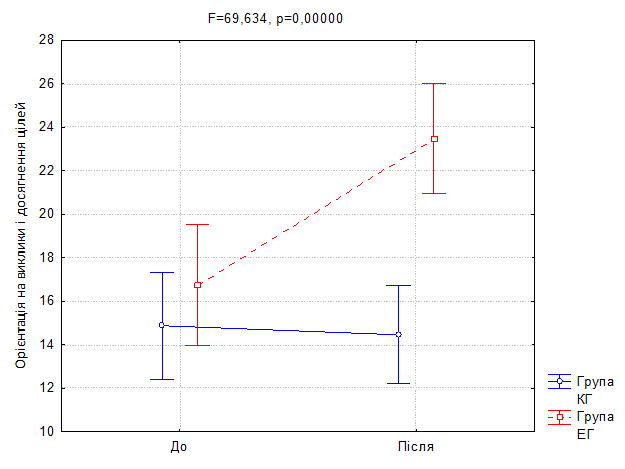
Note: "before" — ascertaining slice; "after" — control slice; "Group CG" — control group; "Group EG" — experimental group.
Prior to the introduction of the programme, both groups were characterised by a low level of indicators of orientation towards challenges and the attainment of goals, whereas after the introduction only in the experimental group did they rise to a medium-high level.
After the introduction of the programme, the indicators of self-control and the capacity to overcome difficulties in the experimental group rose, whereas in the control group they remained unchanged (Fig. 3.2).
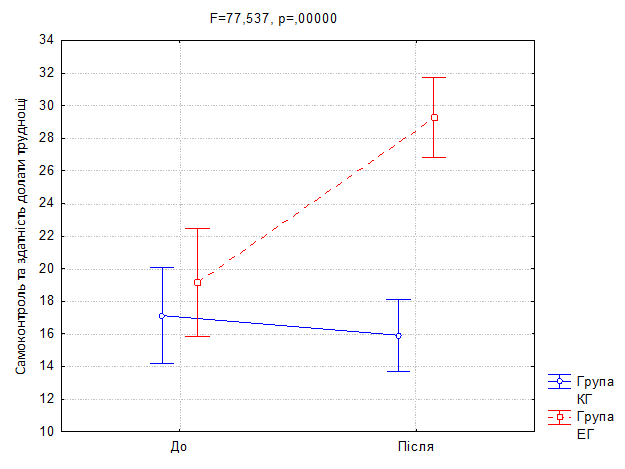
Note: "before" — ascertaining slice; "after" — control slice; "Group CG" — control group; "Group EG" — experimental group.
Prior to the introduction of the programme, both groups were characterised by a low level of indicators of self-control and the capacity to overcome difficulties, whereas after the introduction only in the experimental group did they rise to a medium-high level.
After the introduction of the programme, the indicators of self-determination and meaningfulness of life in the experimental group rose, whereas in the control group they remained unchanged (Fig. 3.3).
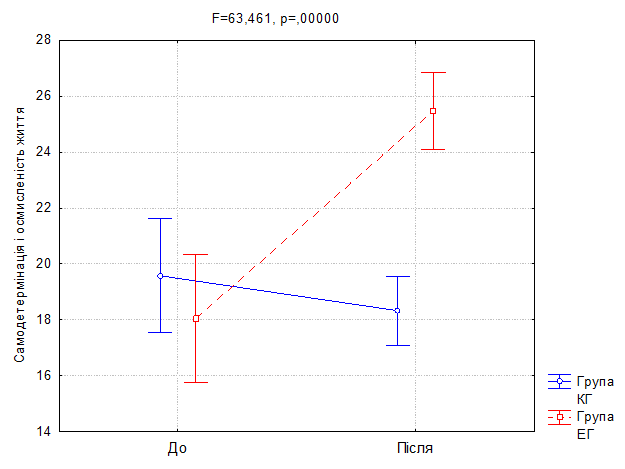
Note: "before" — ascertaining slice; "after" — control slice; "Group CG" — control group; "Group EG" — experimental group.
Prior to the introduction of the programme, both groups were characterised by a low level of indicators of self-determination and meaningfulness of life, whereas after the introduction only in the experimental group did they rise to a high level.
After the introduction of the programme, the indicators of stress resistance in the experimental group rose, whereas in the control group they remained unchanged (Fig. 3.4).
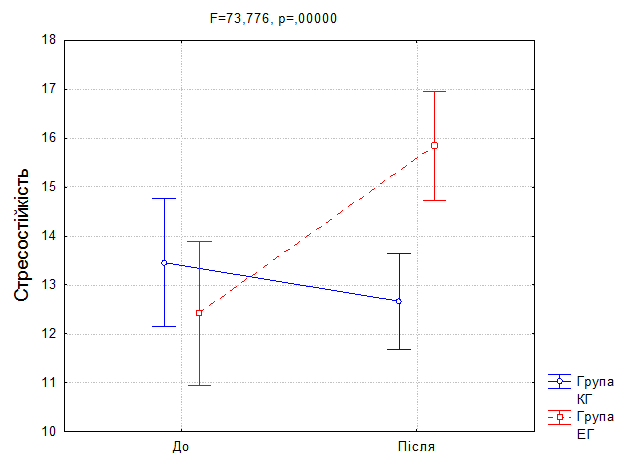
Note: "before" — ascertaining slice; "after" — control slice; "Group CG" — control group; "Group EG" — experimental group.
Prior to the introduction of the programme, both groups were characterised by a low level of indicators of stress resistance, whereas after the introduction only in the experimental group did they rise to a medium-high level.
After the introduction of the programme, the indicators of constructive coping in the experimental group rose, whereas in the control group they remained unchanged (Fig. 3.5).
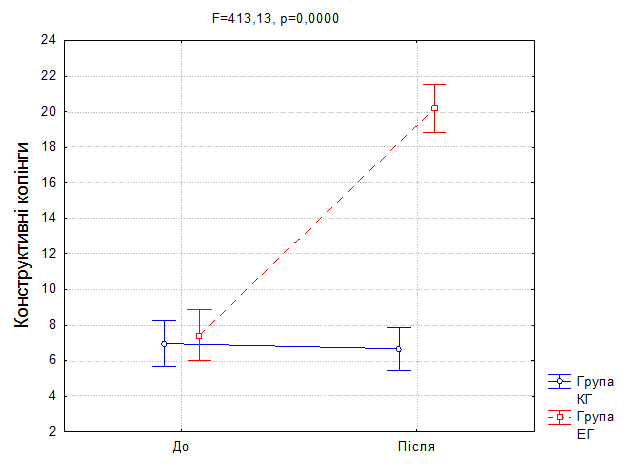
Note: "before" — ascertaining slice; "after" — control slice; "Group CG" — control group; "Group EG" — experimental group.
Prior to the introduction of the programme, both groups were characterised by a low level of indicators of constructive coping, whereas after the introduction only in the experimental group did they rise to a high level.
After the introduction of the programme, the indicators of social contactness in the experimental group rose, whereas in the control group they remained unchanged (Fig. 3.6).
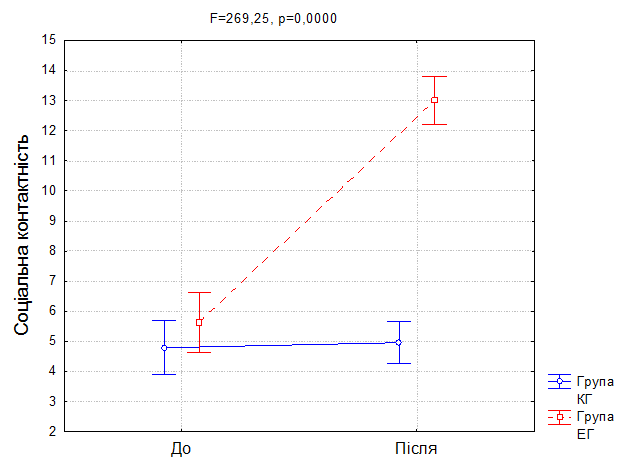
Note: "before" — ascertaining slice; "after" — control slice; "Group CG" — control group; "Group EG" — experimental group.
Prior to the introduction of the programme, both groups were characterised by a low level of indicators of social contactness, whereas after the introduction only in the experimental group did they rise to a high level.
After the introduction of the programme, the indicators of optimal regulation in the experimental group rose, whereas in the control group they remained unchanged (Fig. 3.7).
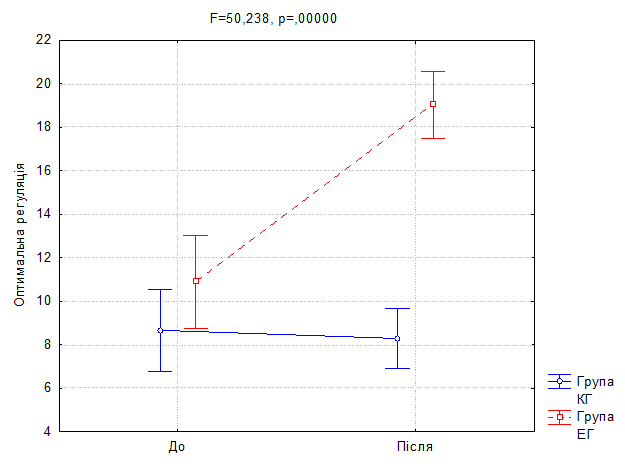
Prior to the introduction of the programme, both groups were characterised by a low level of indicators of optimal regulation, whereas after the introduction only in the experimental group did they rise to a high level.
After the introduction of the programme, the indicators of openness to life experience in the experimental group rose, whereas in the control group they remained unchanged (Fig. 3.8).
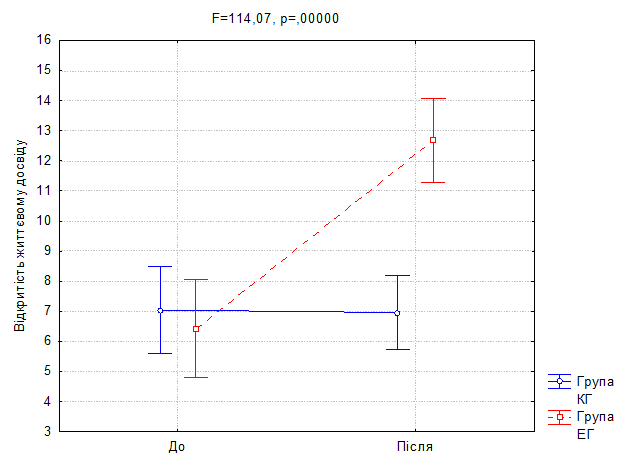
Note: "before" — ascertaining slice; "after" — control slice; "Group CG" — control group; "Group EG" — experimental group.
Prior to the introduction of the programme, both groups were characterised by a low level of indicators of openness to life experience, whereas after the introduction only in the experimental group did they rise to a high level.
After the introduction of the programme, the indicators of openness to life experience in the experimental group rose, whereas in the control group they remained unchanged (Fig. 3.8).
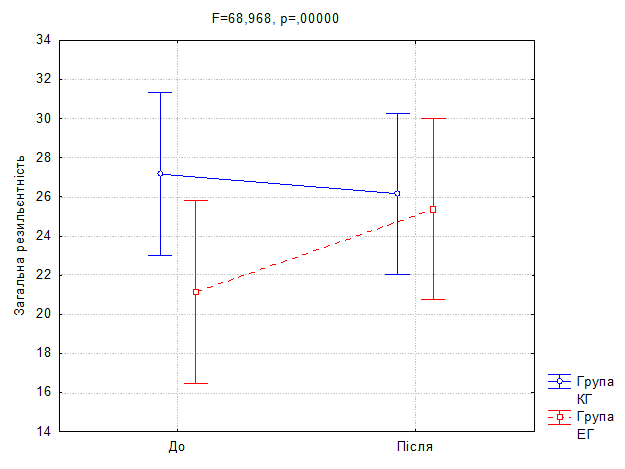
Note: "before" — ascertaining slice; "after" — control slice; "Group CG" — control group; "Group EG" — experimental group.
Prior to the introduction of the programme, the experimental group was characterised by a low level of indicators of general resilience, while the control group was characterised by a medium level. After the introduction, in the experimental group they rose to a medium level, while in the control group they did not change.
Table 3.5 shows that the experimental group, in comparison with the control group, has advantages in all the indicators of resilience at the control slice, except for the processual component (general resilience as determined by the methodology of Z. Kireyeva and B. Odnostalko).
Table 3.5
Indicators of resilience in the control and experimental groups prior to the introduction of the programme
| Indicators | Groups of respondents | U | Z | p | |||
|---|---|---|---|---|---|---|---|
| Control | Experimental | ||||||
| M | ϭ | M | ϭ | ||||
| Orientation towards challenges and the attainment of goals | 14.46 | 5.35 | 23.47 | 5.64 | 66.5 | -3.95 | 0.000 |
| Self-control and the capacity to overcome difficulties | 15.92 | 6.69 | 29.26 | 2.73 | 36.0 | -4.70 | 0.000 |
| Self-determination and meaningfulness of life | 18.33 | 3.81 | 25.47 | 1.39 | 9.0 | -5.36 | 0.000 |
| Stress resistance | 12.67 | 3.10 | 15.84 | 0.83 | 104.5 | -3.02 | 0.003 |
| Constructive coping | 6.67 | 3.52 | 20.16 | 1.86 | 16.5 | -5.17 | 0.000 |
| Social contactness | 4.96 | 1.83 | 13.00 | 1.56 | 2.0 | -5.53 | 0.000 |
| Optimal regulation | 8.29 | 3.00 | 19.05 | 3.70 | 10.5 | -5.32 | 0.000 |
| Openness to life experience | 6.96 | 3.10 | 12.68 | 2.87 | 33.0 | -4.77 | 0.000 |
| General resilience | 26.17 | 12.52 | 25.37 | 5.25 | 207.0 | -0.51 | 0.608 |
Thus, the developmental interventions introduced substantially affected the rise of all indicators of resilience, in particular the indicators of self-determination and meaningfulness of life, of constructive coping and of optimal regulation. No positive shifts in the indicators of resilience occurred among the volunteers of the control group during the formative experiment.
Conclusions to Chapter 3
The comprehensive analysis of the theoretical-methodological approaches of contemporary psychology has made it possible to determine the scientific foundation for the development of the psychological resilience-formation programme for volunteers as a dynamic, integrative psychological formation, whose formation is conditioned by the interaction of personal, motivational, regulatory, meaning-of-life and behavioural factors. The integration of the propositions of the humanistic, existential, cognitive-behavioural, resource, coping-oriented and systemic approaches, as well as of self-determination theory and of the conceptions of altruism, has ensured an integral view of the psychological mechanisms of volunteers' stability under conditions of prolonged stress and emotional load.
On the basis of the generalised theoretical-methodological propositions, the conceptual model and the structural-content characteristics of the psychological resilience-formation programme for volunteers were developed, envisaging a phased formative intervention at the personal, motivational, regulatory and behavioural levels. The programme has a modular structure and is implemented in a group format, using psychoeducational, reflective and practice-oriented methods, which ensures the inner logic, consistency and integrity of the psychological intervention.
The proposed programme is aimed not only at the development of separate psychological skills or resources, but at the formation of inner consistency, autonomous motivation, emotional stability and a mature altruistic orientation of volunteer activity.
The introduction of the programme brought about a rise in the indicators of resilience among the participants of the experimental group, whereas in the control group no significant shifts in the indicators of resilience occurred.
List of references
- Avramchuk O. S. Strategies of psychological avoidance among individuals carrying out volunteer activity under martial law. Journal of Contemporary Psychology. 2024. No. 1 (32). P. 7–14. [in Ukrainian]
- Adamenko L. S. Current approaches to the study of psychological resilience. Bulletin of the National Defence University of Ukraine. Issues in Psychology. 2020. No. 5 (58). P. 5–13. [in Ukrainian]
- Bazyl T. S. Socio-psychological readiness of the personality for volunteer activity in crisis conditions. Issues in Psychology. Bulletin of the National Defence University of Ukraine. 2023. No. 5 (75). P. 5–11. [in Ukrainian]
- Balashov E. M. The impact of participation in an international volunteer youth programme on the self-realisation of student youth. Problems of General and Pedagogical Psychology. 2012. Vol. XIV, Part 6. P. 24–33. [in Ukrainian]
- Balushko O. V. Inter-gender differences in resilience among Ukrainian youth. Lviv, 2025. 48 p. [in Ukrainian]
- Barchi B. V. General psychology with a practicum: laboratory practicum part 2 of the discipline for full-time and part-time students of speciality 053 Psychology. Mukachevo: MSU, 2017. 51 p. [in Ukrainian]
- Bashavets N. A. A systemic approach in the educational process. Contemporary Problems of Physical Education, Sport and Human Health: proceedings of the IV Internet conference (Odesa, 24–25 November 2020). Odesa: publisher Bukaiev Vadym Viktorovych, 2020. P. 116–119. [in Ukrainian]
- Bielavina T. I. Resilience in the context of social work with persons in a totally regulated social environment under conditions of forced isolation. Scientific Notes of V. I. Vernadsky Taurida National University. Series: Psychology. 2020. Vol. 31 (70), No. 3. P. 54–59. [in Ukrainian]
- Biespalova K. O. Motivational aspects of volunteering: experience of Western countries. Bulletin of NTUU "KPI". Politology. Sociology. Law. 2012. Issue 2 (14). P. 67–71. [in Ukrainian]
- Bida O. A., Chychuk A. P., Syroiezhko O. V. Volunteer activity as a socio-pedagogical phenomenon of the social formation of the personality. Humanitarian Studios: Pedagogics, Psychology, Philosophy. 2023. Vol. 14, No. 3. P. 8–15. [in Ukrainian]
- Boiko I. M. The role and place of volunteers in the contemporary hybrid war. Economy and Society. 2023. No. 53. P. 117–123. [in Ukrainian]
- Bondarenko Z. P. Social health of students in the context of the development of volunteering. Bulletin of Alfred Nobel University. Series "Pedagogy and Psychology". Pedagogical Sciences. 2017. No. 1 (13). P. 59–66. [in Ukrainian]
- Bondarchuk O. I., Karamushka L. M. Psychological health of the personality in wartime and the post-war period (Ukraine–Poland–Israel) for educators and psychologists. Bulletin of the National Academy of Educational Sciences of Ukraine. 2023. Vol. 5. No. 1. [in Ukrainian]
- Bulatevych N. V., Batrakina Ye. V. Psychological features of persons engaged in volunteer activity. Psychological Perspectives. 2019. Issue 33. P. 10–23. [in Ukrainian]
- Vainilovych N. A. Factors of formation of human motivation to engage in volunteer activity. Scientific Notes of the National Technical University of Ukraine "Kyiv Polytechnic Institute" (Series: Sociology, Psychology, Social Work). 2010. No. 16. P. 57–68. [in Ukrainian]
- Volkovnytska T. M. Volunteer activity as a method of training specialists in the social sphere. Problems of Social Work. 2012. No. 1 (1). P. 143–148. [in Ukrainian]
- Hirchenko O. L., Peretiatko V. A. Research into the component of spirituality in the structure of value orientations of volunteers. Bulletin of Sumy State University. Series: Psychological Sciences. 2015. No. 126. P. 43–46. [in Ukrainian]
- Hlaholych S. Yu. Analysis of coping behaviour of volunteers whose activity is associated with the provision of military personnel in the ATO zone. Medical Psychology. 2016. No. 4. P. 51–58. [in Ukrainian]
- Hlaholych S. Yu. Diagnosis and correction of psychological maladaptation of ATO zone volunteers. PhD dissertation in Psychological Sciences. 19.00.04 — medical psychology / Kharkiv Medical Academy of Postgraduate Education. Kharkiv, 2018. 167 p. [in Ukrainian]
- Hlaholych S. Yu. Clinical and social features of maladaptive states in volunteers whose activity is associated with the provision of military personnel in the ATO zone. Psychiatry, Neurology and Medical Psychology. 2016. Vol. 3, No. 2 (6). P. 69–76. [in Ukrainian]
- Holyk M. M. The volunteer movement in the system of moral-psychological support of the contemporary Ukrainian army. Hileia: Scientific Bulletin. 2016. Issue 107. P. 116–120. [in Ukrainian]
- Holovko L. V., Holovko T. V. Volunteer activity as a factor of resilience and the accumulation of social capital in communities (using the example of one of the communities of Kyiv Oblast). Demography and Social Economy. 2023. No. 4 (54). P. 38–54. [in Ukrainian]
- Hrabovska I. Volunteering as a complex socio-psychological phenomenon. Ukrainian Studies Almanac. 2020. Issue 20. P. 26–30. [in Ukrainian]
- Hrishyn E. O. Psychological support for the development of resilience as a factor of self-regulation of a personality in a difficult life situation: PhD dissertation : 053 — Psychology. West Ukrainian National University. Ternopil, 2024. 180 p. [in Ukrainian]
- Dvorska A. O. Volunteer activity as a factor in the formation of civic culture. Scientific Notes. Series: Pedagogical Sciences. 2025. Issue 217. P. 100–103. [in Ukrainian]
- Demyda S. M., Nosok M. S. Motivation of students to volunteer activity. Bulletin of Lviv State University of Life Safety. 2016. No. 13. P. 168–174. [in Ukrainian]
- Zhuzha L. M. Moral aspects of the volunteer movement in support of the ATO. Evropský politický a právní diskurz. 2015. Vol. 2, No. 2. P. 210–215. [in Ukrainian]
- Zavadska I. M., Palyliulko O. M. Helping as a way of life: psychological aspects of volunteer activity. Inclusion and Society. 2022. Issue 1. P. 47–55. [in Ukrainian]
- Zavatskyi Yu. A., Zavatska N. Ye., Fedorova O. V., Tsarenok L. B., Volokh K. O. The influence of the family on the resilience of the personality in crisis periods of life. Theoretical and Applied Problems of Psychology and Social Work. 2021. No. 3(2). P. 404–410. [in Ukrainian]
- Zazymko O. V. The motivational component of life competence of medical volunteers in crisis conditions. Issues in Psychology. Bulletin of the National Defence University of Ukraine. 2023. No. 5 (75). P. 29–36. [in Ukrainian]
- Zasiekina L. V., Martyniuk A. Moral distress and compassion fatigue in medical workers under conditions of prolonged traumatic stress. Psychological Journal. 2023. No. 3 (62), Vol. 2. P. 101–113. [in Ukrainian]
- Zelenska K. O. The phenomenological structure of post-stress disorders in volunteers whose activity is associated with supporting military personnel in the ATO zone. Experimental and Clinical Medicine. 2020. No. 3 (88). P. 62–66. [in Ukrainian]
- Zlyvkov V. L., Lukomska S. O. Psychological features of volunteer activity in contemporary Ukraine: the motivational aspect. Scientific Bulletin of V. O. Sukhomlynskyi Mykolaiv National University. Psychological Sciences. 2015. No. 2 (15). P. 40–46. [in Ukrainian]
- Kabysh-Rybalka T. V. Psychological readiness for volunteer activity as a factor of self-realisation of a sports-profile volunteer. Current Problems of Sociology, Psychology, Pedagogy. 2015. No. 2 (27). P. 34–40. [in Ukrainian]
- Karamushka L. M. Psychological health of personnel of educational organisations: an analysis of foreign approaches. Problems of Contemporary Psychology. 2021. No. 3. P. 23–30. [in Ukrainian]
- Karamushka L. M., Shevchenko A. M. Personal resources for ensuring the psychological health of managers and pedagogical workers of educational organisations of the Municipal Educational Institution of the Kyiv Regional Council "KOIPOPK". 2019. [in Ukrainian]
- Karamushka L. M. Mental health of the personality during war: how to preserve and support it: methodological recommendations. Kyiv: H. S. Kostiuk Institute of Psychology of the NAES of Ukraine, 2024. 48 p. [in Ukrainian]
- Karkovska R. I., Klimanska M. B. Motives of volunteer activity of helpline consultants. Problems of Contemporary Psychology. 2017. Issue 37. P. 106–119. [in Ukrainian]
- Keryk O. Professional burnout and manifestations of secondary trauma in specialists of the "person–person" system. Problems of the Humanities. Series "Psychology". 2013. Issue 31. P. 64–72. [in Ukrainian]
- Kyrylenko M. Psychological risks of volunteer activity. Pharmacist Practitioner. 2016. No. 2. P. 43–44. [in Ukrainian]
- Kirieieva Z., Odnostalko O., Biron B. Psychometric analysis of the adapted version of the resilience scale (CD-RISC-10). Habitus. 2020. No. 14. P. 110–117. [in Ukrainian]
- Kokun O. M. Diagnosis of professional hardiness and psychophysiological stability: methodological recommendations. Kyiv: H. S. Kostiuk Institute of Psychology of the NAES of Ukraine, 2024. 58 p. [in Ukrainian]
- Kokun O. M. Hardiness and resilience of the human being in the contemporary world: theory, research, practice: monograph. Kyiv: H. S. Kostiuk Institute of Psychology of the NAES of Ukraine, 2025. 214 p. [in Ukrainian]
- Kokun O. M. Ensuring the psychophysiological stability of various strata of the population of Ukraine under conditions of martial law and post-war recovery: a practical guide / O. M. Kokun, L. M. Bakhmutova, T. V. Kruzheva et al.; ed. by O. M. Kokun. Kyiv: H. S. Kostiuk Institute of Psychology of the NAES of Ukraine, 2024. 110 p. [in Ukrainian]
- Kokun O. M., Vizniuk I. M., Paikush M. A., Dolynnyi S. S., Ordatii A. V., Karimulin R. F. Mental health of volunteers: the genesis of psychosomatic disorders under PTSD conditions. Emergency Medicine (Ukraine). 2024. Vol. 20, No. 8. P. 717–724. [in Ukrainian]
- Kokun O. M., Melnychuk T. I. Resilience handbook: a practical guide. Kyiv: H. S. Kostiuk Institute of Psychology of the NAES of Ukraine. 2023. 25 p. [in Ukrainian]
- Kos O. I. Volunteering as a factor of education of humanistic values of the personality: the experience of Scotland. Pedagogical Sciences: Theory and Practice. 2023. No. 2 (46). P. 130–135. [in Ukrainian]
- Kryvenko Yu. V. Principles of carrying out volunteer activity. Young Scientist. 2016. No. 6 (33). P. 246–250. [in Ukrainian]
- Kryvokon N. I. Volunteer activity as a factor in the development of Ukrainians' hardiness. Problems of Contemporary Psychology: collection of scientific works of Kamianets-Podilskyi Ivan Ohiienko National University, H. S. Kostiuk Institute of Psychology of the NAES of Ukraine. 2015. Issue 30. P. 326–336. [in Ukrainian]
- Krutsiuk O. V. Interrelation of personal and emotional-volitional characteristics of a volunteer. Ukrainian Psychological Journal. 2020. No. 2 (6). P. 53–58. [in Ukrainian]
- Krutsiuk O. V. Individual-psychological and motivational features of the personality as factors of volunteer activity. PhD dissertation. Kyiv, 2019. 230 p. [in Ukrainian]
- Kustovska O. V. Methodology of the systemic approach and scientific research. Ternopil: Ekonomichna Dumka, 2005. 124 p. [in Ukrainian]
- Lazorenko B. P. Socio-psychological rehabilitation and readaptation of volunteers: an empirical assessment of the effectiveness of the paradox technology. Scientific Studies on Social and Political Psychology. 2018. Issue 42 (45). P. 148–159. [in Ukrainian]
- Lazorko O., Shevtsova T. A study of psycho-emotional states of adolescents with different levels of resilience during war. Psychological Perspectives. 2022. Issue 40. P. 87–103. [in Ukrainian]
- Lazos H. P. Resilience: conceptualisation of concepts, a review of contemporary research. Current Problems of Psychology. Volume 3: Counselling Psychology and Psychotherapy. Issue 14. H. S. Kostiuk Institute of Psychology of the NAES of Ukraine. Vinnytsia: FOP Rohalska I. O., 2018. Issue 14. P. 26–64. [in Ukrainian]
- Lazos H. P. A theoretical-methodological model of resilience as the basis for constructing a psychotechnology for its development. Organisational Psychology. Economic Psychology. 2019. No. 2–3 (17). P. 77–89. [in Ukrainian]
- Lenov A. A. Volunteering as a complex social phenomenon of today. Humanitarian Studios: Pedagogics, Psychology, Philosophy. 2023. Vol. 14, No. 2. P. 55–66. [in Ukrainian]
- Lovochkina A. Volunteer activity as a means of forming social activity of internally displaced persons. Social Work. 2018. Vol. 2, No. 4. P. 13–16. [in Ukrainian]
- Liakh T. L. Types of motivation for volunteer activity. Bulletin of Zaporizhzhia National University. Pedagogical Sciences. 2011. No. 2 (15). P. 37–41. [in Ukrainian]
- Liakh T. L. Motivation for volunteer activity. Bulletin of Taras Shevchenko Luhansk National University. 2012. No. 22 (257), Part VIII. P. 84–91. [in Ukrainian]
- Mazur N. O., Tseliukh Ya. O. Trends and motives for the development of volunteering in Ukraine. Bulletin of the National University of Water and Environmental Engineering. Series "Economic Sciences". 2020. Issue 4 (92). P. 177–185. [in Ukrainian]
- Markova M. V., Hlaholych S. Yu. The state of the psycho-emotional sphere of volunteers whose activity is associated with the provision of military personnel in the combat zone. Psychiatry, Neurology and Medical Psychology. 2018. No. 9. P. 93–100. [in Ukrainian]
- Marchuk A., Loboda V., Ivanysa V. Volunteer activity as a means of self-determination and self-realisation of youth. Socio-Economic Relations in the Digital Society. 2023. Vol. 2 (48). P. 104–116. [in Ukrainian]
- Matviienko L. I., Alekseichenko K. S. The personality of a volunteer in the psychological dimension: the value-motivational aspect. Labour Market and Employment of the Population. 2016. No. 1. P. 55–59. [in Ukrainian]
- Myroshnichenko N. O. Professionally oriented training of volunteers for the socio-pedagogical integration of young people with disabilities into the social environment. Collection of Scientific Works of the Khmelnytskyi Institute of Social Technologies of the University "Ukraine". 2013. No. 1 (7). P. 155–158. [in Ukrainian]
- Mykhailychenko O. V. Volunteer activity as a factor in the development of social activity of the personality. Pedagogical Sciences: Theory, History, Innovative Technologies. 2015. No. 7 (51). P. 470–476. [in Ukrainian]
- Molchaniuk O. V., Verbenets T. P. Pedagogical aspects of the formation of a healthy lifestyle of student youth in the process of volunteer activity. Scientific Notes of the Department of Pedagogy. 2012. Issue XXVIII. P. 137–143. [in Ukrainian]
- Moroz R. A., Kazarian P. A. Organisational-psychological principles of volunteer assistance in Ukraine. Issues in Psychology. Bulletin of the National Defence University of Ukraine. 2015. No. 3 (46). P. 192–196. [in Ukrainian]
- Mushkevych M. I. Practical psychology in working with ATO participants. Psychology: Reality and Prospects. 2016. Issue 6. P. 136–142. [in Ukrainian]
- Mushkevych M. I. Psychological support of a family with problem children. Psychology: Reality and Prospects. 2013. Issue 1. P. 91–94. [in Ukrainian]
- Neurova A. B., Kapinus O. S., Hrytsevych T. L. Diagnosis of individual-psychological properties of the personality: an educational-methodological guide. Lviv: NASV, 2016. 181 p. [in Ukrainian]
- Nikolaienko S. I. Volunteer practice as an inseparable component of the professional training of future social pedagogues to work in territorial centres. Pedagogical Sciences: Collection of Scientific Works. 2013. Issue 27. P. 109–114. [in Ukrainian]
- Odnostalko O. S. Resources of personality stability in conditions of complex and atypical life situations: PhD dissertation in Psychological Sciences: 19.00.01 — general psychology, history of psychology. Lutsk: Lesya Ukrainka Volyn National University, 2020. 252 p. [in Ukrainian]
- Olikh S. M., Matviichuk T. V. Features of the motivation of student youth for volunteer activity. Collection of Scientific Works of the Khmelnytskyi Institute of Social Technologies of the University "Ukraine". 2013. No. 2 (8). P. 176–180. [in Ukrainian]
- Pavlieiev V. O. Mindfulness as a method of overcoming burnout syndrome in volunteers. Perspectives and Innovations of Science (Series "Pedagogy", "Psychology", "Medicine"). 2025. No. 6 (52). P. 1463–1474. [in Ukrainian]
- Peretiatko V. Volunteering and the formation of spiritual values and value orientations. Scientific Journal of M. P. Drahomanov NPU. Series 12: Psychological Sciences. 2014. Issue 43. P. 386–393. [in Ukrainian]
- Peretiatko V. A. Volunteer activity as a factor of transformation of value orientations of youth. PhD dissertation in Psychological Sciences. 19.00.05 — social psychology; psychology of social work / Kherson State University. Kherson, 2015. 215 p. [in Ukrainian]
- Pyzhuk V. V. Volunteering as a type of civic activity and its role in the formation of civic consciousness of senior pupils. Current Problems of Public Administration, Pedagogy and Psychology. 2015. Issue 1. P. 60–63. [in Ukrainian]
- Pidbutska N. V., Knysh A. Yu., Bohdan Zh. V. Resources of resilience of future psychologists engaged in volunteer activity during martial law. Theory and Practice of Social Systems Management. 2022. No. 4. P. 16–25. [in Ukrainian]
- Pohribna V. L. The volunteer movement as a sign of changes in the mentality of Ukrainians. Bulletin of the National University "Yaroslav Mudryi Law Academy of Ukraine". 2016. No. 1 (28). P. 196–201. [in Ukrainian]
- Podolianchuk D. S. A study of the cognitive component of value orientations of student-volunteers. Psychological Perspectives. 2021. Issue 37. P. 185–201. [in Ukrainian]
- Podshyvalkina V. I., Tereshchenko O. O. Individual-psychological characteristics of self-determination of subjects of volunteer activity. Habitus. 2020. Issue 18, Vol. 1. P. 128–133. [in Ukrainian]
- Polishchuk N. Volunteering as a socio-pedagogical phenomenon: a terminological analysis. Innovation in Upbringing. 2022. Issue 15. P. 320–329. [in Ukrainian]
- Piontkovska K. Volunteering as a multidimensional social phenomenon in a humanistic social democracy. Collection of Scientific Works of Pavlo Tychyna Uman State Pedagogical University. 2014. Issue 17 (2). P. 105–109. [in Ukrainian]
- Railian L. Volunteering as one of the factors of the formation of the personality of a future primary school teacher. Science. Education. Youth. 2024. P. 180–182. [in Ukrainian]
- Romankova L. Volunteer activity as a component of the formation of moral values of student youth. Higher Education of Ukraine. 2015. No. 4. P. 54–60. [in Ukrainian]
- Romanovska L. I. Volunteering as a means of professional socialisation of future social workers. Scientific Notes. Series: Pedagogy. 2013. No. 1. P. 77–82. [in Ukrainian]
- Ruban M. Defining the concept of volunteering. Scientific Bulletin of V. O. Sukhomlynskyi Mykolaiv National University. Series: Historical Sciences. 2016. No. 2 (42). P. 66–70. [in Ukrainian]
- Savychenko O. M., Lushchyk A. M., Melnychenko S. O., Shunevych Ye. M. Mental health of volunteers in wartime conditions. Scientific Notes of the National University "Ostroh Academy". Series "Psychology". 2024. No. 17. P. 90–96. [in Ukrainian]
- Sai D. V. Moral aspects of volunteer activity of future social workers. Scientific Works. Pedagogy. 2014. Vol. 245, Issue 233. P. 79–83. [in Ukrainian]
- Sai D. V. Pedagogical support of the process of forming moral values of future social workers during volunteer activity. Youth and the Market. 2015. No. 10 (129). P. 161–166. [in Ukrainian]
- Sai D. V. Formation of moral values of future social workers in the process of volunteer activity. PhD dissertation in Pedagogical Sciences. 13.00.07. Theory and methodology of upbringing / Petro Mohyla Black Sea State University. Mykolaiv, 2015. 220 p. [in Ukrainian]
- Svyrydenko D. B. Volunteering as a form of social activity of the personality: a philosophical discourse. Educational Discourse: Collection of Scientific Works. 2025. Vol. 52 (1–2). P. 30–35. [in Ukrainian]
- Serdiuk L. Z., Lahun M. V. Altruistic orientation as a factor of psychological well-being of the personality. Perspectives and Innovations of Science. 2025. No. 4 (50). P. 1700–1711. [in Ukrainian]
- Serdiuk L. Z. Self-determination of psychological well-being of the personality: monograph / L. Z. Serdiuk, I. V. Danyliuk, V. V. Turban, O. I. Penkova, N. D. Volodarska [et al.]; ed. by L. Z. Serdiuk. Kyiv – Lviv: publisher Viktoriia Kundelska, 2021. 236 p. [in Ukrainian]
- Serdiuk L. Z. Psychological technologies for promoting positive mental health of various strata of the population of Ukraine under conditions of martial law and post-war recovery: a practical guide / L. Z. Serdiuk, I. V. Danyliuk, O. A. Chykhantsova et al.; ed. by L. Z. Serdiuk. Kyiv: H. S. Kostiuk Institute of Psychology of the NAES of Ukraine, 2024. 168 p. [in Ukrainian]
- Serdiuk L. Z. Systemic determinants of the development of personal resources of mental health of the personality in difficult life circumstances. Organisational Psychology. Economic Psychology. 2025. No. 36 (3). P. 87–96. [in Ukrainian]
- Serdiuk L. Z., Lahun M. V. Socio-psychological factors of the development of altruistic orientation of the personality in crisis conditions of life activity. Ukrainian Psychological Journal. 2023. No. 1 (19). P. 145–157. [in Ukrainian]
- Ternavska T. Volunteer activity as a path to the professional self-determination of a future social worker. Pedagogical Sciences: Theory, History, Innovative Technologies. 2017. No. 2 (66). P. 149–159. [in Ukrainian]
- Technologies for ensuring the mental health and well-being of educational personnel under conditions of war and post-war recovery: monograph. L. M. Karamushka, O. V. Kredentser, K. V. Tereshchenko [et al.]. Ed. by L. M. Karamushka. Kyiv: H. S. Kostiuk Institute of Psychology of the NAES of Ukraine, 2024. 288 p. [in Ukrainian]
- Tkachenko D. Technologies for the prevention of emotional burnout of volunteers and employees of non-governmental organisations. Social Work. 2017. Vol. 2, No. 2. P. 49–51. [in Ukrainian]
- Tkachuk T. S. Upbringing of humanistic values in students of pedagogical colleges in the process of volunteer activity. PhD dissertation in Pedagogical Sciences. 13.00.07. Theory and methodology of upbringing / SI "Taras Shevchenko Luhansk National University". Luhansk, 2013. 140 p. [in Ukrainian]
- Tropina M. Volunteer activity as a means of personality development, its spiritual formation and self-realisation. Scientific Notes of the Minor Academy of Sciences of Ukraine. Series "Pedagogical Sciences". 2018. No. 11. P. 232–241. [in Ukrainian]
- Fedorchuk V. M., Komarnitska L. M., Storozhuk N. R. Resilience of the personality under martial law. Scientific monograph. Riga, Latvia: "Baltija Publishing", 2023. P. 113–126. [in Ukrainian]
- Khmel O. V., Loviak I. V. Resilience as one of the metacompetencies of the development of professional identity of a future primary-class specialist. Contemporary Strategies for the Development of Pedagogy and Psychology: proceedings of the international scientific-practical conference (Lviv, 23–24 November 2018) / NGO "Lviv Pedagogical Community". Lviv, 2018. P. 87–90. [in Ukrainian]
- Kholod O. M. Inmutation of value orientations and attitudes of volunteers. Scientific Notes of the Institute of Journalism of Borys Hrinchenko Kyiv University. 2012. Vol. 10. P. 327–337. [in Ukrainian]
- Chaika I. Volunteering: the essence of the phenomenon and the features of its functioning in contemporary Ukraine. Scientific-Theoretical Almanac "Hrani". 2017. Vol. 20. No. 7 (147). P. 72–79. [in Ukrainian]
- Chervonenko K. S. Formation of the readiness of future social workers for the organisation of volunteer activity of student youth. PhD dissertation in Pedagogical Sciences. 13.00.07. Theory and methodology of pedagogical education / Bohdan Khmelnytsky Melitopol State Pedagogical University. Melitopol, 2019. 336 p. [in Ukrainian]
- Chykhantsova O. A. Resilience as a personal resource of Ukrainians under martial law. Journal of Contemporary Psychology. 2025. No. 2 (37). P. 55–61. [in Ukrainian]
- Chykhantsova O. A. The role of resilience as a personal resource in situations of uncertainty. Scientific Notes of V. I. Vernadsky TNU. Series: Psychology. 2025. Vol. 36 (75), No. 3. P. 55–61. [in Ukrainian]
- Chykhantsova O. A. The development of resilience of the personality in situations of uncertainty. Scientific Notes of V. I. Vernadsky TNU. Series: Psychology. 2023. Vol. 34 (73), No. 1. P. 35–40. [in Ukrainian]
- Shabanova Yu. O. The systemic approach in higher education. Dnipropetrovsk: NMU, 2014. 120 p. [in Ukrainian]
- Shevchenko O. T. Psychological features of the development of resilience of future nurses working with severely somatically ill patients: PhD dissertation in Psychological Sciences: 19.00.07. Kyiv: I. A. Ziaziun Institute of Pedagogical and Adult Education, 2020. 276 p. [in Ukrainian]
- Shevchuk O. V., Staryk O. V. Volunteering as a socio-psychological characteristic of the personality. Habitus. 2021. Issue 22. P. 25–28. [in Ukrainian]
- Shtepa O. S. A questionnaire of psychological resourcefulness of the personality: results of the development and approbation of the author's methodology. Problems of Contemporary Psychology. Collection of Scientific Works of Ivan Ohiienko KPNU, H. S. Kostiuk Institute of Psychology of the NAES of Ukraine. Issue 39. 2018. P. 380–399. [in Ukrainian]
- Shumakova O. S. The content of volunteer activity of student-volunteers of higher education institutions. Bulletin of Taras Shevchenko Luhansk National University. 2013. No. 23 (282), Part I. P. 213–226. [in Ukrainian]
- Yurchynska H. K., Krutsiuk O. V. Interrelation of the hardiness of the personality of a volunteer and his motivation. Ukrainian Psychological Journal. 2018. No. 2 (8). P. 163–179. [in Ukrainian]
- Yurchynska H. K., Krutsiuk O. V. Volunteer activity: essence and psychological determinants. Ukrainian Psychological Journal. 2017. No. 2 (4). P. 188–204. [in Ukrainian]
- Allport G. W. Becoming: Basic Considerations for a Psychology of Personality. New Haven: Yale University Press, 1955. 106 p.
- Bailey H., Kaplan L. J. Volunteerism during humanitarian crises: a practical guide. Critical Care. 2022. Vol. 26(111). P. 1–6.
- Bartone P.T., Ursano,R.J., Wright K.M. and Ingraham, L.H. The Impact of a Military Air Disaster on the Health of Assistance Workers. Journal of Nervous and Mental Disease. 1989. Vol. 177. Р. 317–328.
- Batson C. D. Altruism in Humans. New York: Oxford University Press, 2011. 329 p.
- Batson C. D. The altruism question: Toward a social-psychological answer. Hillsdale, NJ: Erlbaum, 1991. 288 р.
- Batson C. D., Ahmad N., Tsang J. Four motives for community involvement. Journal of Social Issues. 2002, Vol. 58. №. 3. Р. 429–445.
- Beck A. T. Cognitive Therapy and the Emotional Disorders. New York: International Universities Press, 1976. 356 p.
- Bonanno G. A. Loss, trauma, and human resilience: Have we underestimated the human capacity to thrive after extremely aversive events? American Psychologist. 2004. Vol. 59. № 1. P. 20–28.
- Bonanno G. A. The other side of sadness: What the new science of bereavement tells us about life after loss. New York: Basic Books, 2009. 368 p.
- Boss M. Psychoanalysis and Daseinsanalysis. New York: Basic Books, 1963. 295 p.
- Brown S. L., Brown R. M. Selective investment theory: Recasting the functional significance of close relationships. Psychological Inquiry. 2006. Vol. 17(1). P. 1–29.
- Brown S. L., Nesse R. M., Vinokur A. D., Smith D. M. Providing social support may be more beneficial than receiving it: Results from a prospective study of mortality. Psychological Science. 2003. Vol. 14. № 4. P. 320–327.
- Brown S., Brown R. M. Connecting prosocial behavior to improved physical health: Contributions from the neurobiology of parenting. Neuroscience and Biobehavioral Reviews. 2015. Vol. 55. P. 1–15.
- Bugental J. F. T. Psychotherapy Isn't What You Think. Phoenix: Zeig, Tucker & Theisen, 1999. 278 p.
- Bühler C. The Course of Human Life as a Psychological Problem. Human Development. 1968. Vol. 11(3). P. 184–200.
- Burnett H. J. Jr. Revisiting the Compassion Fatigue, Burnout, Compassion Satisfaction, and Resilience Connection Among CISM Responders. SAGE Open. 2017. Vol. 7(3). P. 1–10.
- Burnett H. J., Jr., Wahl K. The Compassion Fatigue and Resilience Connection: A Survey of Resilience, Compassion Fatigue, Burnout, and Compassion Satisfaction among Trauma Responders. International Journal of Emergency Mental Health and Human Resilience. 2015. Vol. 17(1). P. 318–326.
- Cañas-Lerma A. J., Campos-Vidal J. F., Verger S. «Our focus is on illness and loneliness»: Volunteer work engagement, compassion satisfaction, compassion fatigue, self-care and motivations to volunteer. Health and Social Care in the Community. 2022. Vol. 30(6). P. 1–14.
- Cho H., Wong Z., Chiu W. The Effect of Volunteer Management on Intention to Continue Volunteering: A Mediating Role of Job Satisfaction of Volunteers. SAGE Open. 2020. Vol. 10(2). P. 1–11.
- Clary E. G., Snyder M., Ridge R. D. еt. al., Copeland J., Stukas A. A., Haugen J., Miene P. Volunteer's motivations: Findings from a national survey and a functional strategy for recruitment and retention. Journal of Personality and Social Psychology. 1998. Vol. 74. № 6. P. 1516–1530.
- Connor K. M., Davidson J. R. T. Development of a new resilience scale: The Connor–Davidson Resilience Scale (CD-RISC). Depression and Anxiety. 2003. Vol. 18(2). P. 76–82.
- Deci E. L., Ryan R. M. Intrinsic Motivation and Self-Determination in Human Behavior. New York: Plenum Press, 1985. 371 p.
- Dekel G., Geldenhuys M., Harris J. Exploring the value of organizational support, engagement, and psychological wellbeing in the volunteer context. Frontiers in Psychology. 2022. Vol. 13:915572. P. 1–14.
- Dunkel C. S., van der Linden D., Kawamoto T., Oshio A. The General Factor of Personality as Ego-Resiliency. Frontiers in psychology.2021 12. Р. 34-40.
- Eisenberg N., Fabes R. A., Spinrad T. L. Prosocial Development. Handbook of Child Psychology / Eisenberg N. (Ed.). Vol. 3: Social, Emotional, and Personality Development. New York: Wiley, 2006. P. 646–718.
- Ellis A. Reason and Emotion in Psychotherapy. New York: Lyle Stuart, 1962. 442 p.
- Folkman S. Positive Psychological States and Coping with Severe Stress. Social Science & Medicine. 1997. Vol. 45(8). P. 1207–1221.
- Friborg F., Hjemdal O., Rosenvinge J. H., Martinussen M. A new rating scale for adult resilience: What are the central protective resources behind healthy adjustment? International Journal of Methods in Psychiatric Research. 2003. Vol. 12(2). P. 65–76.
- Fromm E. The Art of Loving. New York: Harper & Row, 1956. 1486 p.
- Hobfoll S. E. Stress, Culture, and Community: The Psychology and Philosophy of Stress. New York: Springer Science & Business Media, 2004. 296 p.
- Hobfoll S. E., Halbesleben J., Neveu J. P., Westman M. Conservation of Resources in the Organizational Context. Annual Review of Organizational Psychology and Organizational Behavior. 2018. Vol. 5(1). P. 103–128.
- International Federation of Red Cross and Red Crescent Societies. Guidelines for Caring for Staff and Volunteers in Crises. https://mhpsshub.org/resource/guidelines-for-caring-for-staff-and-volunteers-in-crises/
- International Federation of Red Cross and Red Crescent Societies. Safety, Standards to facilitate the safety, security and well-being of volunteers. https://www.ifrc.org/sites/default/files/2023-04/2021-10-18_SSW_Imp_guide_EN_V1.pdf
- Jongenelis M. I., Jackson B., Warburton J., Newton R. U., Pettigrew S. Aspects of formal volunteering that contribute to favourable psychological outcomes in older adults. European Journal of Ageing. 2021. Vol. 19(1). P. 107–116.
- Langle A. Existential analysis of freedom. On the practical and psychotherapeutic substantiation of personal freedom. Counseling Psychology and Psychotherapy. 2009. Vol. 27(1). Р. 119–139.
- Langle A. The Art of Involving the Person – Fundamental Existential Motivations as the Structure of the Motivational Process. European Psychotherapy. 2003. Vol. 4(1). P. 25–36.
- Langle A. The existential fundamental motivations structuring the motivational process. Motivation, Consciousness and Self-Regulation. 2011. P. 27–42/
- Langle A. The Search for Meaning in Life and the Fundamental Existential Motivations. Psychotherapy in Australia. 2003. Vol. 10(1). Р. 14–19.
- Längle, A., Orgler С., Kundi М. The Existence Scale. European Psychotherapy, 4(1), 2003. 135-151.
- Lazarus R. S. Psychological Stress and the Coping Process. New York: McGraw-Hill, 1966. 466 p.
- Lazarus R. S., Folkman S. Stress, Appraisal, and Coping. New York: Springer, 1984. 456 p.
- Li J., Ge C., Li S. The Association of Volunteer Motivation and Thriving at Work of College Students During COVID-19: Job Burnout and Psychological Capital as Mediators. Frontiers in Public Health. 2022. Vol. 10.
- Luthar S. S., Cicchetti D., Becker B. The construct of resilience: A critical evaluation and guidelines for future work. Child Development. 2000. Vol. 71(3). P. 543–562.
- Magrone M., Montani F., Emili S., Bakker A. B., Sommovigo V. A New Look at Job Demands, Resources, and Volunteers' Intentions to Leave: The Role of Work–Home Interference and Burnout.International Journal of Voluntary and Nonprofit Organizations. 2024. Vol. 35(6). P. 1118–1130.
- Maslow A. H. Motivation and Personality. 3rd ed. New York: Harper & Row, 1987. 369 p.
- Maslow A. H. Toward a Psychology of Being. 3rd ed. New York: Wiley, 1999. 270 p.
- Masten A. S. Ordinary magic: Resilience processes in development. American Psychologist. 2001. Vol. 56(3). P. 227–238.
- May R. The Meaning of Anxiety. New York: W. W. Norton, 1996. 425 p.
- McDonald M. A., Meckes S. J., Lancaster C. L. Compassion for Oneself and Others Protects the Mental Health of First Responders. Mindfulness. 2020. Vol. 12. P. 659–671.
- McLennan J., Birch A. A potential crisis in wildfire emergency response capability? Australia's volunteer firefighters. Environmental Hazards. 2005. Vol. 6. P. 101–107.
- Meichenbaum D. Stress Inoculation Training: A Preventive and Treatment Approach. New York: Pergamon Press, 1985. 356 p.
- Meredith L. S. et al. Promoting psychological resilience in the U.S. military. Santa Monica: RAND Corporation, 2011. 120 p.
- Morrow-Howell N., Hinterlong J.E., Rozario P.A., Tang F. Effects of volunteering on the well-being of older adults. Journals of Gerontology: Social Sciences. 2003. Vol. 58B. P. S137–S145.
- Musick M., Wilson J. The Volunteers: A Social Profile. Bloomington: Indiana University Press, 1997. 304 p.
- Nasrullah S. M., Refat T., Gustavsson M. E. Mental Health Interventions for Humanitarian Volunteers: A Scoping Review. BMJ Open. 2025. Vol. 15.
- Nichol B., Wilson R., Rodrigues A., Haighton C. Exploring the Effects of Volunteering on the Social, Mental, and Physical Health and Well-being of Volunteers: An Umbrella Review.International Journal of Voluntary and Nonprofit Organizations. 2023. Vol. 35(1). P. 97–128.
- Omoto A. M., Snyder M. Sustained Helping Without Obligation: Motivation, Longevity of Service, and Perceived Attitude Change Among AIDS Volunteers. Journal of Personality and Social Psychology. 1995. Vol. 68 (4). P. 671–686.
- Penner L. A. Dispositional and organizational influences on sustained volunteerism: An interactionist perspective.Journal of Social Issues. 2002. Vol. 58 (3). P. 447–467.
- Piliavin J. A., Charng H.-W. Altruism: A Review of Recent Theory and Research. Annual Review of Sociology. 1990. Vol. 16. P. 27–65.
- Rehberg W. Altruistic individualists: Motivations for international volunteering among young adults in Switzerland.International Journal of Voluntary and Nonprofit Organizations. 2005. Vol. 16(2). P. 109–122.
- Reivich K., Shatté A. The Resilience Factor: 7 Keys to Finding Your Inner Strength and Overcoming Life's Hurdles. New York: Broadway Books, 2002. 342 p.
- Rogers C. R. A Way of Being. Boston: Houghton Mifflin, 1995. 395 p.
- Rutter M. Psychosocial resilience and protective mechanisms. American Journal of Orthopsychiatry. 1987. Vol. 57(3). P. 316–331.
- Ryan R. M., Deci E. L. Self-Determination Theory: Basic Psychological Needs in Motivation, Development, and Wellness. New York: Guilford Press, 2017. 756 p.
- Serdiuk L., Lytvynenko O. Positive Psychotherapy in Promoting Resilience and Hardiness. In: Messias, E., Peseschkian, H. (eds) Positive Psychiatry, Psychotherapy and Psychology. (pp. 643–653). 2025. Springer, Cham.
- Slovic P. «If I look at the mass I will never act»: Psychic numbing and genocide. Judgment and Decision Making. 2007. Vol. 2 (2). P. 79–95.
- Sneed R. S., Cohen S. A Prospective Study of Volunteerism and Hypertension Risk in Older Adults. Psychology and Aging. 2013. Vol. 28(2). P. 578–586.
- Snyder M. Basic research and practical problems: The promise of a «functional» personality and social psychology. Personality and Social Psychology Bulletin. 1993. Vol. 19 (3). P. 251–264.
- Snyder M., Omoto A. M. Volunteerism: Social issues perspectives and social policy implications. Social Issues and Policy Review. 2008. Vol. 2(1). P. 1–36.
- Stukas A. A., Snyder M., Clary E. G. Volunteerism and community involvement: Antecedents, experiences, and consequences for the person and the situation. The Oxford handbook of prosocial behavior / D. A. Schroeder, W. G. Graziano (Eds.). 2015. Р. 459–493.
- Stukas A., Snyder M., Clary E. G. Understanding and encouraging volunteerism and community involvement. Journal of Social Psychology. 2016. Vol. 156(3). P. 243–255.
- Tedeschi R. G., Calhoun L. G. Posttraumatic Growth: Conceptual Foundations and Empirical Evidence. Psychological Inquiry. 2004. Vol. 15(1). P. 1–18.
- Tedeschi R. G., Calhoun L. G. The Posttraumatic Growth Inventory: Measuring the positive legacy of trauma. Journal of Traumatic Stress. 1996. Vol. 9(3). P. 455–471.
- Thoits P. A., Hewitt L. N. Volunteer work and well-being. Journal of Health and Social Behavior. 2001. Vol. 42(2). P. 115–131.
- Ungar M. The social ecology of resilience: Addressing contextual and cultural ambiguity of a nascent construct. American Journal of Orthopsychiatry. 2011. Vol. 81, No. 1. P. 1–17.
- Werner E. E., Smith R. S. Overcoming the Odds: High Risk Children from Birth to Adulthood. Ithaca, NY: Cornell University Press, 1992. 280 p.
- World Health Organization. Psychological First Aid: Guide for Field Workers. Geneva: WHO, 2011. 64 p.
- Yalom I. D. Existential Psychotherapy. New York: Basic Books, 1980. 544 p.
- Yang Z. Understanding spontaneous volunteering in crisis: towards a needs-based approach of explanation. The Social Science Journal. 2021. Vol. 58(4). P. 427–442.
- Zemp C, Sonnenstuhl M., Abujaber N. et al. Addressing the unique supervisory needs of humanitarian volunteers: Insights from piloting the 'Integrated Model for Supervision' in Bangladesh. Mental Health. 2025. Vol. 7. Р. 459–493.